House Renovation Cost Per m² UK 2026: Real Figures From the Spreadsheet
Quick Answer
House renovation costs in the UK range from £400–600/m² for light cosmetic works, £700–1,000/m² for a medium renovation (kitchen, bathroom, replastering, electrics), £1,100–1,800/m² for a full gut renovation, and £2,000+/m² for high-specification finishes. These are 2026 UK figures. Add 20–35% for London and the South East. Your actual cost depends on the existing condition, specification choices, and the trades required.
House renovation cost per m² in the UK in 2026 ranges from £400–600/m² for a light refurbishment up to £2,000+/m² for high-specification full rebuilds. A medium whole-house renovation — new kitchen, bathrooms, electrics, plumbing, plastering and decoration — typically costs £700–1,000/m². A full gut-and-rebuild with structural changes runs £1,100–1,800/m². These figures cover labour and materials but exclude VAT, professional fees and contingency.
Renovation Cost Per m² UK 2026 — The Full Table
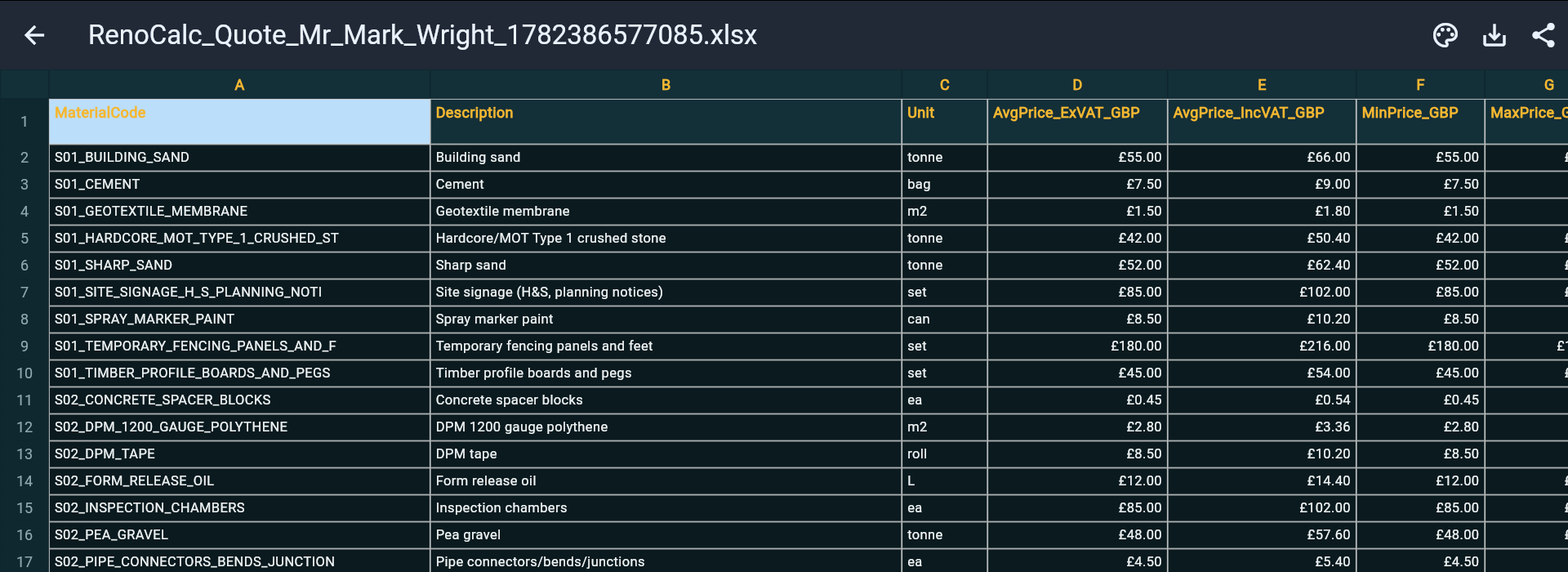
These figures are drawn from the RenoCalc Spreadsheet's material price library and labour rate database, cross-referenced against real jobs carried out across the UK in 2024–2026. They are based on gross internal floor area (GIA) and cover labour and materials only. VAT, professional fees and contingency are additional.
| Renovation Type | Low (£/m²) | Mid (£/m²) | High (£/m²) | What's Included |
|---|---|---|---|---|
| Light refurbishment | £400 | £500 | £600 | Decoration, flooring, kitchen units swap, cosmetic bathroom update |
| Medium renovation | £700 | £850 | £1,000 | New kitchen, new bathrooms, replumb, rewire, plastering, decoration |
| Full gut-and-rebuild | £1,100 | £1,400 | £1,800 | Strip out, structural changes, new everything, extensions possible |
| High-end specification | £2,000 | £2,500 | £3,500+ | Bespoke joinery, luxury sanitaryware, underfloor heating, landscaping |
| House extension (new m²) | £1,800 | £2,200 | £3,000+ | Single or double storey addition — foundations, structure, fit-out |
| Loft conversion (new m²) | £1,400 | £1,700 | £2,200 | Dormer or Velux conversion — full habitable room including stairs |
| Garage conversion (existing m²) | £600 | £900 | £1,400 | Convert existing garage to habitable use — insulation, electrics, finish |
A typical UK semi-detached house has a gross internal floor area of 80–110 m². At a medium renovation rate of £850/m², that equates to a total renovation budget of £68,000–£93,500 — before VAT, professional fees and contingency. These figures give you a useful sanity check against builder quotes before you go to tender.

What Drives the Renovation Cost Per m²
Cost per m² is a starting framework, not a final answer. Two properties with identical floor areas can differ by 40–60% in total renovation cost. These are the variables that move the number most significantly.
Structural Work
Removing load-bearing walls, installing steel beams, underpinning foundations or addressing structural failure dramatically increases cost per m². A single RSJ opening costs £2,500–£6,000 and is not reflected in a simple per-m² rate. Properties with structural issues can add £15,000–£50,000 before renovation work even begins.
Specification Level
The finish specification has the single largest impact on cost per m² within any renovation category. A kitchen at £8,000 supply-only versus one at £35,000 supply-only is the difference between light and high-end refurbishment — same floor area, vastly different cost. Agree the specification before you budget, not after.
Location Uplift
London and the South East add 25–40% to renovation costs compared to the Midlands. Inner London can run 50% above national average. This reflects higher trade labour rates, parking and congestion costs, longer journey times and higher operating costs for contractors. Scotland and Wales are broadly comparable to the Midlands.
Party Wall Agreements
Any structural work within 3–6 metres of a shared wall — including loft conversions, extensions and basement work — requires a Party Wall Agreement under the Party Wall etc. Act 1996. Surveyor fees run £700–£2,500 per neighbour. If neighbours appoint their own surveyor, you pay both. This is a professional fee, not a trade cost, and sits outside the per-m² rate.
Site Access
Restricted access — a narrow alley, no parking, an upper-floor flat, a listed building, a tight urban site — increases cost. Trades spend longer getting materials in and waste out. Skip placement requires highways permits. Scaffold requires additional tie-ins. Rural properties may require trade travel time at premium rates. All of this adds to your effective cost per m².
Existing Condition
Purchasing a property in poor structural condition — failed drainage, rising damp, woodworm, asbestos, poor roof, condemned electrics — increases the cost of renovation significantly. Remediation work must happen before renovation begins and does not add visible floor area or finish quality. Always commission a full building survey before purchasing a renovation project.
Room-by-Room Renovation Cost Per m² UK 2026
Different rooms have very different cost profiles. A bathroom costs far more per m² than a bedroom because of the density of trades involved — tiling, waterproofing, plumbing, electrics, sanitaryware. Here is how the numbers break down by room type.
| Room Type | Low (£/m²) | Mid (£/m²) | High (£/m²) | Key Cost Drivers |
|---|---|---|---|---|
| Kitchen | £900 | £1,400 | £2,800+ | Units specification, appliances, extraction, worktop material, replumbing |
| Bathroom (family) | £900 | £1,200 | £2,000+ | Sanitaryware, tiling, waterproofing, plumbing runs, ventilation |
| En suite | £1,100 | £1,500 | £2,500+ | Small area but all trades required — cost per m² is high |
| Bedroom | £250 | £400 | £700 | Decoration, flooring, built-in wardrobes, electrics (sockets, lighting) |
| Living room / reception | £200 | £350 | £600 | Decoration, flooring, fireplace, cornice restoration, AV installation |
| Extension (new build) | £1,800 | £2,200 | £3,000+ | Foundations, structure, roofing, windows, full first and second fix |
| Loft conversion (new m²) | £1,400 | £1,700 | £2,200 | Structural steels, roofing, insulation, stairs, electrics, fire protection |
The kitchen and bathrooms are where the money goes in a renovation. On a 3-bedroom semi, these rooms might account for 35–40% of the total renovation cost despite making up only 15–20% of the floor area. If you are working to a budget, the specification of kitchen units and bathroom sanitaryware is the most powerful lever you have.
Why Small Rooms Cost More Per m²
A bathroom or en suite is typically 4–8 m². But it requires a plumber, a tiler, an electrician and a plasterer — all of whom have minimum call-out costs and minimum time on site. The small area does not reduce the number of trades required, so the cost per m² is much higher than a large bedroom or living room. This is why whole-house cost per m² figures can be misleading if your renovation is heavily weighted toward wet rooms.

Detailed Cost Guides for Every Renovation Type
The figures above give you the framework. Each guide below provides a full breakdown for that specific renovation type — element by element, including structural, first-fix trades, finish and professional fees. Use these to build your budget before you invite builders to quote.
How to Get Your Exact Renovation Cost Per m²
Generic per-m² figures are the starting point, not the final answer. The only way to get a reliable renovation cost is to build a detailed, element-by-element estimate from your actual floor plan — accounting for the real room sizes, the number of wet rooms, the structural work involved and the specification you are targeting.
RenoCalc does this in under 3 minutes. Upload your floor plan — a scan, a photo of architect's drawings, or a digital file — and the AI scans every room, calculates the areas, and produces a full RenoCalc Spreadsheet covering:
- Room-by-room cost breakdown with per-m² labour and material rates
- Element-by-element schedule of works across all trades
- 40,000+ live formula spreadsheet with material price library and labour rates
- Cover letter, HSE method statements and 12-page contract pack
- Adjustable to your specification level and regional location
This is what 32 years of hands-on construction experience built into a tool looks like. Not a national average — your actual job, costed properly.
Watch How RenoCalc Works
A Note on Contingency
Whatever figure you arrive at — whether from the table above, from builder quotes or from the RenoCalc Spreadsheet — always add a contingency of 15–20% on top. UK renovation projects consistently encounter unforeseen conditions once walls, floors and ceilings are opened up: hidden damp, failing joists, incorrect previous works, concealed service runs that need diverting. This is not a cushion for scope creep. It is a realistic allowance for the uncertainties that every renovation project carries.
Get Your Renovation Cost Per m² — From Your Actual Floor Plan
Upload your floor plan and get a full room-by-room cost breakdown in under 3 minutes. RenoCalc uses 32 years of construction knowledge to produce a professional quote pack that builders and investors can rely on.
Try RenoCalc FreeFrequently Asked Questions
How accurate are cost per m² figures for renovation?
Cost per m² figures are a useful starting framework, not a precise quote. The actual cost depends on the existing condition of the property, the specification level, the trades required, regional labour rates and site access. Two properties of identical floor area can vary by 40–60% in renovation cost. Use per-m² figures to sense-check quotes and set an initial budget, then build a detailed element-by-element estimate using your actual floor plan — which is what RenoCalc does — before committing to a project.
What is not included in renovation cost per m² figures?
Standard cost per m² figures typically exclude: VAT (add 20% if your contractor is VAT-registered), professional fees (architect, structural engineer, party wall surveyor — typically £3,000–£12,000 on a whole-house renovation), planning application fees, Building Control fees, furniture and soft furnishings, landscaping, external works, skip hire and waste disposal, and any unforeseen structural issues revealed once walls or floors are opened up. Always budget a 15–20% contingency on top of your base renovation cost to cover these items.
How much more does renovation cost in London vs the rest of the UK?
London and the South East typically add 25–40% to renovation costs compared to the Midlands or North of England. This reflects higher labour rates, higher material delivery costs, parking and congestion charges, longer travel times for trades and the higher cost of running a business in London. Inner London boroughs attract premium trade rates. The South West and parts of East Anglia also command a modest premium over the Midlands. Scotland and Wales are broadly comparable to the Midlands, though rural areas may attract additional access costs.
Does structural work affect the cost per m² significantly?
Yes — structural work is one of the most significant cost drivers in a UK renovation. Removing a load-bearing wall requires a structural engineer's calculations and a steel beam, typically costing £2,500–£6,000 per opening. Opening up a kitchen-diner from two separate rooms can add £10,000–£25,000 in structural work alone. Properties with subsidence, failed drainage, rising damp or poor roof structure can add £15,000–£50,000 or more in remediation costs before the renovation proper begins. Always commission a full building survey before purchasing a renovation project.
How do I get my exact renovation cost per m²?
The most accurate way to calculate your renovation cost per m² is to build a full room-by-room, element-by-element estimate from your actual floor plan. RenoCalc does this automatically — upload your floor plan and the AI identifies each room, calculates dimensions and produces the RenoCalc Spreadsheet with 40,000+ live formulas, a material price library and UK labour rates. You get a schedule of works, cover letter, HSE method statements and 12-page contract pack — everything needed for a professional quote. Try it free at renocalcapp.com/start.
Questions About House Renovation Cost Per m² UK
Q: What is a realistic budget for a full house renovation in the UK?
For a medium full renovation — kitchen, bathrooms, replastering, rewire, replumb and decoration — budget £700–1,000/m² on gross internal floor area. A typical 3-bedroom semi at 85m² therefore requires £60,000–£85,000. Add VAT at 20% if your contractor is registered, professional fees of £3,000–£12,000, and a 15–20% contingency for unforeseen work.
Q: How much does a light cosmetic house refurbishment cost per m²?
A light refurbishment — decoration, flooring, bathroom cosmetics and minor kitchen update — costs £400–600/m² in 2026. This assumes no structural work, no replastering, and no rewiring. It is the most budget-friendly tier and is typically what BTL investors use to refresh a property between tenancies. RICS House Rebuilding Cost guidance and this tier are entirely separate — the RICS figure covers full rebuild, not cosmetic works.
Q: Does VAT apply to house renovation costs in the UK?
Standard rate VAT at 20% applies to most renovation work carried out by VAT-registered contractors. Some qualifying residential conversions (e.g. converting a commercial building to residential) may attract 5% reduced rate VAT. A zero-rate may apply if the building has been empty for 10+ years. For most standard house renovations, budget 20% VAT on top of your net renovation cost unless your contractor is below the VAT threshold.
Q: How do renovation costs in Scotland compare to England?
Scotland is broadly comparable to the English Midlands for renovation labour costs — typically 5–15% below the UK average quoted by London-based sources. Rural Scotland and the Highlands attract premium costs due to travel time and material delivery. Glasgow and Edinburgh city centres sit closer to Midlands/North England rates. Northern Ireland runs slightly below Scotland in most trade categories.
Q: What does a full rewire cost per m² of floor area?
A full rewire of a 3-bedroom house (85m²) costs approximately £4,500–£7,500 in 2026, equivalent to roughly £53–88/m². This covers new consumer unit, all circuits, sockets, switches, light fittings and the Part P building regulations compliance certificate. The range reflects access difficulty, the number of circuits, and whether any additional circuits (EV charger, kitchen appliances) are included. Rewiring adds approximately £50–100/m² to the overall renovation cost per m².
Q: What is the most cost-effective specification level for renovation?
The mid-specification tier (£700–1,000/m²) consistently delivers the best value-add for resale in the UK residential market. Budget-tier cosmetics are quickly dated and may need refreshing within 5 years. High-specification work exceeding £1,500/m² in most locations does not return its full cost at resale — the premium is absorbed by the market. The exception is high-demand urban areas where end-user expectations are elevated and premium specification is priced in.