Ensuite Renovation Cost UK 2026: What You'll Actually Pay
Quick Answer
Ensuite renovation costs UK range from £3,500–6,000 for a budget refit, £6,000–12,000 for a mid-specification renovation, and £12,000–25,000 for a luxury finish. Creating a new ensuite from scratch (requiring a new partition wall and fresh plumbing runs) costs significantly more than refitting an existing one. Wet rooms typically cost 15–25% more than standard shower-tray ensuites.
An ensuite is one of the most requested additions in UK renovation work — and also one of the most misquoted. Because the room is small, clients often expect the cost to be proportionally small. It isn't. The trades involved are the same as a full bathroom — plumber, electrician, tiler, plasterer — and in a tight space those trades take longer per square metre, not less.
Whether you're refitting an existing ensuite or converting part of a bedroom into one from scratch, this guide covers what you'll actually pay in 2026, split by budget tier, with a clear explanation of the key cost drivers: size, shower type, underfloor heating, tile choice, and how far the plumbing needs to travel.
All figures are UK 2026 trade pricing. London and the South East add 20–30%.
Ensuite Renovation Cost Ranges — UK 2026
The table below covers refitting an existing ensuite — existing plumbing connections in place, partition walls already built. Creating a new ensuite from scratch costs more; see the section below for those figures.
| Spec Tier | Cost Range | Typical Specification |
|---|---|---|
| Budget | £3,500–£6,000 | White sanitaryware, shower tray and enclosure, basic tiles, vinyl floor or small format tiles, chrome towel rail |
| Mid-spec | £6,000–£12,000 | Quality sanitaryware, walk-in shower tray or wet room, porcelain wall and floor tiles, electric underfloor heating, heated towel rail, recessed lighting |
| Luxury | £12,000–£25,000+ | Freestanding basin or countertop basin, frameless shower screen, large-format porcelain or natural stone, underfloor heating, bespoke vanity, thermostatic shower system |
The wide range within each tier reflects the enormous variation in tile costs alone. Large-format porcelain at £40–£80/m² supply-only is a standard choice. Natural stone at £80–£200/m² dramatically shifts the overall budget. In a 3m² ensuite, the tile area (walls and floor) can reach 15–20m² when you account for full wall tiling — so tile choice is a meaningful lever in the total cost.
Refitting an Existing Ensuite vs Creating One from Scratch
There's a substantial cost difference between refitting a room that's already configured as an ensuite and converting bedroom space into one.
Refitting an Existing Ensuite
Strip-out the old suite, retile, replumb connections to the same approximate positions, fit new sanitaryware. The plumbing stack is already there, the waste runs are in place, the partition wall is built. Labour and materials for the fit-out are the main costs — the costs shown in the table above apply here.
Creating a New Ensuite Addition
Here you're taking floor area from the bedroom (or a landing, or a walk-in wardrobe) and converting it. This means: building a partition wall (£400–£900), rerouting plumbing supply and waste from the nearest stack (£800–£2,500 depending on distance), installing extraction through the ceiling or an external wall (£300–£800), and providing electrics for lighting, extractor and underfloor heating from a new circuit (£400–£900).
In total, the additional construction costs for a new ensuite addition — on top of the fit-out costs — run £2,000–£5,000 depending on how far the plumbing needs to travel and how accessible the existing structure is. The all-in cost for a new ensuite addition in 2026 typically runs:
| Spec | Total Cost Range |
|---|---|
| Budget (new addition) | £6,000–£10,000 |
| Mid-spec (new addition) | £10,000–£18,000 |
| Luxury (new addition) | £18,000–£30,000+ |
Key Cost Drivers in an Ensuite Renovation
Size (Typically 2–4m²)
Most ensuites in UK properties are 2–4m². At 2m², you're fitting a shower, WC and basin in a very tight space — every dimension matters. At 4m², you have more flexibility for a walk-in shower enclosure and a more generous vanity. The difference in material cost between a 2m² and 4m² ensuite is relatively small — it's the labour that stays similar because the same trades are involved regardless of size.
Shower Tray vs Wet Room
A shower tray with enclosure is the cheapest option — a decent tray and screen costs £300–£900 supply-only. A wet room (level-access, fully tanked floor) costs more because of the tanking membrane, linear drain and the need for structural floor preparation. Budget an additional £500–£1,500 for wet room construction versus a tray installation. The trade-off is accessibility and a clean, contemporary look — for many clients, the premium is worth it.
Underfloor Heating
Electric underfloor heating in an ensuite is one of the most cost-effective luxury additions available. A 2–3m² mat costs £150–£300 supply-only, installation adds £250–£400 including the thermostat and electrician connection. Running costs in a small room are minimal. The floor must be tiled — electric UFH doesn't work under vinyl or LVT in most cases. If you're tiling anyway, adding UFH at first-fix stage adds very little to the overall project cost and a great deal to the everyday experience of the room.
Tile Specification
Tiles are the most visible design element of an ensuite and the easiest place to overspend. Supply costs for porcelain range from £15/m² (budget) to £100+/m² (large format or textured). Natural stone starts at around £60/m² and can exceed £200/m². In a fully tiled ensuite with 15–20m² of tile area, the difference between a budget tile and a premium tile is £1,000–£3,000 in materials alone — plus additional tiling labour for large-format tiles that require more precise setting and more cutting.
Plumbing Routing
The further the new waste and supply runs need to travel from the existing stack, the more the plumbing costs. Ground floor ensuites routing to a ground-floor stack are straightforward. Upper-floor ensuites where the new waste needs to chase down through a first-floor ceiling void and connect to a ground-floor stack can add £500–£1,500 to the plumbing bill, plus making good to ceiling and floor finishes.
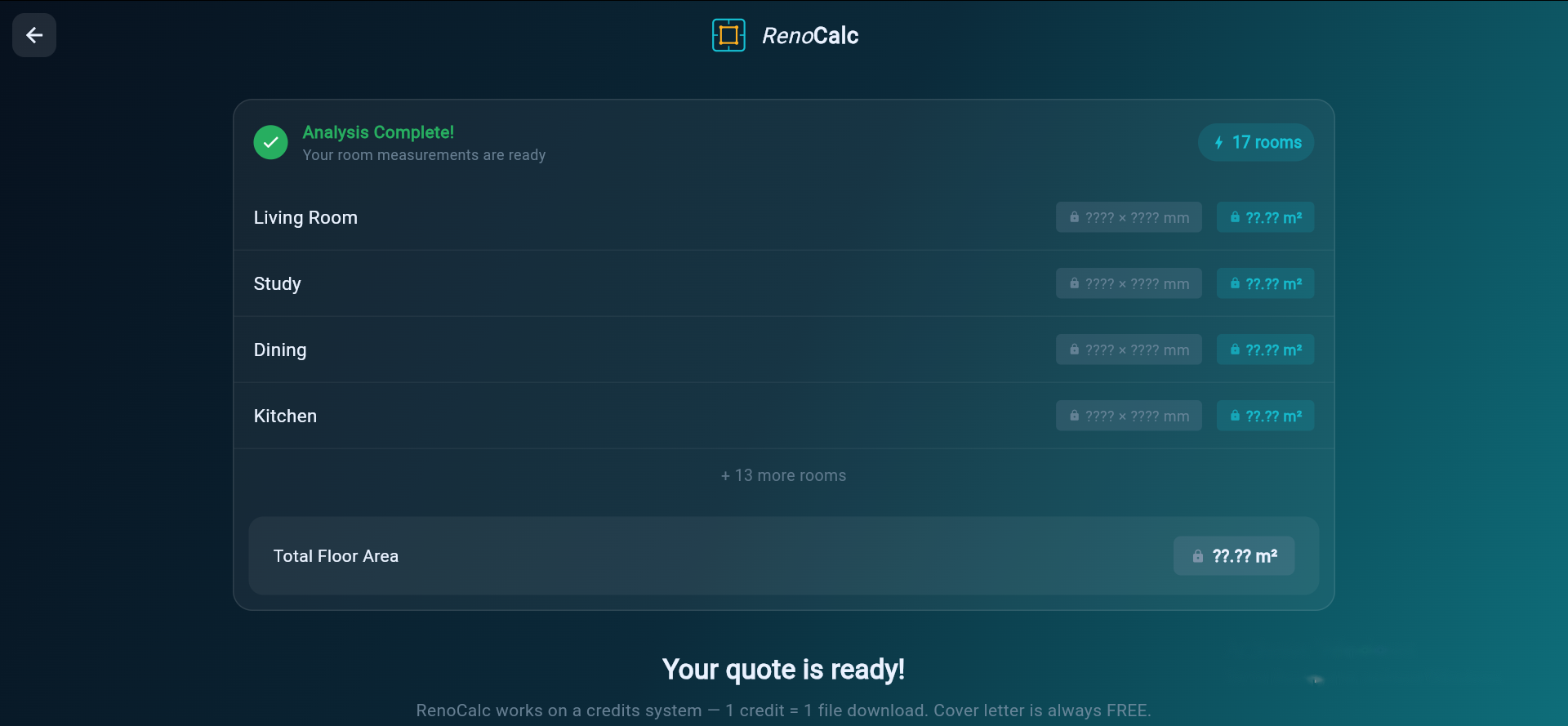
How RenoCalc Quotes an Ensuite in Minutes
Upload your floor plan and RenoCalc produces a full ensuite breakdown — from partition walls and plumbing first-fix through to tiling, sanitaryware and underfloor heating — in around 3 minutes.
Ensuite Renovation: Cost by Element
| Element | Budget | Mid-Spec | Luxury |
|---|---|---|---|
| Strip-out and disposal | £200–£400 | £200–£400 | £300–£600 |
| Plumbing — first and second fix | £600–£1,200 | £900–£1,800 | £1,500–£3,000 |
| Electrics — lighting, extractor, UFH circuit | £400–£700 | £600–£1,000 | £900–£1,800 |
| Waterproofing / tanking | £150–£350 | £250–£600 | £400–£1,000 |
| Tiling — walls and floor | £600–£1,200 | £1,200–£3,000 | £2,500–£6,000 |
| Underfloor heating — mat and thermostat | — | £400–£700 | £500–£900 |
| Shower — tray/wet room + enclosure/screen | £400–£900 | £800–£2,000 | £1,500–£4,000 |
| WC — supply and fit | £200–£400 | £350–£700 | £600–£1,500 |
| Basin and vanity — supply and fit | £150–£350 | £300–£800 | £800–£2,500 |
| Heated towel rail — supply and fit | £150–£300 | £250–£500 | £400–£900 |
| Boarding, plastering, ceiling | £300–£600 | £400–£800 | £500–£1,200 |
| Door (if new addition) | £150–£300 | £200–£450 | £400–£900 |
| Total — refit | £3,500–£6,000 | £6,000–£12,000 | £12,000–£25,000+ |
Planning Permission and Building Regulations
No planning permission is required for an ensuite bathroom within the existing footprint of your property. You are not changing the external appearance of the building — you are rearranging internal space. This applies whether you are refitting an existing ensuite or creating a new one by partitioning part of a bedroom.
Building Regulations do apply to the work — specifically:
- Part G — Sanitation, hot water safety and water efficiency. The plumbing connections must be installed correctly, and if you're installing an unvented hot water system or thermostatic shower, this must be done by a qualified engineer.
- Part P — Electrical safety in dwellings. All electrical work in a bathroom is notifiable. Your electrician must be registered with a competent person scheme (such as NICEIC or NAPIT) to self-certify the work, or you'll need to notify Building Control separately.
- Part F — Ventilation. An ensuite must have adequate mechanical extraction — a minimum of 15 litres/second for an ensuite with shower. The extractor must have a 15-minute overrun timer or equivalent humidity control.
The compliance work for an ensuite is handled by the registered trades doing the installation — your plumber and electrician self-certify their work. You don't need to make a separate Building Regulations application for a standard ensuite refit.
Get Your Ensuite Quote in Under 3 Minutes
Upload your floor plan to RenoCalc and get a full ensuite renovation cost breakdown — every trade, every element, based on your actual room size. Cover letter, schedule of works and method statements included. Built for UK builders and homeowners.
Start Your Free EstimateFrequently Asked Questions
How much does an ensuite renovation cost in the UK?
An ensuite renovation in the UK costs £3,500–£6,000 at budget level, £6,000–£12,000 at mid-spec, and £12,000–£25,000 or more for a luxury ensuite in 2026. These figures cover a refit of an existing ensuite. Creating a brand new ensuite from scratch — converting bedroom space, adding a partition wall and routing plumbing from the existing stack — adds £2,000–£5,000 to these figures.
Do I need planning permission for an ensuite?
No. Adding an ensuite within the existing footprint of your home is internal work and does not require planning permission. The plumbing and electrical work must comply with Building Regulations (Part P for electrics, Part G for hot water and sanitation), but this is handled by your registered trades who self-certify their work through a competent person scheme.
How much does it cost to add a wet room to a bedroom?
A wet room ensuite — fully waterproofed, level-access — costs £6,000–£18,000 depending on size, tile specification and location. The additional cost versus a shower tray is in the tanking, the linear drain and the more involved tiling. Upper-floor wet rooms also require floor strengthening work, which adds to the structural cost.
Is underfloor heating worth it in an ensuite?
Electric underfloor heating in an ensuite costs £400–£900 supply and fit including the thermostat. Running costs are minimal in a small room. It eliminates the need for a heated towel rail as primary heat and makes tiles warm underfoot. For most ensuite renovations, electric UFH represents very good value at this scale — add it at first-fix stage before tiling begins.
How long does an ensuite renovation take?
A straightforward ensuite refit takes 5–10 working days. A new ensuite addition — partition walls, plumbing routed from scratch — takes 10–20 working days. The sequencing matters: strip-out, partition walls, first-fix plumbing and electrics, boarding, waterproofing, tiling, second-fix plumbing and electrics, sanitaryware and finishing. Allow for drying time between stages in the programme.
Questions About Ensuite Renovation Cost UK
Q: How much does it cost to create a brand new ensuite in a bedroom?
Creating a brand new ensuite by partitioning part of a bedroom costs £8,000–£20,000 in 2026, depending on the distance from the soil stack, room size, and specification. Key variables include how far the new waste pipe needs to run (each metre adds cost), whether the floor needs strengthening for a wet room, and the quality of sanitaryware and tiling. In most UK markets, adding an ensuite adds more value to the property than the cost of the work.
Q: What is the minimum size for a functional ensuite?
A functional ensuite with a shower, WC and basin needs a minimum of approximately 1.2m × 2.1m (2.52m²) — enough for a corner shower tray, close-coupled WC and a small pedestal basin. A more comfortable ensuite starts at 1.6m × 2.2m (3.5m²), which allows for a walk-in shower tray, a wall-hung WC and a vanity unit. These dimensions determine how much bedroom space you lose and inform the budget through the amount of tiling, boarding and plumbing involved.
Q: Does an ensuite require Building Regulations approval?
Yes. Ensuite plumbing and electrical work must comply with Building Regulations. Electrical work (Part P) must be carried out by a registered competent person or notified to Building Control. Plumbing and hot water (Part G) and drainage (Part H) apply. For a new ensuite addition, you may also need to demonstrate adequate ventilation (Part F — typically a mechanical extractor with a 15-minute overrun). The Planning Portal has a useful guidance tool for determining what permissions apply to your specific project.
Q: How much does ensuite tiling cost per m²?
Ensuite tiling labour costs £35–£65/m² for a competent UK tiler in 2026, depending on tile size, substrate preparation, and pattern complexity. Large-format tiles (600×600mm+) cost slightly more to lay due to the weight and accuracy required. Supply costs range from £20–£200/m² depending on tile quality. In a 3m² ensuite with full wall and floor tiling, total tile area can reach 18–22m², meaning tiling can represent £2,500–£8,000 of the overall ensuite renovation cost.
Q: Is a wet room more expensive than a standard shower enclosure in an ensuite?
Yes — a wet room costs 15–25% more than a standard shower-tray ensuite of equivalent specification. The premium comes from the full floor tanking (waterproofing membrane across the whole floor rather than just under the tray), the linear drain and its waterproof former, floor levelling to achieve the correct fall to the drain, and the additional tiling area. Wet rooms also require adequate floor structural support — often an additional cost on upper floors with timber joists.
Q: What sanitaryware brands offer the best value for a mid-spec ensuite?
For a mid-spec UK ensuite, trade-supplied sanitaryware from Ideal Standard, Roca, RAK Ceramics and Vado offers a good balance of quality and price. Wall-hung WCs with concealed cisterns cost £400–£900 supply-only for quality mid-range options. Thermostatic shower systems from Aqualisa or Mira run £300–£700 supply-only. Avoid very cheap branded sanitaryware — the fitting costs are identical and low-end cistern mechanisms and cartridges tend to fail within 2–3 years, generating expensive call-back costs.