New Build Cost Per m² UK 2026: What Does It Really Cost to Build a House?

Quick Answer
New build construction costs per m² in the UK range from £1,500–2,000/m² for a basic self-build, £2,000–2,800/m² for a good specification, and £2,800–4,000+/m² for a high-specification build. A 100m² house at mid specification therefore costs approximately £200,000–280,000 in pure build cost, before land, professional fees, planning, and site infrastructure.
The question every self-builder, developer and property investor asks before a spade goes in the ground: what does it actually cost to build a house from scratch in the UK? The short answer is £1,500–4,000+ per square metre of internal floor area, depending on specification. But that range spans a wide spectrum, and where your project sits within it depends on a handful of decisions made early in the process.
I've spent 32 years in construction, working across projects from modest self-builds to substantial residential developments. New build cost per m² is one of those figures that gets quoted loosely, often without the context that makes it useful. This guide gives you that context — breaking down the cost range by specification tier, then by build stage, so you can understand what each element costs and why the total is what it is.
If you're at the appraisal stage, the figures here will help you stress-test your land purchase budget and build a realistic financial model before you commit. If you're mid-design, they'll help you understand which decisions move the needle most on cost.
New Build Cost Per m² by Specification
The specification of the build is the single biggest driver of cost per square metre. The same 150m² footprint can cost £225,000 or £600,000 to build depending on what goes into it. Here are the three main tiers.
| Specification Tier | Cost Per m² | What It Includes |
|---|---|---|
| Basic self-build | £1,500–£2,000/m² | Standard masonry structure, basic kitchen and bathrooms, builder's-grade finishes, minimum specification throughout |
| Good-spec self-build | £2,000–£2,800/m² | Better kitchen and bathroom specification, engineered timber floors or quality tiles, decent sanitary ware, solid internal doors, good insulation specification |
| High-spec / architect-designed | £2,800–£4,000+/m² | Premium kitchen, stone or large-format tile finishes, underfloor heating throughout, triple glazing, smart home integration, structural glazing, landscaping to match |
These figures are build costs — the cost of physically constructing the house, including all materials and labour from foundations to decoration. They exclude land, professional fees, planning costs and utility connections, all of which are covered in the hidden costs section below.
The London and South East premium applies to new builds just as it does to renovations. Add 20–35% to these figures for comparable work in London. Scotland, Wales and some northern regions can run 5–15% below Midlands and South of England rates depending on the specific location and the availability of local contractors.
What a 100m² House Actually Costs
Putting the per-metre figures against a real house size makes them more tangible. A 100m² house — roughly a compact 3-bedroom or a generously proportioned 2-bedroom — is a useful benchmark.
| Specification | Build Cost Range |
|---|---|
| Basic self-build | £150,000–£200,000 |
| Good-spec self-build (mid-market) | £200,000–£280,000 |
| High-specification build | £280,000–£400,000+ |
For a 150m² house at mid-spec — more typical of a 4-bedroom self-build — you're looking at £300,000–£420,000 in build costs. Add land and professional fees on top and the total project cost becomes clear quickly. This is why land appraisal on a self-build is as important as the build cost itself: buying at the wrong land price leaves no margin for the project to work.
Get a Build Cost Estimate in Under 3 Minutes
RenoCalc turns your floor plans into a full new build cost breakdown — every trade, every stage. Upload your plans and start for free.
Start Your Free EstimateCost by Build Stage
Understanding what proportion of the budget falls on each build stage is essential for cashflow planning and for reviewing contractor quotes. These percentages apply to the build cost component only — they're the industry-standard proportions I've worked with across 32 years of construction projects.
| Build Stage | % of Build Cost | What It Covers |
|---|---|---|
| Groundworks and foundations | 10–15% | Site clearance, excavation, hardcore, drainage, concrete foundations — strip, raft or pile depending on ground conditions |
| Superstructure — walls and roof structure | 20–25% | Masonry or timber frame to wall plate level, structural steels, roof structure including rafters, purlins and ridge |
| Weathertight — windows, doors, roof covering | 10% | External windows and doors installed, roof tiles or slates laid, lead flashing and pointing — the building becomes weathertight at this stage |
| First fix | 15% | Electrical cable runs, plumbing pipework, underfloor heating if specified, structural carpentry including studwork, lintels and floor decking |
| Second fix and finishes | 25–30% | Plastering, kitchen and bathroom fit-out, electrical second fix (sockets, switches, consumer unit), plumbing second fix (boiler, radiators, sanitaryware), flooring, internal doors, decoration |
| External works and landscaping | 5–10% | Driveways, paths, boundary walls and fencing, topsoil and seeding, external lighting and drainage connections |
What the Stage Proportions Tell You
Two things are worth noting in these proportions. First, the second fix and finishes stage (25–30%) is where specification choices have the biggest cost impact. A basic kitchen and standard bathroom tile can cost £8,000–15,000; a premium kitchen and stone-clad bathrooms for the same house can cost £40,000–80,000+. This is where the difference between a £2,000/m² build and a £3,500/m² build is primarily created.
Second, groundworks can surprise you. On a site with poor ground conditions — made ground, high water table, fill material, tree roots — the 10–15% groundworks figure can be exceeded significantly. A ground investigation survey before purchasing land is money well spent.
Timber Frame vs Masonry: Which Costs Less?
The choice between timber frame and traditional masonry cavity wall construction is one of the earliest structural decisions on a self-build, and it has cost and programme implications throughout the project.
| Factor | Timber Frame | Traditional Masonry |
|---|---|---|
| Shell construction cost | 5–15% higher in materials | Lower material cost; familiar supply chain |
| Time to weathertight | 1–3 weeks for kit erection | 8–14 weeks for equivalent structure |
| Prelim savings from speed | Significant — fewer weeks of scaffolding, site management | Extended programme increases prelim cost |
| Thermal performance | Excellent — easier to achieve low U-values | Good — requires careful detailing of insulation |
| Trades familiarity | Requires experienced timber frame fixer | Any experienced bricklayer; wider contractor pool |
| Overall total cost comparison | Broadly comparable once programme savings included | Often marginally cheaper on straightforward sites |
For self-builders managing their own project, the speed of timber frame is often the deciding factor. Getting to weathertight in 2 weeks instead of 12 means your internal trades can start sooner, your contingency period is shorter, and your site insurance costs less. On a budget-conscious project on a straightforward flat site, masonry can still be the right call — particularly if you have local bricklayers with competitive rates and a good track record.
If you're building in a conservation area or one where planning conditions require matching materials, masonry may be specified regardless of your preference.
See How RenoCalc Prices a New Build
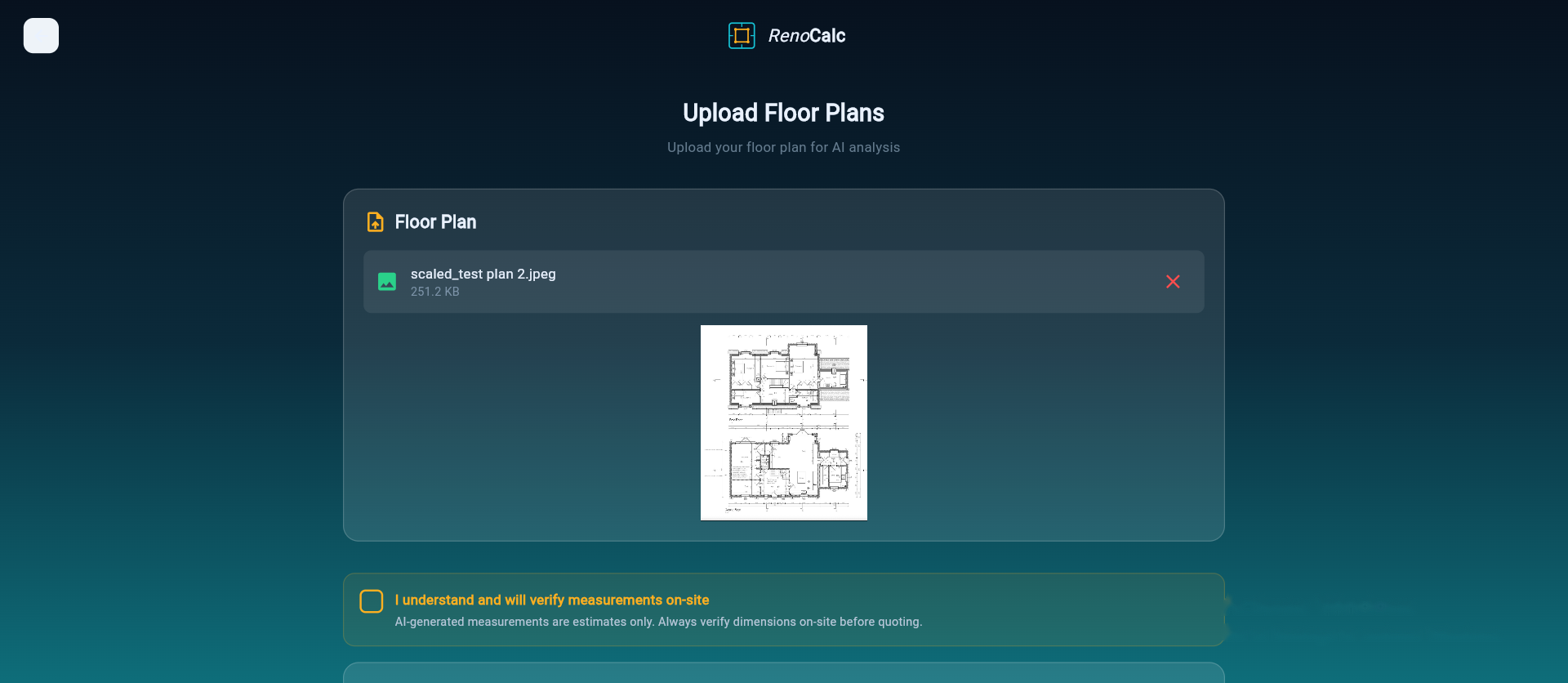
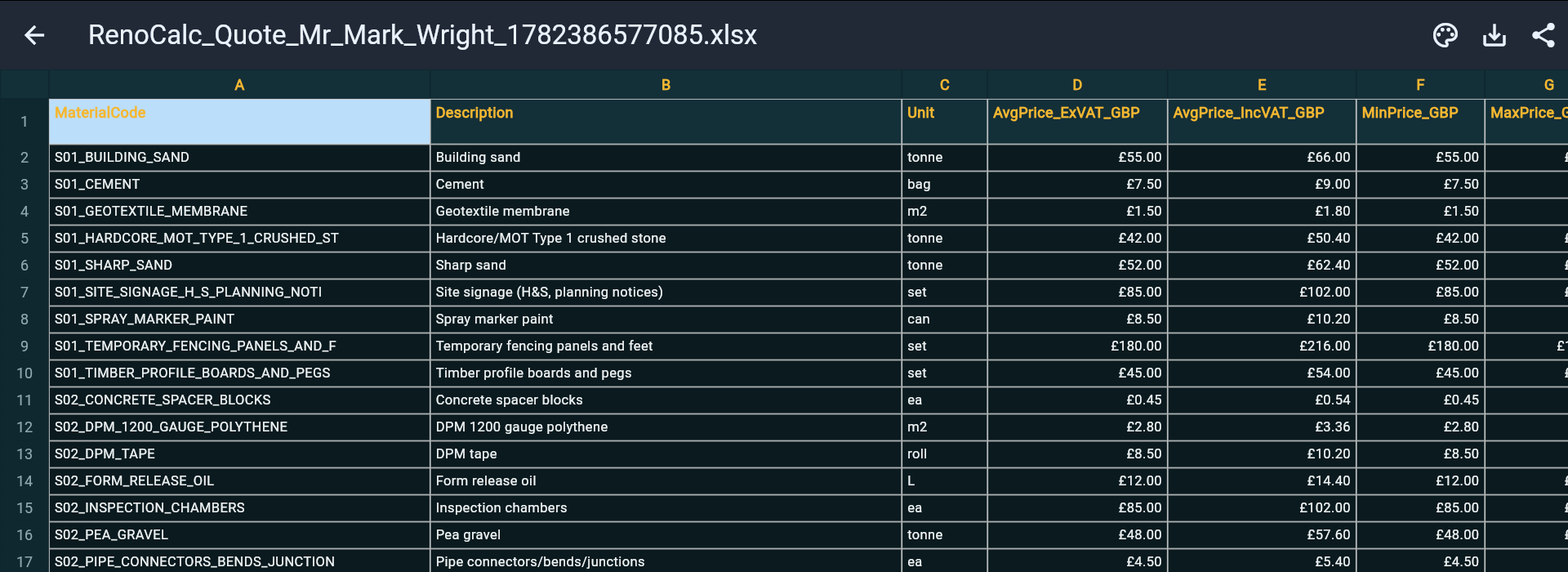
RenoCalc's AI reads your floor plan and generates a complete cost breakdown by trade and build stage — the same structure as the breakdowns in this guide, but specific to your project. Here's how it works:
Upload your floor plan, confirm the scope, and RenoCalc's spreadsheet — 40,000+ live formulas, a full material price library and current UK labour rates — outputs a professional quote pack in under 3 minutes. The cover letter is included free on every quote.
Frequently Asked Questions
What is the average new build cost per m² in the UK in 2026?
New build cost per m² in the UK in 2026 ranges from £1,500–2,000/m² for a basic self-build with standard finishes, up to £2,800–4,000+/m² for a high-specification custom build. A good-spec self-build — which represents the majority of projects — typically falls in the £2,000–2,800/m² range. These figures are build costs only and exclude land, architect fees, planning costs, utility connections and the Community Infrastructure Levy.
How much does it cost to build a 100m² house in the UK?
A 100m² house at mid-specification (good-spec self-build) costs £200,000–280,000 in build costs alone in 2026. At basic self-build spec it drops to £150,000–200,000; at high spec it rises to £280,000–400,000+. Add land purchase, architect and structural engineer fees, planning fees, building control, utility connections (£15,000–30,000), site insurance and the Community Infrastructure Levy for the total project cost — which can add £50,000–150,000+ to the above depending on location.
Is timber frame cheaper than masonry for a new build?
Timber frame materials typically cost 5–15% more than masonry, but the speed advantage — a frame can be erected in 1–3 weeks versus 8–14 weeks for masonry — reduces prelim costs significantly. In total, timber frame and masonry are broadly comparable once programme savings are factored in. For self-builds on tight programmes or where labour costs are high, timber frame often works out comparable or cheaper overall.
What hidden costs should I budget for on a new build?
Hidden costs that are frequently underestimated include: architect and planning fees (£15,000–40,000+), structural engineer (£2,000–6,000), building control (£1,500–5,000), site survey and ground investigation (£1,000–4,000), utility connections (£15,000–30,000+), Community Infrastructure Levy (can be £10,000–80,000+ depending on local authority), site insurance (£2,000–5,000 per year), landscaping and external works (£10,000–30,000+) and a contingency of 10–15% of build cost.
What percentage of a new build budget goes on each build stage?
As a guide: groundworks and foundations 10–15%, superstructure (walls and roof structure) 20–25%, weathertight works (windows, external doors, roof covering) 10%, first fix (electrics, plumbing, carpentry) 15%, second fix and finishes (plastering, kitchen, bathrooms, flooring, decoration) 25–30%, external works and landscaping 5–10%. These are proportions of the build cost — professional fees, planning and utilities sit outside this breakdown.
Do I pay VAT on a new build?
New build residential construction is zero-rated for VAT in the UK, meaning builders charge 0% VAT on qualifying construction work. Self-builders can reclaim VAT on materials through HMRC's DIY Housebuilders Scheme after completion. Professional fees (architects, engineers) are still subject to 20% VAT. This is a significant advantage over renovation work, which is typically charged at 20% VAT (with some exceptions for qualifying conversions).
Do I need planning permission to build a new house in the UK?
Yes. Building a new dwelling requires full planning permission from your local planning authority in virtually all cases. The Planning Portal provides guidance on the application process, required documents and fees. Applications typically take 8–13 weeks to determine. A pre-application consultation with the local authority is strongly recommended before submitting a formal application on any site with planning uncertainty.
What is the Community Infrastructure Levy and how much is it?
The Community Infrastructure Levy (CIL) is a planning charge levied by some local authorities on new development to fund local infrastructure. Not all councils operate a CIL — some use Section 106 agreements instead. Where CIL applies, rates vary from zero to £200–400/m² in high-demand areas. On a 150m² house in a high-CIL area, this could mean £30,000–60,000 before construction begins. Check your local authority's CIL charging schedule before committing to a site purchase.
People Also Ask
What is the cheapest way to build a house in the UK?
The cheapest build route is typically a timber frame or structural insulated panel (SIP) self-build in a lower-cost region of the UK, with the owner project-managing directly and procuring trades individually rather than using a main contractor. A highly involved self-builder managing procurement can save 15–25% compared with a fully contracted build. Standardised designs (avoiding complex roofs, non-rectangular footprints and bespoke specification) also reduce costs significantly. Basic self-build costs start at around £1,500/m² before land and professional fees.
What building regulations apply to a new build house?
A new dwelling in England must comply with the full suite of Building Regulations Approved Documents — covering structure (Part A), fire safety (Part B), drainage (Part H), energy efficiency (Part L), electrical safety (Part P) and accessibility (Part M), among others. Building control must be notified at foundation stage, before oversite concrete is poured, at damp-proof course level, at each floor and roof structure, and on completion. The building control surveyor issues a completion certificate that is required by mortgage lenders.
How long does it take to build a house in the UK?
A typical self-build house takes 12–24 months from site purchase to completion, including planning (2–4 months), design development (2–3 months), procurement and mobilisation (1–2 months) and construction (6–14 months depending on build method and size). Timber frame builds can be weathertight in 4–6 months from breaking ground; masonry builds typically take 8–14 months to the same stage. Delays from planning, utility connections and ground conditions are the most common programme risks.
Is it cheaper to buy or build a house in the UK?
In most areas of the UK, buying an existing house is cheaper than building new when land cost, professional fees and the full build budget are added together. The exception is in areas where land value is high relative to finished house values — where a self-builder can add significant equity through the build process. Self-build also allows you to specify a property exactly to your requirements, which has a value beyond pure financial return. The government's self-build guidance outlines schemes and support available for self-builders.
What insurance do I need for a self-build?
Self-builds require specialist site insurance throughout the construction period, covering: employers' liability (if you employ trades directly), public liability, contract works (covering the structure and materials against damage), and plant and equipment. Most mainstream home insurance policies do not cover a property under construction. Specialist self-build insurance providers include BuildStore and Self Build Zone. The HSE CDM Regulations also apply to self-build projects and impose duties on clients and principal designers.
Can I build a house without a structural engineer?
For a conventional domestic new build you require a structural engineer to design the foundations, beam specifications, structural steel positions and roof structure, and to produce calculations for building control sign-off. While it is technically possible to use standardised NHBC or timber frame manufacturer span tables for simple structures, building control will require engineering input for any non-standard elements. Structural engineer fees typically run £2,000–6,000 for a standard new build house, and their involvement is essential for obtaining a completion certificate and ultimately a mortgage.
Ready to Price Your New Build?
New build cost per m² is a useful starting point — but the figure that matters is the one specific to your floor plan, your specification and your location. The stage-by-stage breakdown in this guide gives you a framework for reviewing contractor quotes and sense-checking your overall budget before you commit.
If you want to move from a general estimate to a project-specific one, try RenoCalc free — upload your floor plan and get a full cost breakdown by trade and build stage in under 3 minutes. No spreadsheet expertise required.
Also worth reading: house renovation cost per m² and house extension cost UK — useful if your project involves extending or substantially altering an existing property rather than starting from scratch.
Build Your New Build Budget in Under 3 Minutes
Upload your floor plan. RenoCalc reads it, prices it and outputs a professional quote pack — cover letter included free. Built by Pindi Sahota, 32 years in construction.
Start Free — No Card Needed