Loft Conversion Cost London 2026: What You'll Pay in the Capital
Loft conversion costs in London 2026 sit 30–50% above the national average and the gap is widening. The London trade market operates at premium rates across every discipline — carpenters, roofers, plasterers, electricians — and a cluster of London-specific factors add cost and complexity that homeowners elsewhere simply don't encounter: party wall agreements on almost every terrace and semi, scaffolding restrictions across much of inner London, conservation area planning requirements, and borough-by-borough variations that make it genuinely difficult to price a loft conversion without local knowledge.
This guide gives you real 2026 cost ranges for the three main London loft conversion types — Velux, rear dormer and mansard — and explains each London-specific cost factor in detail so you know what you're budgeting for before you call a builder.
London Loft Conversion Cost — Quick Answer
Loft conversion costs in London 2026 are 30–50% above the national average. Expect £28,000–£55,000 for a Velux conversion, £45,000–£85,000 for a rear dormer, and £60,000–£110,000 for a mansard. London-specific costs include party wall agreements (almost always required on terraced and semi-detached properties), scaffolding restrictions and licensing, and premium trade rates that vary significantly between inner and outer London boroughs.
London Loft Conversion Prices 2026
The table below shows London-specific cost ranges for each conversion type. These figures reflect 2026 London trade rates and include party wall surveyor fees where applicable. They do not include VAT, which is charged at 20% on the build cost and professional fees.
| Conversion Type | Outer London | Inner London | Notes |
|---|---|---|---|
| Velux (rooflight only) | £28,000–£40,000 | £38,000–£55,000 | Only viable if ridge height is sufficient |
| Rear dormer | £45,000–£62,000 | £58,000–£85,000 | Most common type on Victorian and Edwardian stock |
| L-shaped dormer | £55,000–£75,000 | £68,000–£95,000 | Suited to Victorian terraces with rear outrigger |
| Mansard | £60,000–£85,000 | £75,000–£110,000 | Maximum volume gain; almost always needs planning |
| Hip-to-gable | £50,000–£70,000 | £62,000–£88,000 | Applies to semi-detached with hipped roof ends |
These ranges assume a standard specification — bedroom with en suite, timber staircase, plastered and decorated throughout, uPVC dormer windows. Higher specification finishes (bespoke timber joinery, natural slate, bifold glazing) add materially to cost. London projects also regularly attract a contingency addition of 10–15% on top of quoted prices for access issues, scaffolding overruns and party wall complications.
London Loft Conversion Cost Breakdown — Rear Dormer
| Element | Inner London Cost | Notes |
|---|---|---|
| Architect's drawings and structural engineer | £2,500–£5,500 | London architects charge at premium rates |
| Party wall surveyor fees (both neighbours) | £1,400–£4,000 | Near-universal on London terraces |
| Building Control — Full Plans application | £800–£1,800 | Full Plans application recommended |
| Scaffolding — supply, erection, licensing | £2,500–£6,000 | Footway licences add cost in inner London |
| Structural steels (RSJs) | £2,500–£6,000 | London steel fixers at premium day rates |
| Dormer structure — timber frame and roof | £8,000–£16,000 | GRP flat roof or lead-covered pitched dormer |
| Floor joist strengthening | £2,500–£5,500 | New timber or steel floor joists |
| Roof insulation | £2,500–£5,000 | PIR between and below rafters |
| New staircase | £3,500–£8,000 | London joiners and staircase companies charge more |
| Fire doors (FD30) throughout | £1,000–£3,000 | Required on all rooms off protected staircase |
| First-fix and second-fix electrics | £2,000–£4,000 | London electricians: premium day rates |
| En suite plumbing — first and second fix | £5,000–£9,000 | Waste runs often complex in London terraces |
| Boarding, plastering and finishing | £4,000–£8,000 | London plasterers widely in demand |
| Tiling, flooring and decoration | £3,000–£7,000 | Depends heavily on specification |
| Total — inner London rear dormer | £58,000–£85,000 | Bedroom plus en suite, mid-specification |
Party Wall Act in London: Why It Applies to Almost Every Loft Conversion
The Party Wall etc. Act 1996 requires homeowners to serve formal written notice on adjoining owners before carrying out certain types of work — including loft conversions that involve cutting into or building on a party wall, inserting steel beams through a party wall, or excavating near a neighbour's foundations.
In London, this applies to the overwhelming majority of loft conversions. Victorian terraces make up the bulk of London's housing stock, and on a mid-terrace you have party walls on both sides. Even on an end-of-terrace or semi-detached, the party wall with the neighbouring property is almost always affected by the structural steel installation and floor joist work.
The Party Wall Process
You must serve a Party Wall Notice at least two months before starting structural work. If your neighbour consents in writing within 14 days, you can proceed. If they don't respond, or if they dissent, a dispute is deemed to have arisen and a party wall surveyor (or an agreed surveyor appointed by both parties) must prepare a Party Wall Award — a legal document setting out the conditions under which work can proceed and recording the condition of the neighbour's property before work starts.
On a mid-terrace London property, expect to pay £700–£2,000 per neighbour for party wall surveyor fees. If both neighbours require separate surveyors (as they often do), total party wall costs can reach £3,000–£4,000. This is a genuine London-specific cost that doesn't appear on the same scale outside the capital's dense terrace stock.
Practical Implications
The party wall process adds 2–3 months to the pre-start programme on a London loft conversion. Surveyors prepare a Schedule of Condition of the neighbouring property before work starts — photographs and a written record of any pre-existing cracks or damage. This protects you as the building owner as much as it protects your neighbour. Don't skip this process: disputes over party wall damage are common in London and costly to resolve without the proper paperwork in place.
Planning Permission in London: Conservation Areas and Article 4 Directions
Nationally, most rear dormer loft conversions fall within permitted development rights and don't require a planning application. In London, this is complicated by the significant number of conservation areas and Article 4 Directions that restrict or remove permitted development rights.
Conservation Areas
London has over 1,000 designated conservation areas — more than any other region in England. Large portions of inner London boroughs are conservation areas: much of Islington, significant parts of Kensington and Chelsea, areas of Hackney, Lambeth, Wandsworth, Southwark and Richmond. In a conservation area, you need planning permission for any external alteration that affects the appearance of the building, which includes dormer windows on the rear elevation in many cases. Each London borough applies conservation area policies slightly differently — Camden's is more restrictive than Bromley's.
Article 4 Directions
An Article 4 Direction is a formal designation that removes specific permitted development rights from an area. They're used where the local planning authority wants tighter control over development — common around historic terraces, distinctive streetscapes or areas undergoing rapid change. Many inner London streets have Article 4 Directions attached that require planning permission for dormer windows even outside a formal conservation area. Check with the specific borough before assuming permitted development applies.
Borough-by-Borough Variation
There is meaningful variation in how London boroughs handle loft conversion planning applications. Some boroughs — Camden, Islington, Kensington and Chelsea — apply strict design guidance for dormer windows (materials, set-back from the eaves, width restrictions). Others are more permissive. If your property is in a more restrictive borough, budget an additional £2,000–£3,500 for planning drawings and application fees, plus 8–13 weeks for the planning determination period.
For properties outside conservation areas and without Article 4 restrictions, Velux and rear dormer conversions typically proceed under permitted development — but always obtain a Lawful Development Certificate from the borough to confirm this before starting work. The certificate costs £234 (England, 2026) and protects you when selling.
Inner vs Outer London: The Pricing Difference
The London trade market is not a single market. Inner London — broadly zones 1 to 3, covering the core boroughs of Islington, Camden, Hackney, Lambeth, Southwark, Wandsworth, Tower Hamlets and Lewisham — operates at trade day rates 15–25% higher than outer London boroughs such as Bromley, Havering, Barking and Dagenham, Sutton and Croydon.
Several factors drive this differential. Travel time to site is longer and costlier for trades operating out of zone 3 or beyond. Parking, congestion charges and ULEZ costs add to their operating costs on inner London sites. Demand consistently outstrips supply for reliable trades in zones 1–2. And the concentration of wealth in inner London sustains higher prices — homeowners in Islington and Hackney are willing to pay for quality trades in ways that keep the market elevated.
What This Means for Your Budget
A rear dormer on a Victorian terrace in Bromley might be quoted at £50,000–£62,000. An identical specification on an identical property in Islington might be quoted at £68,000–£82,000 — the same trades, the same materials, 30% more expensive because of location. Factor this into your budget from the start. Don't use national average prices as your London baseline.
| Area | Example Boroughs | Rear Dormer Cost Range |
|---|---|---|
| Inner London (zones 1–2) | Islington, Camden, Hackney, Lambeth | £68,000–£85,000 |
| Mid London (zones 2–3) | Lewisham, Wandsworth, Hammersmith, Brent | £58,000–£72,000 |
| Outer London (zones 3–6) | Bromley, Croydon, Sutton, Havering | £45,000–£62,000 |
Victorian Terraces, Edwardian Semis and the Mansard Conversion
London's housing stock is dominated by Victorian and Edwardian properties built between approximately 1840 and 1914. This stock has particular characteristics that directly affect loft conversion cost and suitability.
Victorian Terraced Houses (1840–1900)
Victorian terraces typically have pitched roofs with a ridge height sufficient for a dormer or mansard conversion. The rear outrigger — a narrow single-storey or two-storey extension at the back — creates the classic London L-shaped footprint that suits an L-shaped dormer perfectly. The L-shaped dormer exploits both the main rear slope and the outrigger slope, creating significantly more floor area than a standard rear dormer. On a Victorian terrace in Hackney or Lewisham, an L-shaped dormer is often the highest-value loft conversion option available.
Party wall considerations on mid-terrace Victorians are complex: there are party walls on both sides of the main structure and often a party wall shared with the rear neighbour's outrigger. In some configurations, four party wall notices may need to be served. Always have a party wall surveyor review the property before committing to a loft conversion programme.
Edwardian Semi-Detached (1900–1914)
Edwardian semis are the dominant property type in outer London — Bromley, Croydon, Ealing, Merton. They tend to have hipped roof ends, which makes hip-to-gable conversion relevant here, often combined with a rear dormer. The hip-to-gable plus rear dormer combination on an Edwardian semi is one of the most common and most value-adding loft conversions in London. Budget £60,000–£85,000 in outer London, £75,000–£105,000 in mid to inner London for this combination.
The Mansard Conversion
The mansard conversion is the defining loft conversion type for London's inner terraces, particularly in conservation areas where the near-vertical rear wall of a mansard is more sympathetic to the existing roofline than a standard box dormer. A mansard replaces the sloping rear roof surface with a near-vertical wall (typically 72 degrees or steeper), topped with a shallow pitched or flat roof section. This creates the maximum possible floor area and ceiling height within a loft space.
Mansard conversions almost always require planning permission because they materially alter the roofline. They also cost more than standard dormers due to the brickwork or render to the near-vertical rear wall and the more complex structural design. In inner London, a well-specified mansard conversion will add significant value — the premium it commands at resale typically justifies the additional construction cost.
Scaffolding in London: Restrictions and Additional Costs
Scaffolding on London streets is heavily regulated. On a terrace property where scaffolding must extend over the pavement or footway, a licence from the local authority is required before erection. In inner London boroughs, this process can take 2–4 weeks and costs £300–£800 in licensing fees. The scaffolding contractor must also have liability insurance that meets the borough's requirements and must comply with restrictions on working hours (no erection or striking before 8am or after 6pm in residential areas).
In some inner London streets, scaffolding must be narrowed or cantilevered to avoid blocking the pavement, which adds to the erection cost. On narrow Victorian terrace streets, traffic management may also be required for the erection and striking days. Budget £2,500–£6,000 for scaffolding on a London loft conversion, compared to £1,000–£2,500 nationally. Allow 2–4 weeks of lead time for the licensing process before work can start.
Frequently Asked Questions — Loft Conversion Cost London
How much does a loft conversion cost in London in 2026?
Loft conversion costs in London 2026 are 30–50% above the national average. A Velux conversion costs £28,000–£55,000, a rear dormer costs £45,000–£85,000, and a mansard costs £60,000–£110,000. Inner London boroughs (Islington, Hackney, Lambeth, Southwark) command the highest rates. Outer London boroughs (Bromley, Havering, Sutton) sit closer to the lower end of London pricing.
Do I need a party wall agreement for a loft conversion in London?
Almost certainly yes. The vast majority of London loft conversions are on terraced or semi-detached Victorian and Edwardian properties where structural work — floor joists, steel beams, dormer structure — affects the party wall shared with neighbours. Under the Party Wall Act 1996, you must serve formal notice on adjoining owners at least two months before starting structural work. Budget £700–£2,000 per neighbour for party wall surveyor fees — a genuine London-specific cost that can total £3,000–£4,000 on a mid-terrace.
Do I need planning permission for a loft conversion in London?
Most rear dormer and Velux loft conversions in London fall within permitted development rights, subject to volume limits (40m3 for terraced houses, 50m3 for semi-detached and detached). However, London has a significant number of conservation areas and Article 4 Directions that remove permitted development rights — particularly in inner London boroughs. Always check with the specific London borough before assuming permitted development applies, and obtain a Lawful Development Certificate to confirm your position.
What is a mansard loft conversion and how much does it cost in London?
A mansard conversion replaces the sloping roof with a near-vertical rear wall, maximising usable floor area — the conversion type most associated with London's Victorian terraces. Mansard conversions typically require planning permission. Cost in London 2026 ranges from £60,000–£110,000 depending on scale, specification and borough. The premium over a standard dormer comes from more complex structural work, brickwork to the near-vertical rear wall, and the higher specification typically expected in the London market.
Is there a difference in loft conversion cost between inner and outer London?
Yes, significantly. Inner London boroughs (zones 1–3) attract trade rates 15–25% higher than outer London boroughs. Scaffolding costs are also higher due to footway licensing requirements. A rear dormer that costs £55,000 in Bromley may cost £70,000–£80,000 in Islington for the same specification. Always use location-adjusted rates when budgeting a London loft conversion.
Ready to Budget Your London Loft Conversion?
A London loft conversion is one of the most effective ways to add space and value to a capital property — particularly on Victorian terraces where the loft is the last untapped volume. The costs are real and significant, but so is the return: a well-executed rear dormer or mansard in an inner London borough regularly adds £80,000–£150,000 to the resale value of a property.
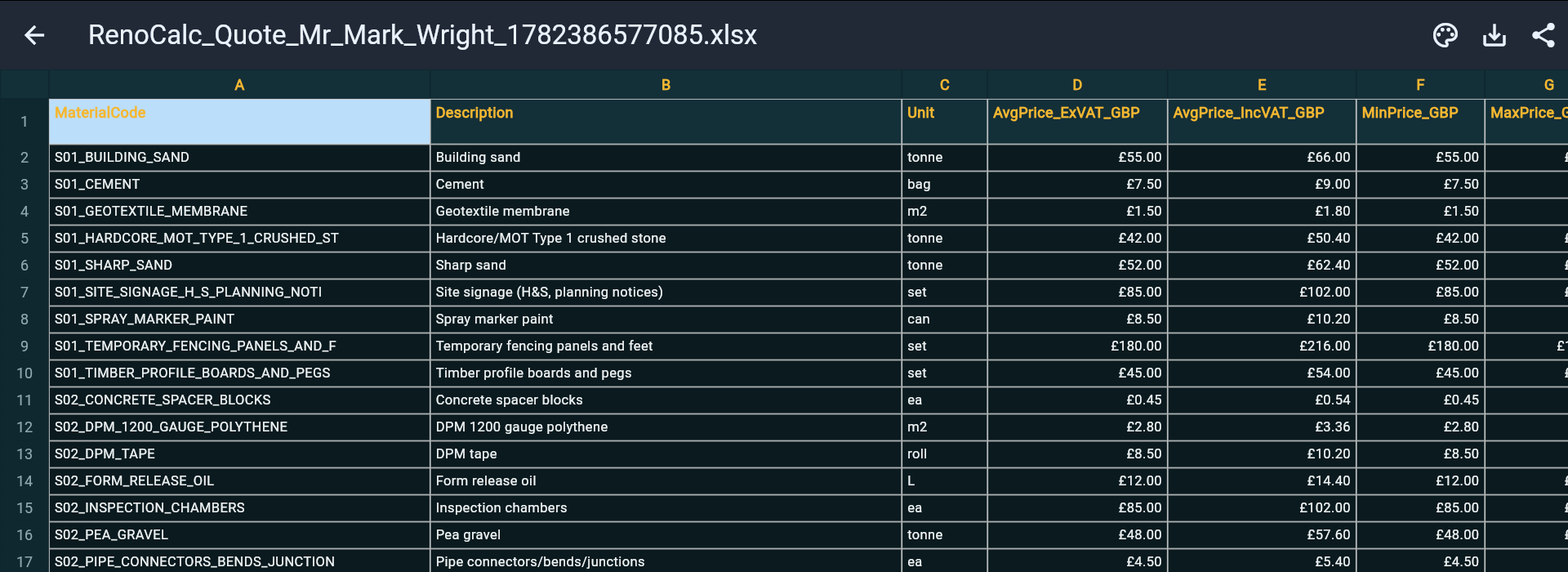
Use the cost tables in this guide to build your pre-tender budget, and allow properly for the London-specific costs: party wall surveyors, scaffolding licensing, conservation area planning fees. If you want to generate a working cost estimate before you speak to builders, try RenoCalc free — upload your floor plan and get a full loft conversion quote in minutes, calibrated to London trade rates.
Get a London Loft Conversion Estimate in Under 3 Minutes
RenoCalc turns your floor plan into a full loft conversion quote — structural work, roofing, stairs, insulation, electrics, plumbing and finish — calibrated to London trade rates. Built for UK builders and property investors.
Start Your Free Estimate