How to Compare Builder Quotes: A Homeowner's Guide to Not Getting It Wrong
You have invited three builders to quote for your renovation. The quotes come back: £24,000, £31,000 and £38,500. The obvious move is to go with £24,000. That move is wrong — or at least, it's wrong unless you first confirm that all three builders are quoting for exactly the same job.
In 32 years of construction I have seen homeowners make this mistake repeatedly. The cheapest quote wins the job. Three months later the project is over budget, behind schedule and the homeowner is dealing with a builder who is adding variations that were never priced. The cheap quote was cheap because it didn't include everything.
This guide is for the client side — homeowners and property investors receiving multiple builder quotes. It covers what to actually compare, what red flags to look for in a suspiciously cheap quote, and how to get an independent estimate so you know what the job should cost before you go to tender.
The First Problem: Are They Quoting the Same Thing?
Before you compare any numbers, the most important question is whether each builder has priced for the same scope of work. This is not as simple as it sounds.
Builder A visits your property and interprets the job as: structural opening, kitchen removal, new kitchen supply and fit, plastering, electrics, new flooring throughout. Builder B visits the same property and prices: structural opening, new kitchen supply and fit, touch-up plastering. Builder C prices: structural opening, kitchen installation only — client to supply kitchen and flooring.
All three have priced "the kitchen renovation". All three prices are useless for comparison because they have priced different things.
The only way to get genuinely comparable quotes is to provide every builder with the same written brief — a detailed scope of works describing exactly what is included, the materials specification, and what the client is supplying versus the builder. Without that brief, you are comparing apples with oranges and the numbers mean nothing.
For a guide to what a professional builder's quote should include, see our guide to how a building quote is written and a UK building quote example.
What to Actually Compare
When you have received quotes from multiple builders, work through each of the following systematically. Create a simple comparison sheet with each builder's response against each criterion.
1. Scope of work
Read each quote carefully and list exactly what each builder says they will do. Look for differences — elements one builder includes that another doesn't mention. Where there are differences, go back and ask: "Your quote doesn't mention [element X] — is that included or excluded?" Never assume inclusion; always confirm in writing.
2. Exclusions
A professional quote should explicitly list what is not included. Common exclusions: groundworks, structural engineer's calculations, planning fees, Building Control fees, specialist trades (waterproofing, asbestos removal, structural steelwork), decoration, floor finishes, sanitaryware supply. If a quote has no exclusions listed, ask the builder to provide a written list — every job has exclusions, and if they are not stated, disputes follow.
3. Materials specification
Is each builder pricing for the same quality of materials? A quote for "new bathroom" could be pricing a £300 suite or a £2,000 suite. If the client is supplying materials, is that reflected consistently across all quotes? For like-for-like comparison, either specify the exact materials (brand, model, grade) or ask builders to quote to a stated specification level (budget, mid-range, premium).
4. Programme and timeline
When does each builder propose to start, and how long will the job take? A builder who can start immediately may be less busy for a reason. A realistic programme matters — an underestimated timeline means disruption extending well beyond what was anticipated. Ask for a written programme showing trade sequence and key milestones, not just a "six to eight weeks" estimate.
5. Payment terms
How does each builder want to be paid? The standard approach for renovation work is stage payments tied to completion milestones — for example: 10% on mobilisation, 30% on completion of structural work, 30% on completion of first fix, 20% on practical completion, 10% retention after defects period. A builder who demands 30–50% upfront before any work has started is a significant risk. Payment in advance removes your leverage entirely if problems arise.
6. Insurance and qualifications
Every builder working on your property should carry public liability insurance — minimum £2 million cover is standard; £5 million or more is better for larger projects. Ask to see the insurance certificate, not just a claim that they have it. For specific trades: Gas Safe registration (gas engineers), NICEIC or NAPIT registration (electricians), and any relevant trade body membership. These are not box-ticking exercises — they directly affect whether the work will be inspected and signed off correctly.
| Criterion | What to Check | Questions to Ask |
|---|---|---|
| Scope | Is every required element listed and priced? | "Is [missing element] included or excluded?" |
| Exclusions | What is explicitly not included? | "Please confirm your exclusions in writing." |
| Materials spec | Are all builders pricing the same quality? | "What brand/grade of [material] are you pricing?" |
| Programme | Start date; duration; trade sequence | "Can you provide a written programme?" |
| Payment terms | Stage payments vs large upfront deposit | "What are your payment milestones?" |
| Insurance | Public liability certificate — valid and sufficient cover | "Can I see your current PL insurance certificate?" |
| VAT | Is VAT shown? Should it be? | "Are you VAT registered?" |
Red Flags in a Cheap Quote
A significantly cheaper quote is not automatically a better deal. Here are the warning signs that a low price reflects something missing rather than genuine efficiency.
No VAT when there should be
Any builder with annual turnover above the VAT registration threshold (£90,000 in 2026) must be VAT registered and must charge VAT on their services. A builder doing significant renovation work who is not VAT registered either has a very low turnover (raising questions about their experience level) or is operating without VAT registration they should have. If a quote shows no VAT and the builder is clearly doing enough volume to be registered, ask the question directly.
No insurance mentioned
If a quote makes no reference to insurance and the builder cannot produce a current public liability certificate when asked, do not appoint them. If something goes wrong — a burst pipe, structural damage, an injury on site — you need to know there is insurance in place. No certificate means no protection.
No programme or schedule
A builder who cannot give you a realistic programme for the work either hasn't thought the job through properly, or knows the timeline is likely to slip and would rather not commit to paper. Either is a problem.
Vague scope with no breakdown
A single-line quote ("complete renovation — £24,000") tells you nothing about what is and isn't included. Variations will follow for everything that wasn't explicitly agreed. The cost of a vague quote is usually paid in disputes and overspend during the job, not upfront.
Large upfront deposit requirement
A request for more than 10–15% of the total contract value upfront is a warning sign. Reputable builders with established supplier relationships do not need large sums of client money before work starts — they have trade accounts and credit terms. A large upfront requirement may indicate cash flow problems, limited trade credit, or worse.
How to Ask for a Like-for-Like Comparison
The most effective approach is to prepare a written scope of works before you invite any builders to quote — a document that describes exactly what you want done, to what specification, with what materials (or a stated materials standard), and what you as the client are responsible for supplying. Every builder quotes against the same document, so you can compare prices directly.
If you have received quotes that are difficult to compare, go back to each builder with a standardised list of questions:
- Is [specific element] included in your quote?
- What materials are you pricing for [specific element]?
- What is excluded from your price?
- Are there any provisional sums or allowances in your price that might change?
- Does your price include VAT?
Get answers in writing — email is fine. Verbal assurances during a site visit are not useful when a dispute arises later. Having a clear paper trail of what was agreed at quote stage protects both parties.
Once you have confirmed that you are comparing like-for-like, the price difference between builders becomes meaningful. At that point, a 15–20% variation in price for genuinely comparable scope and materials is worth investigating — but it may simply reflect different overhead structures, different labour rates or different margin expectations, all of which are legitimate.
Getting an Independent Estimate First
The most powerful position to be in when inviting builders to quote is knowing what the job should cost before any quote arrives. That knowledge protects you in two ways: you immediately recognise quotes that are significantly underpriced (missing scope) and quotes that are significantly overpriced (excessive margin or misunderstanding of the brief).
Traditionally, getting an independent estimate meant commissioning a quantity surveyor — a formal process that costs £500–£2,000+ and takes several weeks. For most residential renovation projects, that cost and time are not justified.
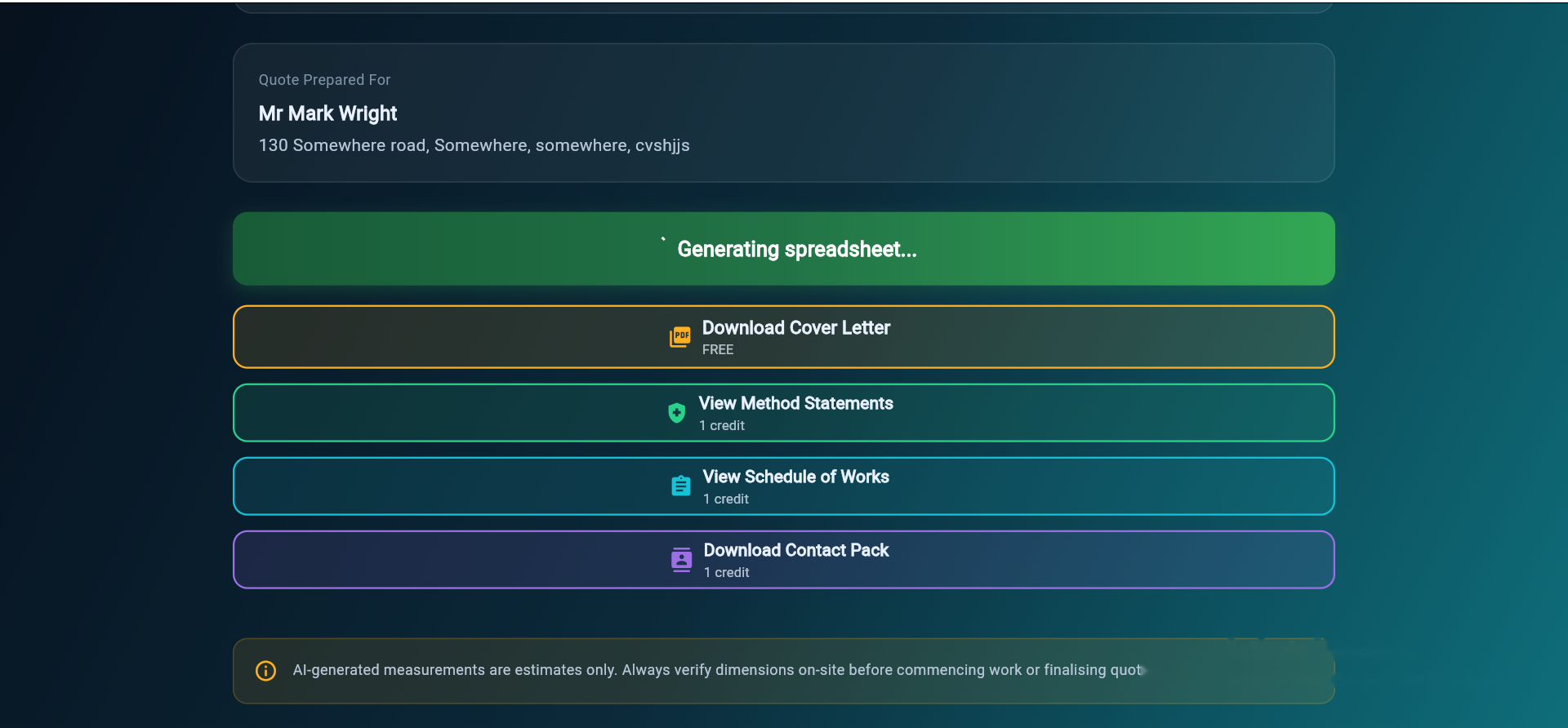
RenoCalc provides an AI-generated estimate from your floor plan: upload your drawings, the AI measures room dimensions automatically, and you receive a full cost breakdown covering materials and labour across all trades within minutes. This is not a substitute for a professional QS on a complex commercial project, but for residential renovation work — a loft conversion, a full refurbishment, a house extension — it gives you a credible independent reference point at a fraction of the cost and time.
You can also use the RenoCalc estimate to understand what the job should cost per square metre and compare that against our guide to house renovation cost per m2 UK.
How RenoCalc Generates an Independent Estimate
Upload a floor plan, the AI scans room dimensions, and you receive a full breakdown of what the renovation should cost — no builder required at this stage. Useful for due diligence, for benchmarking quotes, or for understanding the scope of a property before purchase.
Frequently Asked Questions
Why are builder quotes so different from each other?
Builder quotes vary because they often price different things. One builder may include plastering; another may not. One may include all materials; another may be pricing labour only. One may be using trade-quality materials; another may be pricing to the budget end of the market. Before you compare the bottom-line numbers, you need to establish that every builder is quoting for exactly the same scope, the same materials specification, and the same exclusions. Without that, comparing prices directly is meaningless.
What should a proper builder's quote include?
A proper builder's quote should include: a detailed description of all work to be carried out, any items explicitly excluded, the materials specification, the proposed start date and programme duration, a payment schedule tied to stages of completion, VAT (if the builder is VAT registered), the builder's company name and registration details, public liability insurance details, and any warranty terms. If a quote is a single line saying "complete renovation works — £28,000", it tells you nothing useful.
Should I always choose the cheapest builder quote?
No. The cheapest quote often reflects a narrower scope, lower-quality materials, missing trade elements, or a builder who has underpriced the job and will manage cash flow through variation orders. The right question is not "which is cheapest?" but "which is best value for the same scope?" That requires genuine like-for-like comparison. If one quote is genuinely lower for the same scope and materials specification, understand where the saving comes from — it can be legitimate, but it must be explained.
What are the red flags in a cheap builder quote?
Key red flags: no VAT shown when the builder should be VAT registered (turnover above £90,000 threshold); no insurance details; no schedule or programme; vague scope with no breakdown; payment terms that demand a large upfront deposit; no company registration details; no exclusions listed. A suspiciously cheap quote is often cheap because the builder has not priced for something that will inevitably need doing — and will charge for it as a variation once work is underway.
How can I get an independent estimate to check builder quotes against?
RenoCalc provides an AI-generated estimate from your floor plan — upload your drawings and receive a full cost breakdown covering all trades within minutes. This gives you an independent benchmark before you receive builder quotes, so you understand what a job should broadly cost and can identify when a quote is significantly below or above that range. It is not a substitute for a professional quantity surveyor on large projects, but for residential renovation work it provides a credible reference point at a fraction of the cost.
Know What a Job Should Cost Before You Ask a Builder
The most common mistake homeowners make when appointing a builder is not having an independent view of what the job should cost before any quote arrives. Without that reference point, you have no basis to evaluate whether the quotes you receive are reasonable, overpriced or dangerously underpriced.
Use the checklist in this guide to evaluate every quote you receive. Confirm scope, exclusions, materials, programme, payment terms and insurance before you compare any numbers. And use RenoCalc's AI floor plan estimate to establish an independent baseline before you go to tender — it takes minutes and costs a fraction of a formal QS report.
Get an Independent Renovation Estimate From Your Floor Plan
Upload your floor plan and RenoCalc's AI returns a full cost breakdown in under 3 minutes — materials and labour across all trades, before you invite a single builder to quote.
Get Your Free Estimate