Best Takeoff Software UK 2026: From Manual Spreadsheets to AI Floor Plans
Before any construction project can be priced, the quantities need to come from somewhere. That process — measuring materials, areas, lengths and volumes from drawings or site visits — is called a quantity takeoff. It is the step that almost every builder underestimates in terms of time, and the step where most estimating errors originate.
In 2026 there are three fundamentally different ways to do a takeoff: manually with a scale rule and spreadsheet, digitally with click-to-measure PDF software, or automatically using AI that reads a floor plan and handles the measurement itself. Each approach suits a different type of builder and a different type of work.
I have spent 32 years in construction. I know how long a manual takeoff takes — and I built RenoCalc because renovation builders need a better answer to this problem. This guide explains each approach honestly, including where traditional digital takeoff tools genuinely win over AI, and where they don't.
What Is a Quantity Takeoff?
A quantity takeoff — sometimes called a material takeoff or QTO — is the process of extracting measurable quantities from a set of drawings or site survey. Before you can price any construction work, you need to know:
- How many square metres of flooring, wall tiles or plasterboard
- How many linear metres of skirting board, coving or structural steel
- How many cubic metres of concrete or screeded floor
- How many individual items — doors, windows, radiators, socket outlets
- What trade labour each element requires and in what quantities
Getting the takeoff wrong — missing an element, measuring incorrectly, or applying the wrong area calculation method — directly causes you to under-price or over-price the job. For renovation work, where scope changes frequently and floor plans are often approximate, the speed and accuracy of the takeoff process matters enormously.
The traditional approach is to sit with a scale rule, printed drawings and a spreadsheet and measure everything by hand. A full renovation takeoff done manually takes an experienced estimator anywhere from four hours to two full working days. This is time that most renovation builders either don't have, or spend before they have won the job.
Category 1: Manual / Spreadsheet Takeoff
The scale rule and spreadsheet approach is still by far the most common method used by UK renovation builders — not because it's the best, but because it requires no software, no subscription and no learning curve. You scale off dimensions from drawings (or measure on site), enter them into Excel, build your own formulas and produce a priced schedule.
The case for it
- No cost — Excel or Google Sheets is free
- Completely customisable to your own method
- Works for any type of project and any type of drawing
- Many experienced estimators are faster with their own spreadsheet than learning new software
The honest problems
- Extremely time-consuming — a full renovation takeoff takes four to eight hours minimum
- Measurement errors compound: a wrong room dimension affects flooring, skirting, plasterboard and paint at the same time
- No material price library — you maintain your own rates and they go out of date
- Output is only as professional as your spreadsheet template
- Each job is effectively a blank sheet — there is no institutional knowledge built into the tool
Manual takeoff is a legitimate starting point, particularly for sole traders in the early stages of building their business. But as soon as your quote volume increases, or the jobs get more complex, the time cost of manual takeoff becomes a significant constraint on how many jobs you can tender.
Category 2: Digital Takeoff Software
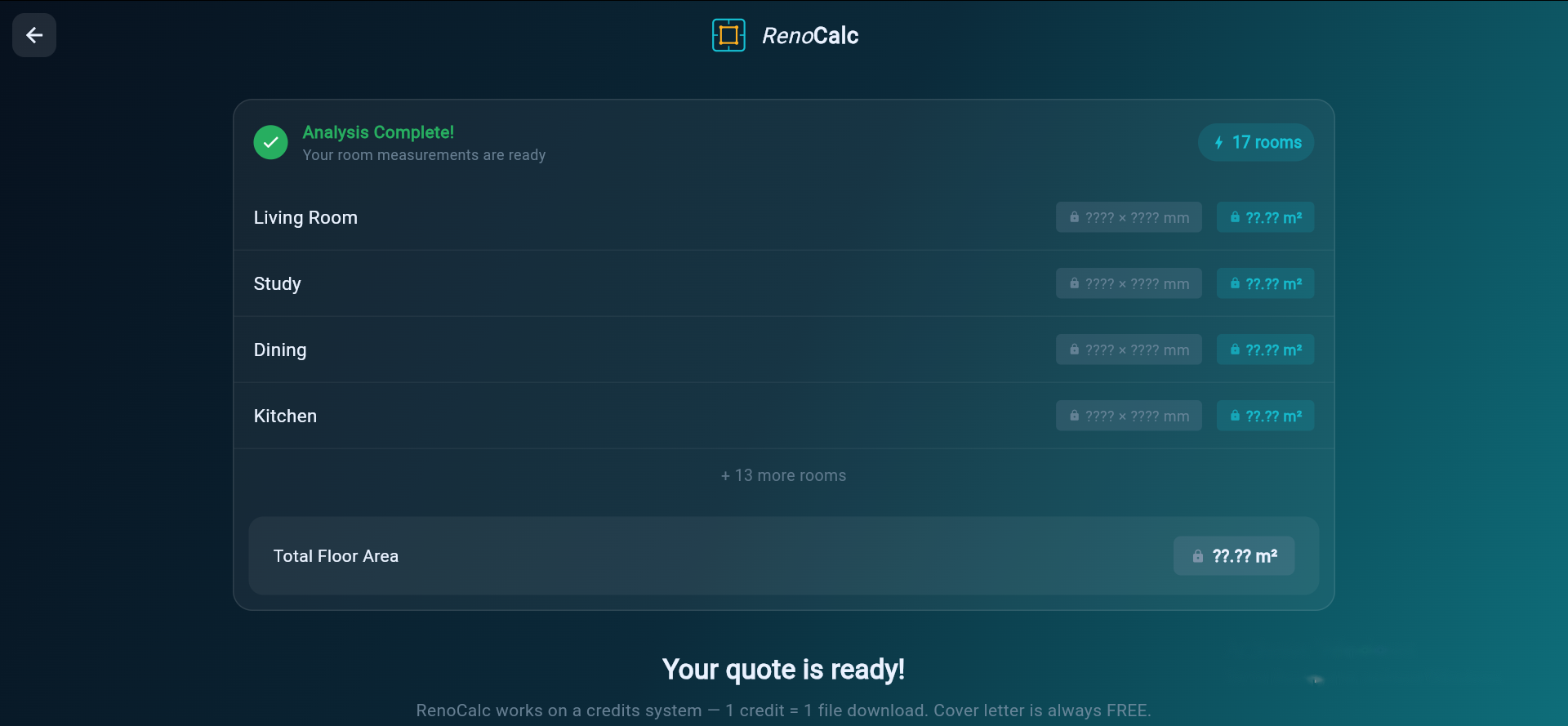
Digital takeoff tools allow an estimator to measure quantities directly from a PDF or CAD drawing on screen, using click-to-measure tools rather than a physical scale rule. The software handles the scaling and unit conversion — you click along a wall, around a room perimeter, or across a floor area, and the tool returns the measurement in your chosen unit.
The two most widely used digital takeoff platforms in the UK commercial construction market are PlanSwift and Bluebeam Revu.
PlanSwift
PlanSwift is a dedicated quantity takeoff tool with strong integration into estimating workflows. It handles linear, area and count takeoffs from PDF drawings, and can link measured quantities directly to a pricing database. Widely used by commercial estimators and quantity surveyors. The interface is powerful but requires investment in learning and setup.
PlanSwift is mid-market in price and is genuinely useful for estimators handling multiple commercial projects with detailed drawing sets. For a sole-trader renovation builder quoting jobs from a sketch plan, it represents significant overkill and cost.
Bluebeam Revu
Bluebeam Revu is primarily a PDF markup and collaboration tool used widely across the UK construction industry for drawing review, RFIs and document management. It includes a measurement tool for takeoff but this is secondary to its core document management function. Many commercial contractors use Bluebeam for drawing review and a separate dedicated estimating platform for pricing.
Bluebeam is excellent for what it does — collaborative PDF review at scale. For a builder who primarily needs to do quantities from a floor plan quickly, it is both more expensive and less focused than necessary.
The honest case for digital takeoff tools
If you are a commercial estimator handling multiple concurrent bids, with detailed architectural and structural drawings, and a team of people reviewing those drawings collaboratively — digital takeoff tools are the right category for you. The click-to-measure workflow on a calibrated PDF is significantly faster and more accurate than a physical scale rule on printed drawings. The investment in learning and subscription is justified by volume and project complexity.
If you are a renovation builder quoting from a client's floor plan or architect's sketch, this category is more tool than you need — and none of it eliminates the time you spend measuring.
Category 3: AI-Automated Takeoff (RenoCalc)
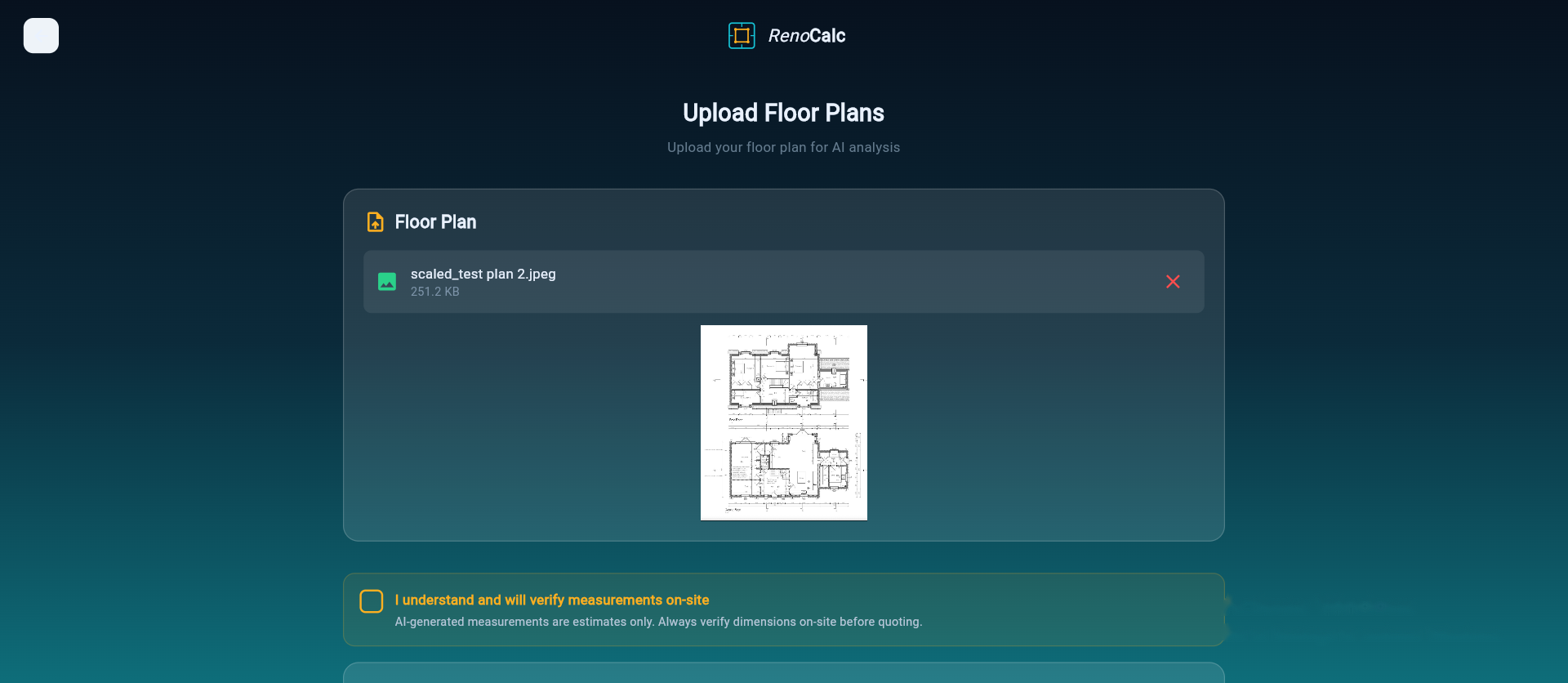
The third category — and the newest — is AI-automated takeoff. Rather than a human measuring from drawings (either manually or with click-to-measure tools), the AI reads the drawing itself, detects room boundaries, measures dimensions and uses those measurements to drive the estimate.
RenoCalc is the only tool in the UK renovation market that operates this way. The process:
- Upload a floor plan — professional PDF, architect's drawing or a photograph of a hand-drawn sketch
- The AI scans the image, identifies rooms and their dimensions automatically
- The AI applies material and labour quantities across all relevant trades based on the measured areas, perimeters and volumes
- Within approximately three minutes, you receive the full quote pack: the RenoCalc Spreadsheet (40,000+ pricing formulas), a cover letter, a project schedule, method statements for 12 trades, and a contract pack
This is not a digital version of manual takeoff. The measurement step itself is automated — you do not click around rooms or draw lines. The AI handles measurement; you review the result.
Where AI takeoff works best
AI floor plan reading is most effective for renovation and refurbishment work — residential and light commercial projects where the scope is defined by room-level measurements. Loft conversions, extensions, full refurbishments, HMO conversions, bathroom and kitchen fits, and similar scope all produce accurate results because the floor plan contains the information the AI needs.
For complex commercial new-build with highly detailed drawings, annotated specifications and multi-discipline coordination, human-guided takeoff on detailed drawings still has a place. But for the renovation builder producing four to ten quotes per month, AI takeoff eliminates what is typically their biggest time bottleneck.
Comparison Table: The Three Takeoff Approaches
| Approach | Time per Job | Accuracy Risk | Cost | Best For | Limitations |
|---|---|---|---|---|---|
| Manual (Excel + scale rule) | 4–16 hours | High — human measurement error | Free | Sole traders starting out; simple repeat jobs | Very slow; no price library; no professional output |
| Digital takeoff (PlanSwift, Bluebeam) | 2–6 hours | Medium — calibration dependent | £50–200+/mo | Commercial estimators; large multi-discipline bids | Requires detailed drawings; significant learning curve; still manual |
| AI-automated (RenoCalc) | ~3 minutes | Low — AI-measured from floor plan | Free / £9.99 per quote / from £19.99/mo | Renovation builders; property developers; one-man-bands | Best suited to renovation scope; not for complex commercial new-build QS |
Who Needs What
High-volume commercial estimators
If you are tendering multiple concurrent commercial bids from detailed architectural drawings — structural, MEP, architectural all in one package — digital takeoff tools are the right choice. PlanSwift or Bluebeam for measurement, linked to a dedicated estimating platform like EstimatorXpress for pricing. The investment in software, learning and subscription is justified by the volume and value of bids you are handling.
Renovation-focused builders
If your work is renovation and refurbishment — loft conversions, extensions, full refurbishments, HMO conversions — and your jobs come from floor plans or architect's drawings, RenoCalc is the correct tool. The AI handles measurement, the 40,000+ formula spreadsheet handles pricing, and the full document pack handles the professional output. For lower volumes, pay-per-use at £9.99 per quote is often cheaper than any monthly subscription.
See our broader guide to quoting software for UK builders for how the full document pack fits into your client-facing workflow.
One-man-bands and sole traders
Start with RenoCalc. The floor plan AI handles the measurement, the pricing library handles the rates, and you get a professional document pack to present. You do not need to invest months learning digital takeoff software when an AI can handle the measurement step in minutes. As your business grows and your work moves towards larger commercial projects, you can add digital takeoff capability at that point.
Property investors and developers
You are on the other side of the quote — you want to know what a renovation should cost before you appoint a builder, so you can verify the quotes you receive. Upload your floor plan to RenoCalc and get an independent AI-generated estimate for the full scope of work. Useful for due diligence before purchase or before going to tender. See also our guide to how a material takeoff works so you understand what any quote should include.
See AI Takeoff in Action
The fastest way to understand what AI-automated takeoff actually looks like is to watch it happen. Upload a floor plan, watch the AI scan and measure, receive the full quote pack within minutes.
Frequently Asked Questions
What is a quantity takeoff in construction?
A quantity takeoff (QTO) is the process of measuring and listing all the materials, labour and components needed to complete a construction project, taken directly from drawings or specifications. It is the foundational step in producing an accurate cost estimate — before you can price a job, you need to know how much of everything is required. Takeoff can be done manually with a scale rule and paper drawings, digitally using click-to-measure software on PDFs, or automatically using AI that reads a floor plan and measures rooms without human input.
What is the best takeoff software for UK builders?
For renovation and refurbishment builders, RenoCalc is the most efficient option — it reads a floor plan automatically using AI and eliminates the manual measurement step entirely. For commercial estimators handling large projects with detailed drawings, digital takeoff tools like PlanSwift or Bluebeam Revu provide click-to-measure capability on PDFs and CAD files. For sole traders and small firms just starting out, a well-structured Excel spreadsheet with a scale rule is still a valid approach — slow, but no software cost and no learning curve.
How long does a manual takeoff take?
A manual quantity takeoff for a standard three-bedroom renovation using a scale rule and spreadsheet takes an experienced estimator four to eight hours at minimum. For a full refurbishment with multiple trades, it can take one to two full working days. Digital takeoff tools reduce this by roughly 50–70% through click-to-measure on PDFs. RenoCalc's AI floor plan reading reduces the measurement step to minutes, with the full quote pack generated in approximately three minutes from upload.
Can AI do a construction takeoff automatically?
Yes, for renovation and refurbishment work. RenoCalc's AI reads a floor plan — whether a professional PDF, an architect's drawing, or a photograph of a hand-drawn sketch — detects rooms, measures dimensions automatically and uses those measurements to generate a full materials and labour estimate across all trades. This is not a digital version of manual takeoff; the AI performs the measurement itself. For complex commercial drawings with detailed annotations and specifications, traditional digital takeoff tools with human-guided measurement remain more appropriate.
Is digital takeoff software worth it for small builders?
For small renovation builders, traditional digital takeoff tools like PlanSwift or Bluebeam typically represent an unnecessary cost and learning curve. They are designed for commercial estimators handling detailed CAD drawings on large projects. For renovation work, RenoCalc's AI approach — which eliminates the measurement step entirely from a floor plan — is both faster and more cost-effective, especially with pay-per-use pricing from £9.99 per quote. Start with RenoCalc and add more complex tools only if your work genuinely requires detailed commercial takeoff capability.
The Right Takeoff Tool for Your Work
The takeoff problem is not the same for every builder. A commercial estimator tendering a £2m office fit-out from a 50-sheet drawing package needs something very different from a renovation builder quoting a loft conversion from an architect's sketch.
The honest answer: for renovation and refurbishment work, AI-automated takeoff from a floor plan is the best approach available in 2026. It eliminates the most time-consuming step in the quoting process and delivers a professional output without the investment in learning complex digital takeoff tools.
If you want to understand more about how the full estimating process works once the takeoff is complete, the builder quoting software comparison covers the full picture from takeoff to document pack.
Try RenoCalc Free — AI Takeoff From Your Floor Plan
Upload any floor plan — PDF, photo or sketch. The AI measures rooms automatically and returns a full renovation quote pack in under 3 minutes. Pay per quote or subscribe monthly.
Start Your Free Estimate