Building Quote Example UK: A Full Worked Sample Annotated by a 32-Year Builder
Quick Answer
A UK building quote example should show a complete, itemised cost breakdown including: trade-by-trade scope, materials with quantities, labour hours and rates, preliminaries, contingency (typically 5–10%), VAT position, and payment schedule. This page walks through a real kitchen extension quote — 4m x 5m, Midlands, approximately £45,000–£65,000 total — section by section.
You can read ten articles about what a building quote should contain and still not know what one actually looks like. So this guide takes a different approach — here is a full, worked UK building quote for a kitchen extension, section by section, with my commentary on what each part is doing and what a weak quote gets wrong in that same section.
The project is a single-storey kitchen extension on a 1960s semi-detached, rear of house, approximately 4m x 5m footprint, flat roof with a fully glazed bi-fold door. Total build cost falls in the £45,000–£65,000 range — a realistic mid-spec figure for the Midlands in 2026. This is exactly the type of quote that RenoCalc generates from your floor plan.
Work through each section. By the end, you will know what a professional quote looks like, where the weak quotes fall short, and what your clients are comparing when they receive three prices and have to choose.
Quote Header and Reference
Quote Reference: MB-2026-083
Date Issued: 20 June 2026
Valid Until: 20 August 2026 (60 days)
Prepared by: Meridian Building Co Ltd — 18 Canal Street, Wolverhampton, WV1 4AQ
Company No.: 08844511 | VAT No.: 234 1987 45
PL Insurance: £5,000,000 | Policy No.: AXA/PL/887342
Pindi's note: The quote reference matters more than most builders think. It lets you track every quote you send, tie it to a client record, and discuss it specifically — "I am calling about quote MB-2026-083" rather than "I sent you a price a few weeks ago." The valid-until date tells the client that your price is based on current material and labour costs and will not hold indefinitely. Sixty days is reasonable for a project of this size. Anything longer than 90 days is risky given how quickly materials costs move.
Client and Site Details
Client: Mr Thomas & Ms Alicia Brennan
Client Address: 7 Birchwood Close, Walsall, WS3 2DT
Site Address: As above
Contact: Thomas Brennan — 07890 123456
Site Visit Date: 13 June 2026
Architect/Designer: Patel Design, drawing ref PD-BR-07/06/26
Project Type: Single-storey rear kitchen extension
Pindi's note: Including the site visit date and the architect's drawing reference is not bureaucratic padding — it is protective. If the client comes back three months later saying "your price was based on a different layout," you can show them exactly which drawings you priced from and when you visited. I have seen disputes avoided simply because the builder had this information clearly in the quote. Also: confirming the site address separately from the client address matters on larger jobs where the client lives elsewhere — and it makes the quote searchable by address.
Scope of Works — Itemised by Trade
The itemised scope of works is the heart of the quote. Every section below lists the work included and the price for that trade element. Vague descriptions are not acceptable — each item should be specific enough that the client and builder would both interpret it the same way on site.
| Trade / Item | Description | Labour | Materials | Total |
|---|---|---|---|---|
| Groundworks & Foundations | ||||
| Strip foundations | Excavate and pour strip foundations to Building Control spec (min 600mm wide x 1200mm deep subject to soil conditions) | £1,800 | £1,200 | £3,000 |
| Floor slab | 100mm insulated concrete slab including DPM, 75mm PIR insulation, mesh reinforcement and 100mm concrete | £950 | £1,050 | £2,000 |
| Structure — Walls | ||||
| External cavity walls | Brick outer skin / block inner skin with 100mm PIR cavity insulation — full extension perimeter (approx 18 lineal m) | £3,200 | £4,800 | £8,000 |
| Structural steelwork | Supply and install 2no. RSJ beams to rear wall opening — steel sizes per structural engineer's calcs | £800 | £2,200 | £3,000 |
| Opening formed in existing rear wall | Break out existing brickwork, install padstones, insert RSJs with temporary propping — make good | £1,200 | £300 | £1,500 |
| Roof | ||||
| Flat roof structure | 200mm timber joists at 400mm centres — full extension footprint (approx 20m²) | £900 | £1,100 | £2,000 |
| Flat roof insulation | 150mm PIR insulation boards above structure + 18mm OSB deck — warm roof build-up | £600 | £1,400 | £2,000 |
| GRP flat roof covering | Full GRP fibreglass roof system with upstands and drip trims — 25-year manufacturer guarantee | £1,200 | £1,800 | £3,000 |
| Glazing & Doors | ||||
| Bi-fold door system | Supply and install 3-panel aluminium bi-fold door, thermally broken frame, low-E double glazing — 2700mm wide x 2100mm high | £600 | £4,900 | £5,500 |
| Roof lantern (if applicable) | Provisional sum — client to confirm selection | — | — | £2,500 PS |
| First Fix — Electrics | ||||
| Electrical first fix | All wiring for lighting, double sockets, extract, underfloor heating thermostat and TV point — by qualified electrician, Part P notified | £850 | £650 | £1,500 |
| Plumbing | ||||
| Plumbing connections | Hot and cold connections to new kitchen position, waste run to existing drain — first and second fix (fixtures excluded) | £800 | £500 | £1,300 |
| Underfloor heating — electric | Electric UFH mat supply and install under tile area (approx 12m²) including thermostat and wiring | £350 | £650 | £1,000 |
| Internal Finishing | ||||
| Plasterboard and skim | Dot-and-dab plasterboard to all new internal walls and ceiling — full skim coat finish | £1,400 | £1,100 | £2,500 |
| Electrical second fix | Fit light fittings, sockets, switches, extractor — all fixtures by client unless agreed otherwise | £550 | £250 | £800 |
| Tiling to floor | Large format porcelain tile supply and lay — 600x600mm (approx 20m²) including grout and adhesive | £800 | £1,200 | £2,000 |
| Decoration | Two coats emulsion to all walls and ceiling, gloss to skirting and architraves — client to select colours | £700 | £300 | £1,000 |
Pindi's note: This level of detail is what separates a professional quote from a one-page price. Every row tells the client exactly what they are getting. When a client is comparing three prices, the builder who itemised every line is the one the client trusts — even if they are not the cheapest. The provisional sum on the roof lantern is honest: if the client has not chosen one yet, a PS is correct. Never guess a number for something you have not priced properly and label it included.
Materials List with Quantities
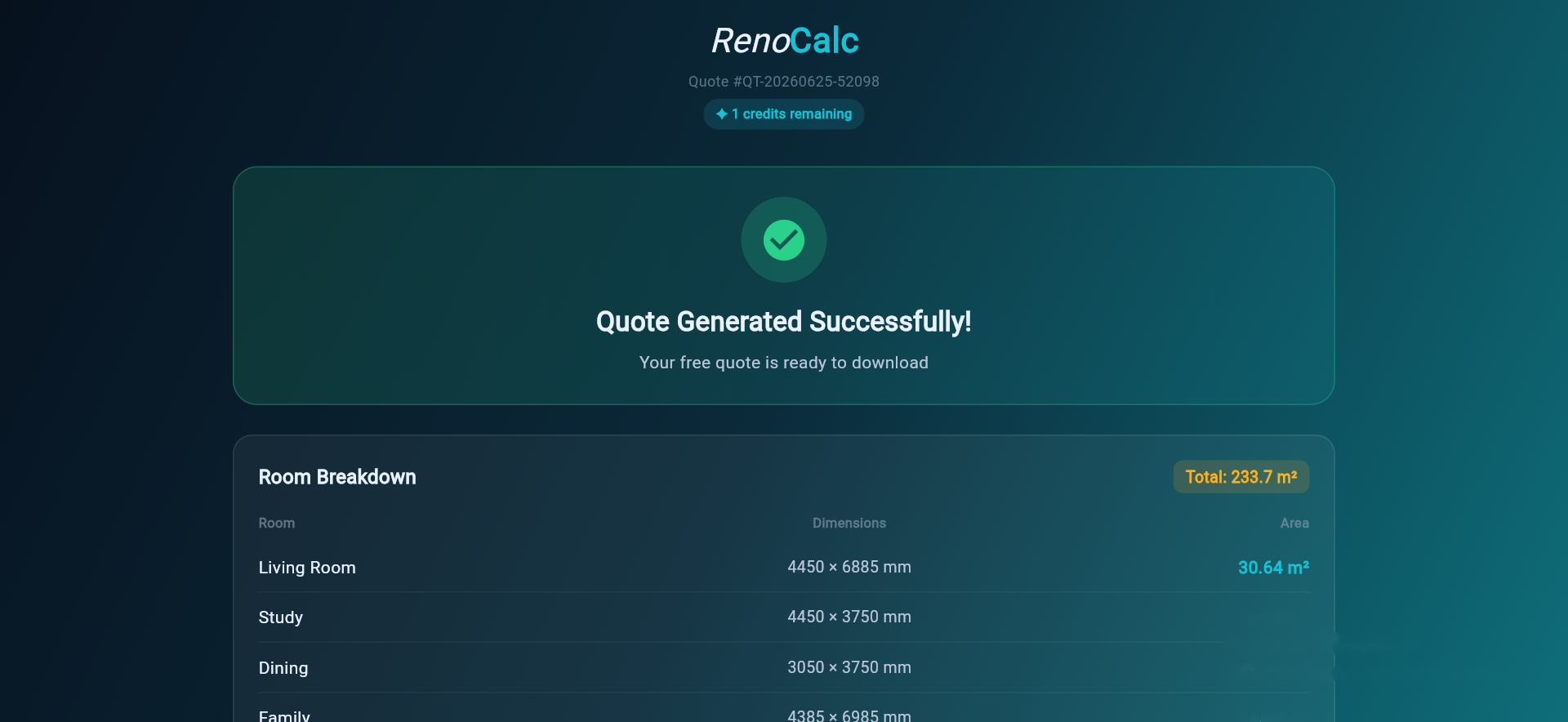
Some quote packs include a separate materials schedule alongside the trade itemisation. This is particularly useful on larger or more complex jobs, and it is what RenoCalc produces in the materials section of the RenoCalc Spreadsheet. For this extension, the key material quantities are as follows:
| Material | Quantity | Unit | Rate | Cost |
|---|---|---|---|---|
| Facing bricks (to match existing) | 3,200 | No. | £0.65 | £2,080 |
| Concrete blocks (inner leaf) | 420 | No. | £1.80 | £756 |
| PIR cavity insulation (100mm) | 18 | m² | £22 | £396 |
| Flat roof PIR insulation (150mm) | 22 | m² | £48 | £1,056 |
| Ready-mix concrete (slab) | 2.2 | m³ | £145 | £319 |
| Porcelain floor tiles 600x600mm | 22 | m² | £42 | £924 |
Pindi's note: A materials schedule with quantities does two things. First, it proves you have taken off the job properly and are not guessing. Second, it gives the client visibility of what they are paying for materials versus labour — which helps them understand the breakdown rather than querying your day rates in isolation. This level of transparency builds trust and dramatically reduces the likelihood of disputes about the final account.
Labour Rates
Some builders prefer not to show labour rates separately, preferring a combined supply-and-fix price. Both approaches are acceptable — but showing the rates helps the client understand why your price is what it is, particularly if you are not the cheapest.
| Trade | Day Rate | Notes |
|---|---|---|
| Site manager / general foreman | £350/day | On site throughout |
| Bricklayer | £280/day | Includes labourer |
| Carpenter / joiner (first fix) | £300/day | |
| Electrician | £320/day | NICEIC registered |
| Plumber | £310/day | Gas Safe registered (if applicable) |
| Plasterer | £280/day | |
| Tiler | £260/day | |
| Decorator | £240/day |
Pindi's note: These are real Midlands rates for 2026. London and the South East typically run 25–35% higher on labour. Day rates on their own mean nothing without knowing how many days each trade is on site — which is why the itemised trade schedule above is the right place to put the numbers. The rates table is a reference document, not the quote itself.
Preliminaries
| Item | Cost |
|---|---|
| Scaffold — erect, hire (12 weeks) and dismantle | £1,800 |
| Skip hire — 2 no. 8-yard skips (groundworks + strip-out) | £600 |
| Building Control — Full Plans application and inspections | £900 |
| Structural engineer — calculations and drawings | £800 |
| Site insurance premium for duration of works | £350 |
| Temporary protection / dust sheets / site welfare | £250 |
| Preliminaries Total | £4,700 |
Pindi's note: Prelims are one of the sections most commonly hidden or undercharged in weak quotes. A builder who absorbs scaffold and Building Control into their overhead is not being generous — they are either underquoting (and will recover it via variations) or not pricing it at all (and will absorb the cost). Either outcome is bad for the builder. Show your prelims explicitly. The client should know that scaffold and Building Regulations are real costs — and seeing them listed reinforces that you are running a proper operation, not working out of a van without insurance.
Contingency (5%)
A contingency is not a guess or a padding line. It is an explicit allowance for unforeseen work that is statistically likely to arise on a project of this type, but which cannot be specifically priced without opening up the structure.
On this extension: sub-base conditions, the condition of existing drainage runs near the excavation, and the condition of the existing rear wall when opened up are all genuinely unknown at quote stage. The contingency covers those unknowns. Any portion not spent is returned or credited against the final account.
Contingency is calculated at 5% of direct works cost (trade items + materials), before prelims:
Direct works total: approximately £41,600 x 5% = £2,080 contingency
Pindi's note: Every builder who has been on site longer than six months has encountered something unexpected inside a wall or below ground. A contingency is not dishonest — it is professional. The builder who includes no contingency and then raises variations for unforeseen work looks like they are adding extras to inflate the bill. The builder who includes a named contingency and accounts for it transparently looks like they planned properly. Name the contingency. Explain what it covers. Account for it on the final account.
VAT and Total
Quote Summary — MB-2026-083
Pindi's note: VAT must be shown explicitly. A quote that says "£50,880 + VAT" and leaves the client to calculate it is not wrong — but a quote that shows the full VAT amount and the inclusive total removes any ambiguity. On a £50,000 job, the client needs to know that the total cost is over £61,000. That affects their budget planning. Show it clearly. And note: if you are not VAT-registered, state that explicitly — "VAT not applicable — not VAT registered" — so the client is not left wondering whether VAT is hidden somewhere.
What RenoCalc Generates from Your Floor Plan
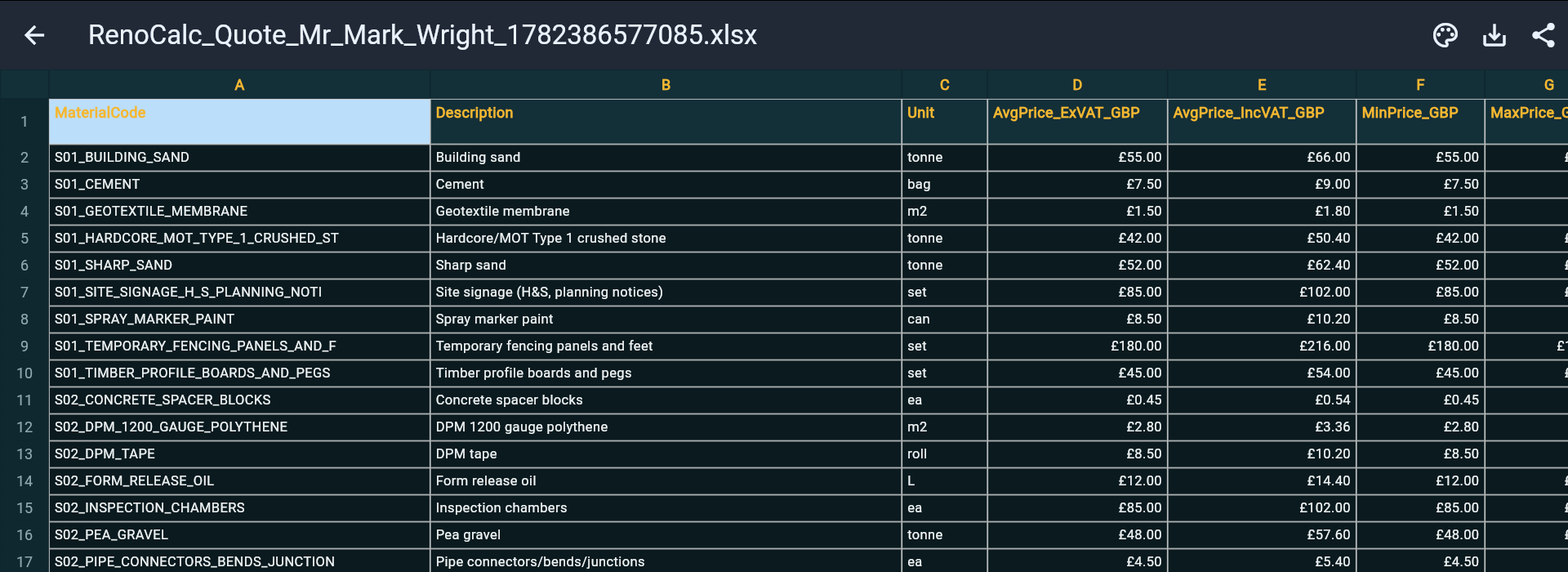
This worked example is exactly the type of output RenoCalc produces. Upload your floor plan — whether it is an architect's drawing, a hand-drawn sketch, or a planning document — and RenoCalc reads the rooms, dimensions and layout, then generates:
- The RenoCalc Spreadsheet with every trade itemised, labour and materials split, and a running total
- A cover letter, always free, formatted professionally and ready to send
- A full schedule of works broken down by trade and phase
- HSE method statements for the relevant work types
- A 12-page contract pack
The whole process takes under 3 minutes. You are not filling in a form — you upload the plan and the AI does the rest.
See It in Action
Generate a Quote Like This from Your Floor Plan
RenoCalc turns your floor plan into a full building quote — every trade itemised, materials listed, cover letter written. Start free, no card required.
Start Your Free QuoteFrequently Asked Questions
What should a UK building quote include?
A complete UK building quote should include: a header with quote reference, date and validity period; client and site details; a brief introductory paragraph; an itemised scope of works broken down by trade (groundworks, structure, steels, roofing, electrics, plumbing, plastering, finishing); a materials list with quantities; labour rates per trade; preliminaries such as skip hire, scaffold and site management; a contingency sum (typically 5%); VAT at the applicable rate; and the total. A cover letter should accompany the pack, and a schedule of works should provide the programme detail.
How much does a kitchen extension cost in the UK?
A single-storey kitchen extension in the UK typically costs £45,000 to £65,000 in 2026 for a mid-spec build, including groundworks, structure, steelwork, flat or tiled roof, bi-fold or glazed doors, electrics, plumbing connections, plastering, decoration and flooring. The range is wide because it depends heavily on the extension footprint, specification of glazing and finishes, whether a utility room or WC is included, and regional labour costs. London and the South East add 25–35% to these figures.
What is a contingency sum in a building quote?
A contingency sum is a percentage of the build cost — typically 5% — added to cover unforeseen costs that are likely to arise but cannot be specifically priced at the quote stage. Common examples include unexpected ground conditions during excavation, rotting timbers found when opening up walls, or unforeseen services runs. A professional builder includes the contingency transparently in the quote and accounts for any expenditure against it on the final account. If the contingency is not spent, it is returned to the client or applied against other costs.
Should a builder's quote include VAT?
A VAT-registered builder must show VAT on their quotes. The standard rate is 20% on most residential construction work. Some work qualifies for a reduced 5% rate — for example, conversion of a commercial building to residential, or certain works to properties empty for two or more years. New-build residential work is zero-rated. If a builder is not VAT-registered, they should say so explicitly in the quote so the client is not surprised. Never assume VAT is included if it is not stated.
How does RenoCalc generate a building quote?
RenoCalc generates a building quote by scanning your uploaded floor plan with AI, reading the rooms, dimensions and layout, and then producing a full quote pack covering every trade — from groundworks to finishing. The output includes the RenoCalc Spreadsheet with itemised costs, a professionally written cover letter (always free), a schedule of works, HSE method statements and a 12-page contract pack. The whole process takes under 3 minutes from uploading your floor plan.
What are preliminaries in a building quote?
Preliminaries (prelims) are the site management and overhead costs associated with running the project — as distinct from the direct trade costs. They include: scaffolding, skip hire, site management time, insurance for the works period, temporary facilities, welfare facilities, plant hire, and site security. Prelims are typically 8–15% of the direct trade costs on a residential project. They should be shown as a separate section in the quote so the client understands what they cover. Omitting prelims from a quote leads to underpricing and disputes.
Do I need to be VAT registered to quote for building work in the UK?
No — you only need to be VAT registered if your taxable turnover exceeds the registration threshold (£90,000 in 2026). Below this, you cannot charge VAT and should state this on your quotes. Above the threshold, VAT registration is compulsory and you must charge and account for VAT on your quotes and invoices. Some construction services qualify for a reduced 5% rate or zero rate — see HMRC's VAT construction industry guidance for full details.
How do I find a reputable builder to quote on my project?
The Federation of Master Builders offers a free Find a Builder tool that connects homeowners with vetted, insured member builders across the UK. FMB members are independently inspected and must meet standards for insurance and professional conduct. Getting quotes from at least three builders — including at least one FMB member — is the standard recommendation for projects above £5,000.
How long should a UK building quote be valid for?
A UK building quote should state a clear validity period — typically 30 to 60 days from the date of issue. After this period, material costs and labour availability may have changed, and you are entitled to revise the price. Quotes without a stated validity period create problems: clients sometimes present a quote months after it was issued and expect it to be honoured at the original price. Always include the validity date in the quote header. If a client returns after the validity period, re-price before confirming.