Construction Quote Proposal Template: Turn Your Quote Into a Job-Winner
Quick Answer
A construction quote proposal is the full client-facing document that sells the job, not just prices it. It includes: an executive summary of what you will do, company credentials and insurance details, a detailed scope of works, itemised costs, project timeline, and payment terms. Builders who send a proposal rather than just a quote number win significantly more jobs.
Most builders send a number. The best builders send a story.
After 32 years in the trade, the single most consistent observation I have about how builders win (and lose) jobs is this: the client does not always choose the lowest price. They choose the builder they trust most with their property, their money, and their time. A construction proposal — not just a quote — is how you build that trust before the job starts.
A quote tells the client what it costs. A proposal tells them who you are, what you will do, how you will manage the job, and what happens if anything changes. It is the document that closes the gap between receiving a price and signing a contract. This guide covers every section, what to put in each one, and how RenoCalc generates the core sections automatically so you are not building this document from scratch every time.
Quote vs Proposal: What's the Difference?
A quote is a price, valid for a period, attached to a scope. It answers the question: how much? A proposal answers a broader set of questions: who are you, what exactly will you do, when will you do it, how will you communicate during the works, and what are the rules if anything goes wrong?
In a competitive tender situation — where multiple builders are invited to quote — a proposal is the differentiator. If three builders quote similar prices but one has sent a seven-page proposal with a company profile, photos from the site visit, a week-by-week programme and a clear payment schedule, that builder has demonstrated competence, organisation and professionalism. The client is choosing between builders, not just between prices, and the proposal is the evidence base for that decision.
Even on smaller residential jobs, a proposal that goes beyond a price sheet changes the conversation. It signals that the builder takes the job seriously, has thought it through, and has systems in place. That signal is worth more than a slightly lower number to many clients — particularly those who have been burned by disorganised builders before.
Section 1: Executive Summary
The executive summary opens the proposal. It is two or three paragraphs — not a long section — and its purpose is to demonstrate that you understand the project. Write it in plain language. It should cover:
- What the project is — the scope in one sentence
- What the client's goal is — why they are doing this (more space, better kitchen, rental income, resale value)
- Your proposed approach in summary — key decisions or your recommended sequence
- The total price and proposed start date
Do not write the executive summary generically. Reference the actual site, the specific rooms, the specific challenges you identified on the survey visit. This section is where you show you were paying attention when you were there, and where you earn the right to have the rest of the proposal read carefully.
Section 2: Company Profile
The company profile section is where you prove you are the right builder for this job. It should include:
Experience and Track Record
State how long you have been trading, what types of work you specialise in, and where you have worked. If you have relevant experience — previous loft conversions if this is a loft conversion, previous extensions in a similar style — say so explicitly. Do not just say "over 30 years of experience." Say what that experience has been spent doing.
Accreditations and Membership
FMB (Federation of Master Builders), TrustMark, Checkatrade, Gas Safe, NICEIC, NAPIT — any relevant trade body membership should be listed. These matter because they signal that you are accountable to a body that can be contacted if things go wrong. Clients who have never been through a major build find this reassuring.
Insurance
State your public liability insurance level (typically £1m–£5m) and your employer's liability if you have employees or subcontractors working under your direction. Offer to provide a certificate on request. This is basic professional practice, but many builders never mention it — and clients notice the absence.
References
Include two or three references — ideally from similar projects — with contact details. Or link to your Checkatrade/Google profile if reviews are strong. References are the highest-value trust signal you can include, because they represent the testimony of previous clients rather than claims you make about yourself.
Section 3: Scope of Works
The scope of works is the most detailed section and the most important legal document in the proposal. It is the written description of what you are going to do — room by room, trade by trade — and it forms the basis of the contract. If something is in the scope, you do it at the quoted price. If it is not, it is a variation.
Write the scope in plain language — clients are not quantity surveyors. "Remove existing bathroom suite, level floor, board and tile walls to full height, supply and install new sanitaryware, retile floor, replumb to existing positions" is clear and complete. "Full bathroom renovation" is not.
Where possible, include photographs from the survey visit: the existing bathroom, the wall that needs to come out, the access hatch to the loft. Photos demonstrate understanding and they reduce ambiguity about what the existing conditions are — which protects the builder if the client later disputes what they knew at the time of signing.
Section 4: Itemised Costs
The cost section should break the total down by trade and — where the project spans multiple rooms — by room. Labour and materials should be listed separately so the client can see what they are paying for. Provisional sums should be named explicitly with a note on when and how they will be confirmed.
At the bottom of the cost section, include the VAT position (VAT-registered or not, and the applicable rate for this type of work), the quote validity period (typically 30 or 60 days), and a note about what triggers a variation instruction — specifically that any changes to the scope must be agreed in writing before additional work begins.
A clear, detailed cost section demonstrates that you understand what you have quoted. Clients who receive a single lump sum and nothing else have no way to assess whether the number is reasonable — and uncertainty breeds hesitation. An itemised cost section invites scrutiny and handles it by being thorough.
Section 5: Programme and Phasing
The programme section shows the client when things will happen. It does not need to be a Gantt chart — a simple week-by-week narrative is sufficient for most residential construction proposals. What it must include:
- Proposed start date (subject to acceptance by a named date)
- Key milestone dates — when the property will be watertight, when first fix is complete, when the client can return if they have vacated
- Estimated completion date with caveats for weather-dependent external works
- A note that Building Control inspection visits are outside the builder's control and may affect programme
If the project is being done in phases while the property is occupied, the programme section should show which areas will be affected and when, and what access to utilities will be maintained throughout. This is the section that manages daily-life expectations — and for residential clients, it is often the section they read most carefully.
Section 6: Payment Terms and Contract
Payment terms should be stage-based — tied to milestones in the programme rather than calendar dates. A typical residential construction payment structure:
- Deposit on signing (typically 10–20%) to secure the start date and cover material ordering
- Stage payment at practical completion of first fix
- Stage payment at practical completion of plastering and second fix
- Final payment on practical completion and client sign-off
Never ask for more than 30–35% upfront on a residential job. Clients are rightly wary of builders who ask for large deposits — it is a recognised fraud pattern, and even if you are entirely legitimate, a large upfront payment creates resistance. Stage payments spread the risk on both sides.
The contract section of the proposal should cover: how variations are instructed and priced, what constitutes practical completion, what the defects liability period is (typically 12 months), and how disputes are resolved. A robust contract makes variations cleaner and disputes rarer — and it signals to the client that you have been through enough jobs to know what can go wrong.
How RenoCalc Covers the Full Proposal
Building a construction proposal from scratch for every job is time-consuming. The cost section alone — itemised by trade and room — can take two to three hours for a mid-size renovation. The schedule of works takes another hour. The contract documents require legal knowledge most builders do not have at their fingertips.
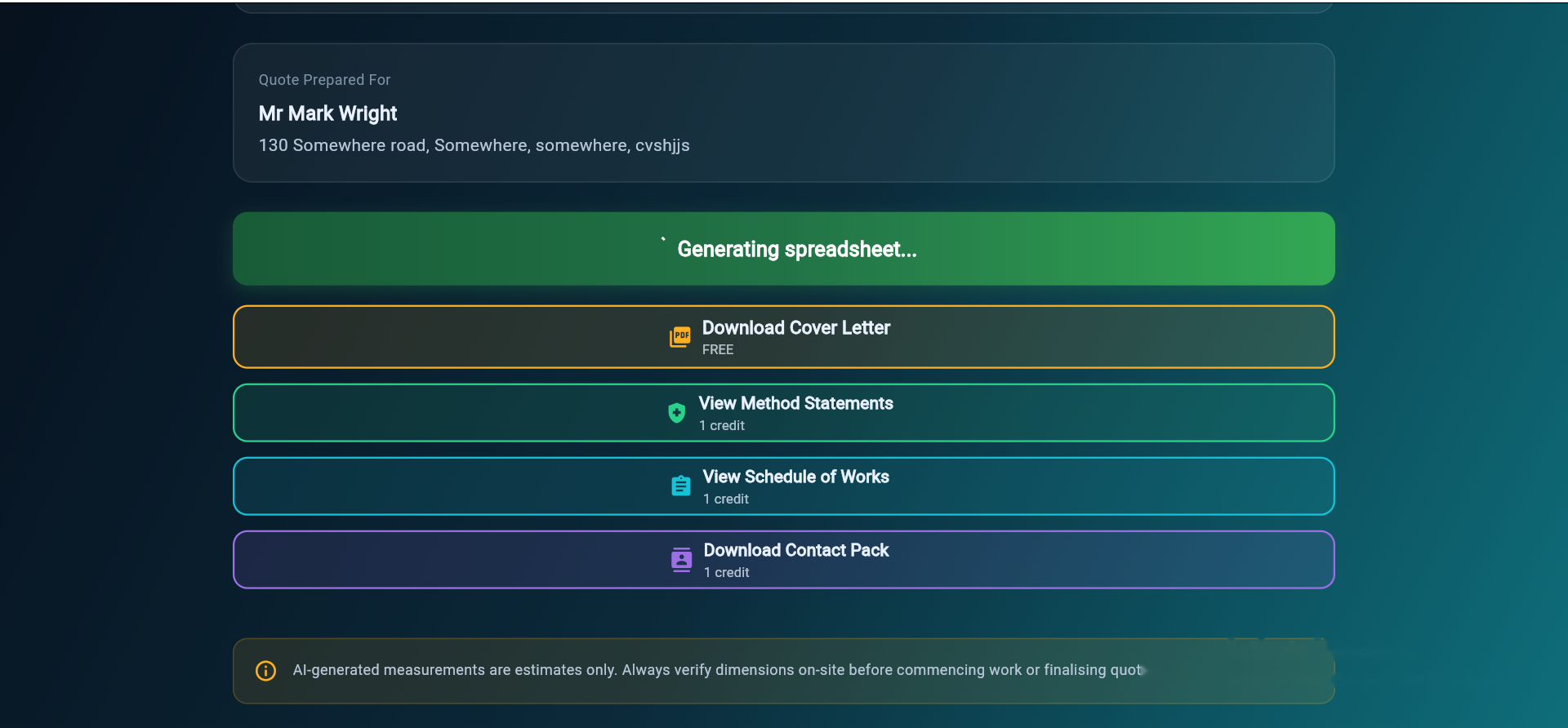
RenoCalc generates the core sections of a construction proposal from a floor plan in approximately three minutes. The output pack includes:
- A RenoCalc Spreadsheet — itemised costs by trade and room, with labour and materials separated, ready to drop into the costs section of the proposal
- A cover letter — personalised to the project, which functions as the basis of the executive summary
- A schedule of works — the trade-by-trade programme document, which populates the programme section
- HSE method statements for 12 trades — demonstrating compliance and safety planning, which belong in the contract/terms appendix
- A 12-page contract pack — covering variation procedures, payment terms, dispute resolution and practical completion
What RenoCalc does not write for you is the company profile, the references, and the personal elements of the executive summary — those are yours. But everything else — the sections that take the most time and require the most specialist knowledge — is produced automatically. You add the story; RenoCalc provides the substance.
See also: how to win more building jobs and construction quote letter example.
Watch the Output Being Generated
This walkthrough shows how RenoCalc takes a floor plan and produces a full construction proposal pack — from AI scan to finished output, in under three minutes.

Frequently Asked Questions
What is the difference between a construction quote and a construction proposal?
A quote is a price. A proposal is a document that sells the job — it puts the price in context by explaining what you are doing, why you are the right builder for it, what the client can expect during the works, and what happens if anything changes. A proposal covers the full client experience: executive summary, company profile, scope of works, itemised costs, timeline, and contract terms. Most builders send a quote; the builders who win the best jobs send a proposal.
What sections should a construction proposal template include?
A construction proposal template should include: (1) an executive summary — what you will do and when; (2) a company profile — your experience, accreditations, insurance and references; (3) scope of works with photos or drawings if available; (4) itemised costs broken down by trade and phase; (5) programme and phasing — timeline and key milestones; (6) payment terms — stage payments tied to programme milestones; (7) contract terms — variations procedure, dispute resolution, retention.
How does a cover letter differ from an executive summary in a construction proposal?
A cover letter is a brief introduction — typically one page — that accompanies the proposal and addresses the client directly. It confirms what you visited, what you are quoting, and your enthusiasm for the project. An executive summary is the first section of the proposal itself — it summarises the scope, the approach, the price and the start date in two or three paragraphs. The cover letter is personal; the executive summary is professional. Both are needed in a full construction proposal.
What does RenoCalc's output pack include for client proposals?
RenoCalc generates a full construction proposal output pack from a floor plan in approximately three minutes. The pack includes: a RenoCalc Spreadsheet with itemised costs by trade and room, a cover letter addressed to the client, a schedule of works (the programme section), HSE method statements for 12 trades, and a 12-page contract pack covering variations, payment terms and dispute resolution. Together these cover every section that a professional construction proposal needs.
Should a construction proposal include photos and drawings?
Yes. Site photos taken during the survey visit — showing existing conditions, access constraints, specific items to be retained or demolished — add significant credibility to a construction proposal. They demonstrate that you were on site, understood the job, and that your price reflects the actual conditions rather than a generic estimate. If architect's drawings are available, include the relevant floor plans and elevations. If not, a simple sketch showing the proposed layout helps clients visualise what they are approving.
How long should a construction proposal document be?
There is no fixed page count, but a professional construction proposal for a residential project typically runs to 12–25 pages including all sections and attachments. The cover letter is one page. The executive summary is one to two pages. The scope of works is the longest section — length depends on the complexity of the job. A simple kitchen extension may run to 8 pages total; a full house renovation with multiple trades may run to 20 or more. Length is less important than completeness and clarity. Every section should earn its place.
What is the difference between a schedule of works and a scope of works?
A scope of works describes what will be done — it lists each item of work by trade or area and forms part of the contractual basis of the quote. A schedule of works (or programme) describes when it will be done — it sets out the sequence of trades, key milestones, and the project timeline. Both are essential in a full construction proposal. The scope protects against disputes about what was included; the schedule sets client expectations about duration and phasing.
Do I need to be a member of the Federation of Master Builders to send a proposal?
No — FMB membership is not required to send a professional construction proposal. However, if you are an FMB member, including your membership number and logo in the company profile section significantly strengthens the document. Clients use membership of bodies like the FMB as a trust signal when comparing builders. Non-members should still include their public liability insurance details, any CSCS card numbers, and any scheme memberships such as TrustMark or Checkatrade. See the Federation of Master Builders for information on membership.
How should VAT be shown in a construction proposal?
VAT should be shown as a separate line at the end of the itemised cost section — show the net total, the VAT amount, and the gross total. For residential construction work, VAT is typically 20%, though some conversions and renovations qualify for a 5% reduced rate. If you are not VAT-registered, state this clearly so the client does not assume VAT is included. For full guidance see HMRC's VAT construction industry guidance.
Stop Sending Numbers. Start Sending Proposals.
The gap between a price and a signed contract is won or lost in how you present yourself. Most builders are competing on price alone because that is all their quote communicates. A construction proposal that covers the full picture — who you are, what you will do, when you will do it, and how you will handle the unexpected — is the document that turns a good price into a confirmed job.
RenoCalc produces the substance: the itemised costs, the schedule of works, the method statements and the contract pack, from a floor plan in under three minutes. You add the company profile and the personal touch. Together, that is a proposal worth sending. Try RenoCalc free and see what your next proposal could look like.
Generate a Full Proposal Pack in 3 Minutes
Upload your floor plan. RenoCalc produces a RenoCalc Spreadsheet, cover letter, schedule of works, HSE method statements and 12-page contract pack — the core of a professional construction proposal, ready to personalise and send.
Start Free — No Card Needed