Construction Quote Cover Letter: A Real UK Example (and Why Most Are Too Thin)
Quick Answer
A construction quote cover letter is the professional introduction to your quote — it summarises who you are, what you are quoting for, key inclusions, and your next steps. It should be one page, professional, and specific to the project. Common mistakes: too vague on scope, no mention of insurance or qualifications, no call to action. RenoCalc generates the cover letter automatically, always free.
Most builders send a price. The best builders send a package — and the cover letter is the first thing the client reads. In 32 years of construction, I have seen thousands of quote letters. A large proportion of them do one thing: state a number. No context, no credentials, no next steps. Just a number on a letterhead, sometimes not even that.
That is not a cover letter. That is a price on paper, and it does very little to convince a client to choose you over a cheaper competitor.
This guide walks through a real UK construction quote cover letter, section by section, with annotations on what is working and what a weak letter gets wrong. If you want to know what to write — and why it matters — read through the full example below.
RenoCalc generates this cover letter automatically from your floor plan, every time, and it is always free.
The Cover Letter Example — Full Text
Below is a realistic example of a professional UK building quote cover letter, written in the kind of plain, confident language that wins work. I have kept it to one page, which is the right length. Read through it first, then I will break each section down.
42 Station Road, Birmingham, B15 2NQ
Tel: 0121 496 3300 | info@hartleybuilding.co.uk
Public Liability: £5,000,000 | Company No. 09881234
Date: 20 June 2026
Valid Until: 20 July 2026
14 Elmwood Drive, Solihull, B91 3RP
Thank you for inviting Hartley Building Services to quote for the proposed single-storey kitchen extension at 14 Elmwood Drive. We visited the property on 10 June 2026 and have prepared this quotation based on the drawings provided by your architect, Kendrick Design Associates, dated 4 June 2026.
James Hartley
Director — Hartley Building Services Ltd
james@hartleybuilding.co.uk | 07700 900 447
Section 1: The Opening Paragraph
The opening does three things: it acknowledges the client by name and property address, it states specifically what you are quoting for, and it references the drawings or site visit you used as the basis. This matters because it immediately distinguishes your letter from a generic template sent to every enquiry.
What is working: Hartley references the architect's drawings by name and date. This tells the client that the quote is based on actual design documents — not a rough verbal discussion. It also signals professionalism and protects the builder if the scope changes later.
What weak letters do instead: "Thank you for getting in touch. Please find our quote attached." That is not an opening — it is filler. It tells the client nothing about whether you understood the job, visited the property, or read the drawings. It gives the client no confidence that your price is based on an accurate understanding of the work.
Section 2: Company Confidence Paragraph
This is the paragraph most builders skip, and it is the one that separates a professional builder from a man with a van. The client is about to hand over a significant sum of money for work on their home. They need to know who you are before they can decide whether to trust you.
What is working: Hartley covers four things in four sentences: years in business, area of specialism, insurance level, and a reference to directly employed labour. The reference to a similar completed job in Dorridge is important — it tells the client you have done this before, locally, and are confident enough to offer a reference. You do not need to write a page of marketing copy. Four sentences, four facts. That is enough.
What weak letters do instead: Omit this section entirely, or replace it with vague language like "we pride ourselves on quality workmanship." That phrase means nothing. Any builder can write it. Insurance level, years of experience, and a specific reference — those things mean something.
Also missing from weak letters: Any mention of the payment or contract terms, and whether the builder is VAT-registered. Both belong in the letter or the attached terms, not as a surprise on the invoice.
Section 3: Scope Summary
The scope summary in the cover letter is not the full schedule of works — it is the headline version. It tells the client what is in the price, references where the full detail lives, and sets the frame for any exclusions.
What is working: Hartley lists the main trade categories included — groundworks, structure, steels, roof, glazing, electrics, plumbing, plastering, and flooring — and specifically notes that party wall and Building Regulations are handled in preliminaries. Clients often worry about these hidden costs. Addressing them here removes uncertainty. The reference to pages 4–9 of the attached schedule gives the client a clear route to the detail.
What weak letters do instead: Write "works as discussed on site" with no further detail. This is one of the most common causes of disputes between builders and clients — the client believed the price included something the builder did not price for. A brief scope summary, even in the cover letter, gives both parties a shared understanding before work starts.
See our full guide to building quote templates UK for the complete structure of a professional quote pack including the schedule of works.
Section 4: The Numbers Reference
The cover letter should state the headline price clearly — not bury it. Then it should point the client to the itemised breakdown rather than trying to explain every line in the letter itself.
What is working: Hartley states the total price with VAT noted explicitly, includes the contingency as a named line so the client understands it is already in the total, and calls out the exclusions (kitchen appliances as provisional sums) rather than hoping the client does not notice. This is honest and professional. The client knows exactly what the price covers before they read anything else in the pack.
What weak letters do instead: State the price without mentioning VAT, without noting what is excluded, and without any reference to contingency. The client then discovers halfway through the job that VAT adds 20% to the bill, or that kitchen fittings are "extra." Both of those conversations are avoidable — and damaging to the relationship.
For a fully worked UK building quote example including all line items and trade breakdowns, see our building quote example UK guide.
Section 5: Next Steps and Call to Action
The call to action is the section most builders forget. If you do not tell the client what to do next, they will do nothing. They will sit on the quote, wait for the others to arrive, and eventually award the job to whoever followed up.
What is working: Hartley tells the client exactly what to do — sign and return the acceptance page — and gives a specific mechanism (there is a page in the pack for this). It then gives an indication of start dates so the client understands the timeline. It ends with a personal phone number, which makes it easy to ask questions. All of this reduces friction between receiving the quote and deciding to proceed.
What weak letters do instead: End with "please do not hesitate to contact us if you have any queries." That is a passive sign-off that puts the responsibility entirely on the client. It does not encourage action, and it does not tell the client what accepting the quote actually involves. The result is a quote that sits in an inbox while the client decides.
Section 6: Sign-Off
The sign-off is brief in the example above, and it should be. But note what is there: the director's name, their title and company, a direct email address, and a direct mobile number. Not the general company line — a direct number for the person who wrote the quote.
What is working: A direct contact name and number signals that a real person is responsible for this quote and is available to discuss it. It also means the client does not have to ring a general number and explain who they are before they can get an answer. Small detail, but it makes the quote feel personal rather than processed.
See RenoCalc Generate This in Under 3 Minutes
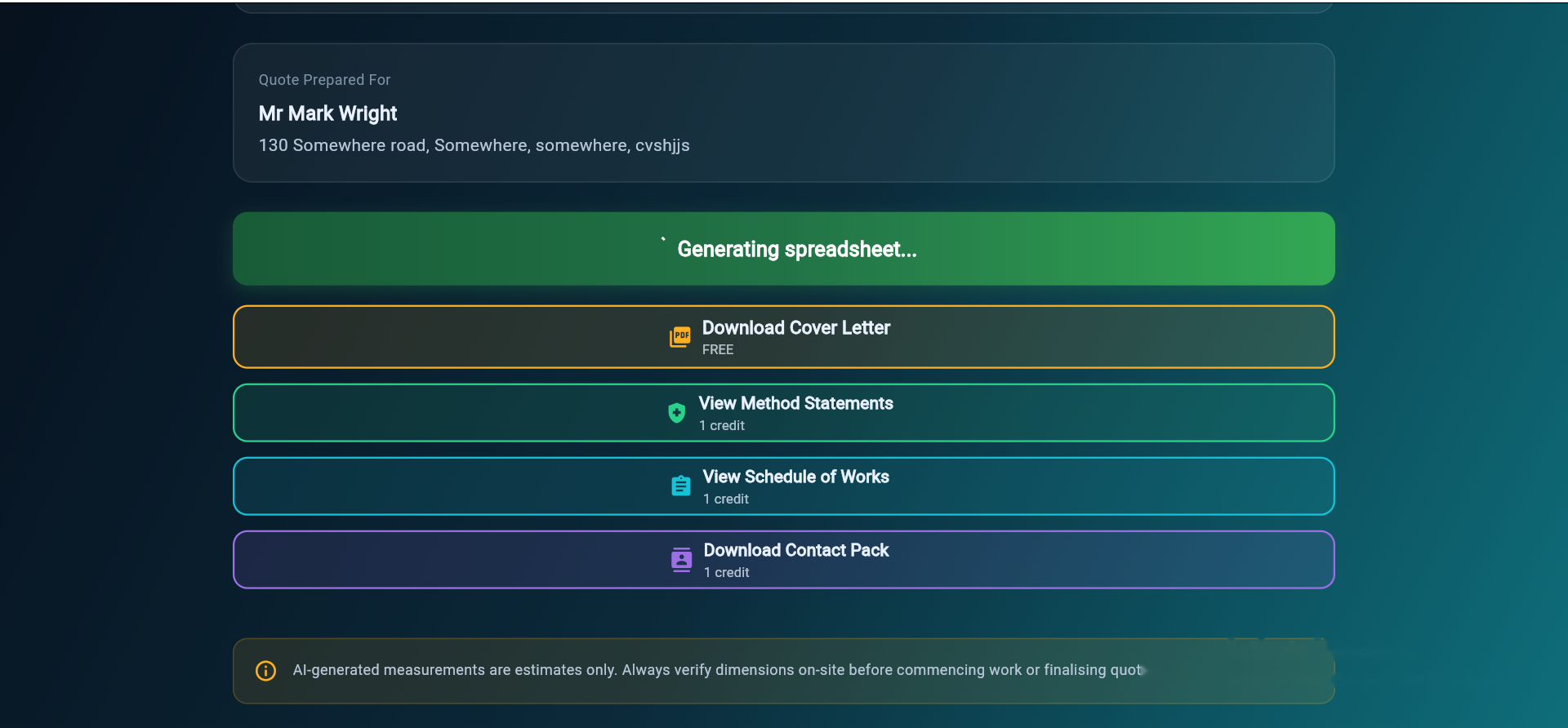
RenoCalc builds the cover letter, schedule of works, itemised cost breakdown and contract pack from your floor plan. The cover letter is always free — it generates automatically every time you run a quote.
Common Mistakes in Builder Cover Letters
Having read thousands of these letters over 32 years, here are the most common failures — and what each one costs you.
Too Vague on Scope
Writing "as discussed" or "works as per your brief" is not a scope summary. It is a recipe for a dispute. Every element of the job that matters to the client needs to be either in the schedule of works or acknowledged in the cover letter. If the client thinks the price includes flooring and you did not price it, you will either absorb the cost or damage the relationship when you raise a variation. Neither outcome is good.
No Mention of Insurance
Clients are increasingly aware that not every builder carries adequate public liability insurance. If you do not mention your cover level in the letter, a client who thinks about it will wonder whether you are insured at all. State it once, simply: "Public liability: £2,000,000" or "£5,000,000." It takes four words and removes a doubt.
No Call to Action
A cover letter that ends without telling the client what to do next will not convert as well as one that does. Tell them how to accept — whether that is signing a page, sending an email, or calling a number. Give them a reason to act soon: your start date availability is the most natural one. Builders who follow up a quote with a phone call two or three days after sending it win a disproportionate share of the work. A clear call to action in the letter primes the client for that call.
Unprofessional Tone
Grammar errors, casual language, and missing contact details all undermine confidence in the builder. The cover letter is often the client's first written interaction with your company. If the letter looks careless, the client will reasonably wonder whether the work will be too. Write the letter as you would want to receive one if you were spending fifty thousand pounds on your own home.
No Quote Reference Number
A quote without a reference number is harder for the client to file and harder for you to track. It also looks less professional. Every quote should have a unique reference — even if it is just your initials and the year and a sequential number. Hartley's example uses HBS-2026-047. Simple, clear, professional.
RenoCalc Writes the Cover Letter for You — Always Free
Upload your floor plan, set the project type and scope, and RenoCalc generates a professional cover letter alongside the full quote pack — schedule of works, itemised costs, HSE method statements and a 12-page contract. The cover letter is included on every plan, free.
Start Your Free QuoteFrequently Asked Questions
What should a construction quote cover letter include?
A professional construction quote cover letter should include: an opening paragraph stating what you are quoting for and where you saw or received the enquiry; a company confidence paragraph covering your experience, public liability insurance, any trade memberships or accreditations, and one or two relevant completed projects; a brief scope summary referencing the full schedule of works attached; a clear statement of the quoted price with a note on what is and is not included; a call to action telling the client what to do next; and a professional sign-off. Keep it to one page — the detail lives in the schedule of works.
How long should a builder's quote letter be?
A quote cover letter should be one page — roughly 250 to 400 words. Its job is to introduce you and your price, not to explain every line of work. The technical detail belongs in the schedule of works and itemised cost breakdown attached to the letter. A letter that runs to three pages with everything spelled out typically means the quote pack is poorly structured, not more thorough.
What is the most common mistake in construction quote letters?
The most common mistake is being too vague on scope — writing something like "carry out works as discussed" without specifying what that means. This creates disputes on site when the client's expectation differs from what the builder priced. The second most common mistake is omitting any mention of insurance or company credentials, which makes the letter look unprofessional and gives the client no reason to trust you over a cheaper competitor. The third is no clear call to action — the letter should tell the client exactly what to do next.
Does RenoCalc write the cover letter automatically?
Yes. RenoCalc generates the quote cover letter automatically from your floor plan and project details — and it is always free, regardless of which pricing plan you are on. The letter is formatted professionally, references the attached schedule of works and quote pack, and is ready to send. You can edit it before sending if you want to add specific project notes or client details.
Should a builder include their insurance details in a quote cover letter?
Yes. Including your public liability insurance details — insurer name, policy number, and cover level — in your cover letter is one of the most effective ways to differentiate your quote from competitors. Most homeowners are nervous about letting a stranger work on their property. A clear statement of your insurance cover reduces that anxiety. FMB members can also reference their membership. See the Federation of Master Builders for more on trade accreditation.
Does VAT need to be mentioned in a construction quote cover letter?
Yes — the cover letter should clearly state whether the quoted price includes or excludes VAT, and at what rate. For most residential building work, VAT is 20%. Some work — such as conversions of commercial buildings or properties empty for over two years — may qualify for the 5% reduced rate. New-build residential work is zero-rated. Stating the VAT position in the cover letter prevents confusion when the client receives the invoice. For full guidance, see HMRC's VAT construction industry guidance.
Can a cover letter be emailed rather than printed and posted?
Yes — most quote cover letters are now sent by email, either as a PDF attachment or as a formatted email body. If emailed, the subject line should include the client's name, property address, and quote reference. The quote pack (itemised costs, schedule of works, contract pack) should be attached as a single well-named PDF. Avoid sending the quote as multiple loose attachments — a single consolidated document is more professional and easier for the client to file and reference.
What is a good opening line for a builder's quote cover letter?
A good opening line names the project, references the survey visit, and thanks the client for the opportunity — in one sentence. Example: "Further to our survey visit on [date], please find enclosed our quotation for the proposed [kitchen extension / full renovation / loft conversion] at [address], as discussed with you at the time." This demonstrates that you visited, that the quote is site-specific, and that you are following through on a real enquiry — not a generic letter.