How to Write a Building Quote: A Builder's Step-by-Step Guide
Quick Answer
To write a building quote: (1) Do a thorough site visit and measure everything. (2) Break the scope into individual trades. (3) Calculate material quantities with waste factors. (4) Apply your labour rates per trade. (5) Add preliminaries and a 5–10% contingency. (6) Write a professional cover section with scope summary, exclusions, payment terms, and validity period. (7) Present as a branded PDF.
Two quotes. Two different outcomes. Same builder — me — and both within six months of each other.
The first was for a £60,000 full house renovation on a 1930s semi in Coventry. The client had four quotes on the table. I wasn't the cheapest. I won the job. The second was for a £90,000 rear extension and full refurb — a bigger job, one I wanted badly. I lost it to a builder who came in £4,000 cheaper. Neither of those results had anything to do with price. The £60k job I won because my quote was clear, detailed, and professional. The £90k job I lost because I sent a two-page Word document that listed totals without explaining anything. The client told me afterwards: "Your quote felt like you were guessing."
Thirty-two years on the tools has taught me that how you write a quote matters as much as what you put in it. This guide walks you through every step — from the site visit to the final PDF — so your quotes win more jobs and protect you when things don't go to plan.
Step 1: Do the Site Visit Properly
The quality of your quote is determined by the quality of your site visit. If you rush the measure-up, you'll miss things. If you don't photograph the existing condition, you'll have no record when a client disputes what was there before you started. If you don't ask the right questions, you'll price a job that doesn't match what the client actually wants.
On every site visit, I take room-by-room measurements with a laser measure, not a tape. I photograph every elevation, every ceiling, every floor, any areas of obvious defect or concern — damp patches, cracked plaster, dodgy electrics, signs of movement. I ask directly: what is your budget? What's your timeline? Are you the sole decision-maker, or does your partner need to be involved? That last question matters — I've been to far too many follow-up meetings that were really first meetings because the partner wasn't there the first time.
The site visit isn't just data collection. It's your first chance to build trust. Clients remember a builder who asked the right questions, took notes, and actually listened. That impression carries through to how they read your quote.
Step 2: Break the Scope into Trades
Once you have your site visit notes, the next step is to structure the work logically. The most reliable way to do this is to break it into trade packages — the same way a main contractor would organise a programme. Don't write one lump-sum figure. Break it down.
A typical renovation scope broken into trades looks like this:
- Demolition and strip-out
- Groundworks (if applicable)
- Structural works — steels, lintels, RSJs
- Brickwork and blockwork
- Roofing
- First-fix carpentry — joists, studwork, door frames
- First-fix plumbing — pipework, soil runs
- First-fix electrics — cables, back boxes, consumer unit
- Insulation
- Plastering and boarding
- Second-fix carpentry — skirting, architrave, doors, stairs
- Second-fix plumbing — sanitaryware, radiators, boiler
- Second-fix electrics — sockets, switches, lights, testing
- Tiling
- Flooring
- Decoration
- External works (if applicable)
Not every job has every trade. But going through this list for every quote means nothing gets missed. Missing a trade at quote stage is how builders lose money — you've committed to a fixed price without pricing everything that's in it.
Step 3: Calculate Materials
For each trade package, work out the quantities you need. How many square metres of plasterboard? How many linear metres of 100x50 timber? How many bags of multi-finish plaster? How many metres of 22mm copper pipe? These quantities come from your measurements — which is why step 1 has to be thorough.
Apply current prices from your supplier or a trade price list. Material prices in the UK move regularly — timber prices in particular have been volatile since 2020. Don't use prices from memory or from a quote you did eight months ago. Get a current price. If you're doing a significant job, get a quote from your merchant for the main materials before you submit your quote to the client.
Add waste allowance — typically 10–15% on cut materials like tiles and timber. Don't forget fixings, adhesives, sealants, and all the small consumables that add up. These are easy to overlook individually and significant in aggregate on a large job.
Step 4: Calculate Labour
Labour is where most builders either undercharge or guess. Neither is a good approach on a fixed-price job.
For each trade, estimate the hours of work required. If you're using subcontractors, you'll have their rates — price the labour at those rates. If you're doing the work yourself, price it at your day rate multiplied by the number of days each element will take. Don't underprice your own time because it feels awkward to charge what it's worth. Your time has a cost whether you charge for it or not.
Be realistic about the programme. A second-fix carpenter who you're sharing with another site might not be available when you want them. Trades that depend on each other — plastering can't start until first-fix is done; second-fix electrics can't start until plaster is dry — mean gaps in the programme. Those gaps still cost you in site management time even if no one is swinging a hammer.
Step 5: Add Preliminaries and Contingency
Preliminaries are the costs of running the job that aren't directly tied to a specific trade — and they're the most commonly forgotten items in a building quote. On a renovation job, prelims typically include:
- Scaffolding (erect, hire, strike)
- Skip hire — usually multiple skips over the duration
- Welfare facilities — site toilet if needed
- Site management time — your time running the job, not doing the work
- Builder's insurance for the duration of the works
- Plant hire — concrete mixer, dumper, powered access
- Temporary protection — floor protection, weather protection
- Builder's clean on completion
On a mid-size renovation, prelims can easily add £3,000–£8,000 that you won't recover if you don't include them.
Contingency is different. Contingency covers the things you genuinely couldn't have known at quote stage — the hidden rot behind the bathroom tiles, the underfloor void that turns out to be deeper than expected, the asbestos that nobody knew was in the textured ceiling. On renovation work specifically, I include 5–10% contingency as a line item and explain to the client exactly what it's for. Most clients understand this. The ones who don't — who insist you remove it — are the ones you're most likely to have a problem with on site.
Step 6: Write the Cover Section
The cover section of a building quote is what the client reads first. It sets the tone for everything that follows. A good cover section includes:
Scope summary. Two or three paragraphs describing the works in plain English — not technical jargon, not a list of quantities. What are you actually doing? What will the property look like when you've finished? This is where you demonstrate that you understood the brief.
Exclusions. State clearly what is not included. "This quote excludes: architect's fees, structural engineer's calculations, building regulations fees, party wall awards, any specialist subcontractor works not listed above, kitchen appliances, sanitaryware (unless specified), and any works arising from unforeseen conditions." An exclusions list protects you. Without one, the client can argue that anything they assumed was included is your responsibility.
Payment schedule. Set out how and when you expect to be paid. A typical payment schedule might be: 10% deposit on signing, 25% at completion of structural works, 25% at first-fix completion, 25% at second-fix completion, 15% on practical completion. Never start a job without a deposit. Never carry more than one stage of work without a payment. Cash flow kills building businesses — not lack of work.
Validity period. State that this quote is valid for 30 days (or whatever period suits you). Material prices change. Labour rates change. An open-ended quote can leave you committed to a price that no longer works by the time the client decides to proceed.
Step 7: Present Professionally
This is the step where most builders leave money on the table. The content of the quote might be excellent — thorough, accurate, fairly priced — but if it arrives as a plain text email with no formatting, or a scruffy Word document with inconsistent fonts and a logo squashed into a corner, it undermines everything that's in it.
Your quote document should look like it came from a professional company. That means:
- Branded PDF on company-headed paper
- Your company name, address, registration number, VAT number (if applicable)
- Your logo, clearly placed
- Clear section headings and consistent formatting throughout
- A cover letter — a separate one-page letter that thanks the client for the enquiry, summarises your approach, and invites them to contact you with any questions
- A signature block on the acceptance page
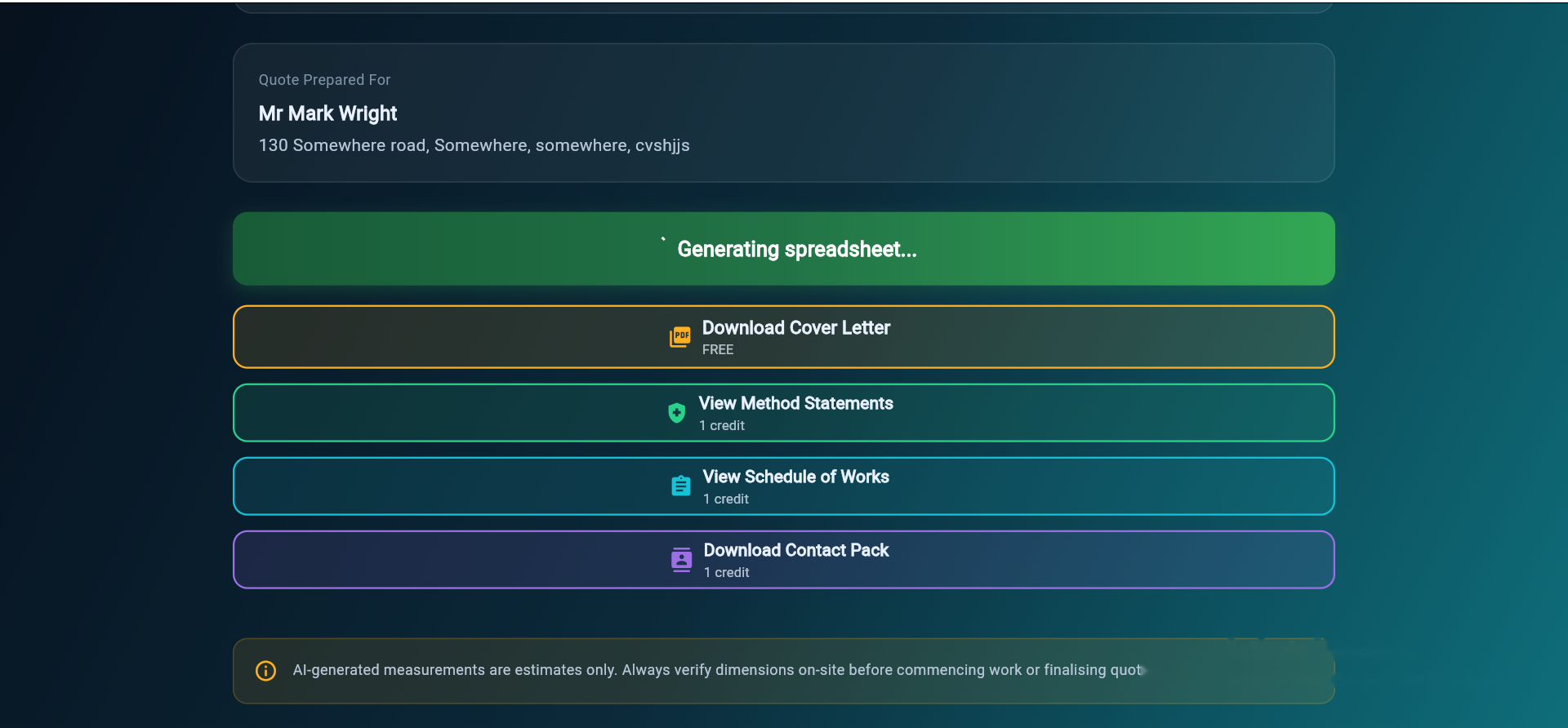
The cover letter in particular is underused. It costs nothing to write, takes ten minutes, and is the single most effective thing you can do to differentiate your quote from the others on the client's table. RenoCalc generates the cover letter for free as part of every quote pack — because I know from experience how much it matters.
Common Mistakes That Cost You Jobs and Money
Vague Scope Leads to Disputes
The most expensive word in a building quote is "etc." Writing "first-fix electrics, etc." means nothing. Etc. to you means one thing. Etc. to the client means everything they assumed was included. Write exactly what you're doing. Write exactly what you're not doing. Be specific to the point of being repetitive if that's what it takes.
No Exclusions List
If your quote doesn't have an exclusions section, the client will assume everything is included. This is where disputes start. I've been in a room with a client who was genuinely certain that their architect's fees were included in my quote — because I hadn't said they weren't. Include an exclusions list on every single quote, without exception.
No Payment Schedule
Quoting a final total with no payment terms is how builders end up funding other people's building work with their own money. A client who hasn't committed to interim payments has every incentive to slow-walk the process. Set out your payment schedule upfront. Make it part of the acceptance terms. Don't start work without a signed quote that includes payment terms — not just a handshake.
Too Slow to Respond
Speed matters more than most builders realise. If a client has contacted three builders and two of them respond within 48 hours and one takes ten days, the slow one is already on the back foot before anyone has seen a number. Get to the site visit quickly. Get the quote out within a week of the site visit. The faster you respond, the more serious you look — and the more likely you are to be compared against your quote rather than against a builder who got there first.
How RenoCalc Handles Steps 2–7
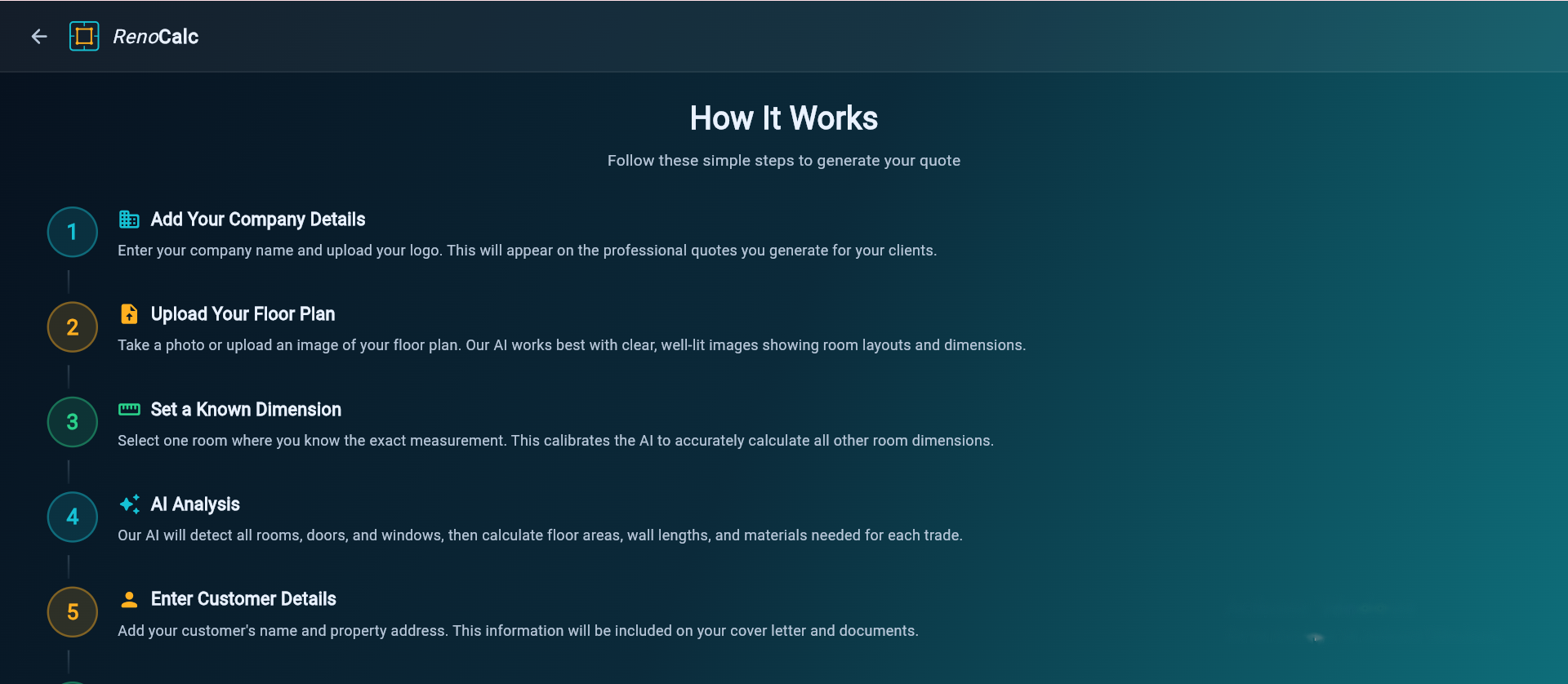
The site visit is always yours to do. But everything from breaking the scope into trades through to the professional PDF output — RenoCalc handles from a floor plan upload in under three minutes.
The AI scans your floor plan, identifies every room, measures every wall, and generates a full trade-by-trade cost breakdown: materials priced against a UK trade price library, labour calculated at current UK rates, prelims included, margin applied. The output is a complete quote pack — schedule of works, method statements, contract pack, and a free cover letter — ready to send as a professional PDF.
What used to take me a full day now takes three minutes to generate and an hour to review and customise. That's the difference between quoting two jobs a week and quoting ten.
Write Your Next Quote in Under 3 Minutes
Upload your floor plan and RenoCalc generates a complete, professional building quote — scope, materials, labour, prelims, cover letter and contract. Free to start, no card required.
Start Your Free QuoteFrequently Asked Questions
What should a building quote include?
A proper building quote should include: a clear scope of works describing exactly what you will and won't do; a material breakdown with quantities; a labour breakdown by trade; preliminaries (scaffold, skips, site management); your profit margin; a payment schedule; exclusions; the validity period; and your company details, insurance and any accreditations. A cover letter on headed paper adds professionalism and helps the client understand what they're signing up for.
How long should a building quote take to write?
A thorough quote for a mid-size renovation job used to take me a full day to prepare properly — measure up, price materials, work out labour, check subcontractor rates, write it all up. With RenoCalc, the bulk of that process — scope breakdown, material quantities, labour rates — is generated from the floor plan in under 3 minutes. You still need to review it and write your cover section, but the time saving is significant.
Should a building quote be a fixed price or a day rate?
For most building work, a fixed-price quote is better for both parties — the client knows what they're paying and you know what margin you're carrying. Day rate works on small undefined jobs where the scope genuinely can't be fixed in advance. If you're pricing a renovation with a clear scope and drawings, quote a fixed price. If you quote day rate on a fixed-scope job, clients will assume you're padding the hours — and sometimes they're right to think that.
What is the difference between a quote and an estimate in construction?
A quote is a fixed offer to carry out specified works for a stated price — once accepted, you're bound by it. An estimate is an approximate figure, not a binding price. In practice, many builders use both terms loosely, which causes confusion. If you issue a document headed 'Quote' or 'Quotation', the client will treat it as a binding price regardless of what you intended. Be clear about what you're issuing, and if there are genuine unknowns, describe them explicitly in your exclusions and state that they may be subject to variation.
How do I write a building quote that wins more jobs?
Win rate on quotes comes down to three things: speed, clarity, and presentation. Speed matters because the first credible quote in often wins. Clarity matters because clients buy confidence — a vague quote creates doubt. Presentation matters because most builders still send plain text emails or scruffy Word documents; a clean, branded PDF with a proper cover letter signals that you run a professional operation. Those three things together are what separates a quote that wins from one that doesn't.