How to Quote a Building Job: From Site Visit to Signed Contract
Quick Answer
To quote a building job professionally: qualify the client first (decision-maker, realistic budget, reasonable timeline), do a thorough site visit, prepare a complete itemised quote within 48 hours, present it face-to-face or with a call if possible, follow up once by phone three to five days later. Most jobs are won or lost in the follow-up, not the price.
This guide is not about writing a quote. It's not about pricing a job. Those are separate guides and both have their place. This guide is about the complete quoting process — everything that happens from the moment a client makes contact to the moment you have a signed contract and a deposit in your account.
Writing an accurate quote is only one part of winning a job. I've seen builders produce meticulous, detailed, fairly-priced quotations and still lose the job — not because the number was wrong, but because they didn't follow up, didn't present it well, or didn't know what to do when the client came back with an objection. I've seen the reverse too: builders who win jobs with higher quotes because they were faster, more confident, and knew how to handle the conversation after the number went in.
The quoting process has eight stages. Most builders nail two or three of them and guess the rest. This guide covers all eight.
Step 1: Take the Enquiry and Qualify the Client
Not every enquiry is worth pursuing. Spending a day doing a site visit, taking measurements, pricing materials, writing up a quote, and preparing a PDF — only to find out the client has a budget of £15,000 for a job that costs £70,000 — is one of the most demoralising experiences in the building trade. It's also entirely avoidable.
When an enquiry comes in — by phone, email, website form — have a brief conversation before you agree to a site visit. Three questions tell you almost everything you need to know:
- What is your approximate budget for this project?
- What is your ideal start date and timeline?
- Are you the decision-maker, or does a partner or third party also need to be involved?
A client who won't engage with the budget question is a client who may not have a realistic budget — or one who wants to gather quotes without revealing enough to get an honest assessment. A client who needs to "check with their partner" at every stage will slow the process down and may never get to a decision. This doesn't mean refuse the job — it means price your time accordingly and don't over-invest in the quoting process until you're confident there's a real, fundable job there.
Step 2: Arrange the Site Visit
Once you've qualified the enquiry, move fast. Respond within 24 hours. Arrange the site visit within 48–72 hours if you can. Speed at this stage signals professionalism — it tells the client that you're organised, interested, and capable of managing a project. A builder who takes five days to respond to an enquiry and three weeks to arrange a visit has already communicated something about how they manage their work.
Confirm the appointment in writing — email or text. Include your name, company name, and the time and date confirmed. This is your first piece of professional communication with this client. Make it look like it came from a company that takes its work seriously.
Step 3: Do the Survey
The survey is where the quote is made or lost. Arrive on time. Bring a laser measure, a notebook, and your phone for photographs. Measure every room. Note the existing condition — floor finish, wall condition, ceiling height, any visible defects, the state of the services, access constraints, parking and delivery logistics.
Ask the questions you couldn't answer over the phone: what exactly is the client expecting to change? Are there drawings or a specification? Have planning or building regulations consents been obtained? Who is the client's architect or designer, if any? Is the property rented or owner-occupied during the works?
Listen more than you talk. The client will tell you what matters to them if you give them the space to. The builder who listens at the survey is the builder who writes a quote that speaks to what the client actually wants — not just a list of materials and prices.

Step 4: Prepare the Quote
A proper building quote — the kind that wins jobs and protects you if something goes wrong — covers five things: scope, price breakdown by trade, exclusions, payment schedule, and validity period. Don't submit a quote without all five.
Price your materials from current supplier prices. Price your labour by trade and by realistic hours. Include your prelims — scaffold, skips, site management, insurance. Add your contingency allowance, especially on renovation work. Apply your profit margin and check the total against current UK cost per m² benchmarks as a sense-check.
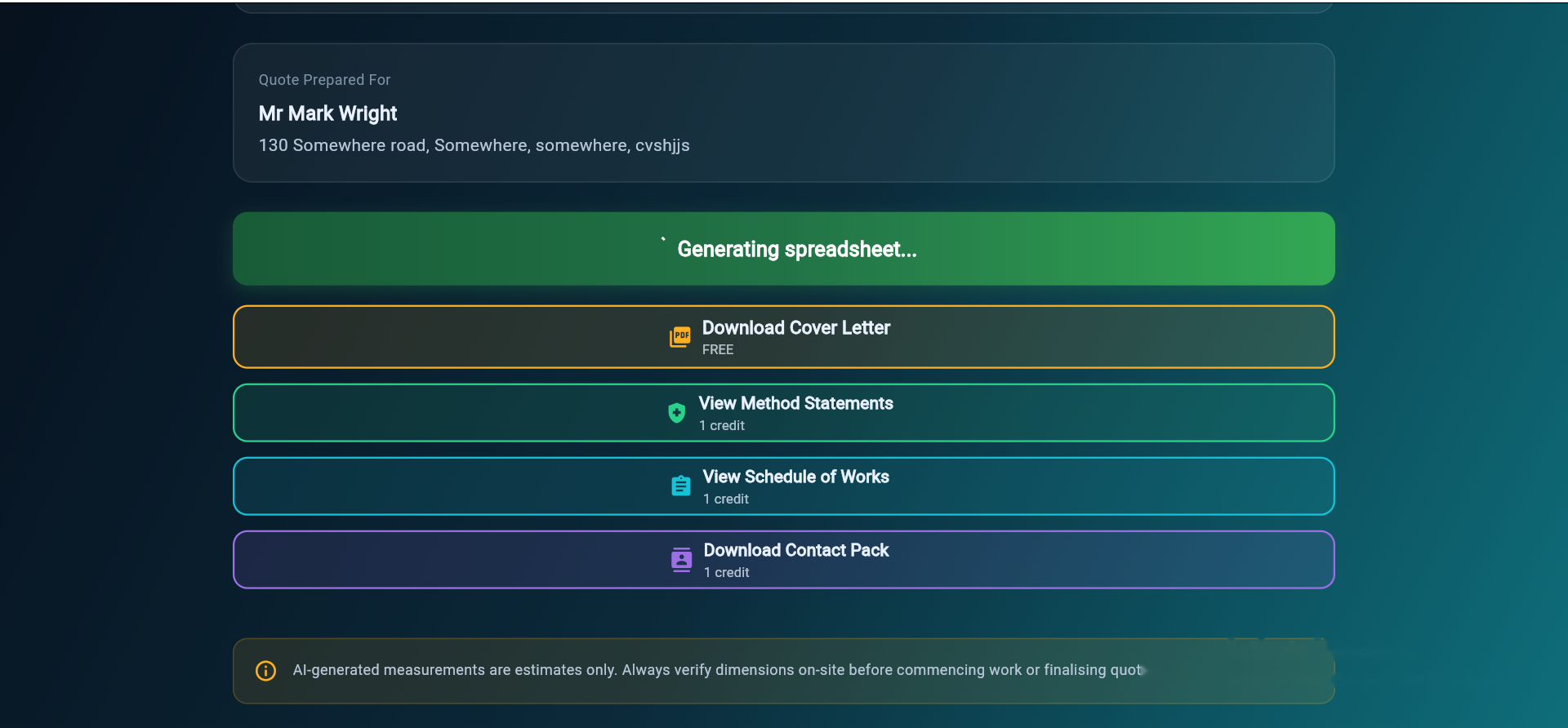
On a detailed renovation job, this used to take me a full day. With RenoCalc, the trade-by-trade breakdown, materials, labour, and prelims are generated from the floor plan in under three minutes. I spend the time I save reviewing, customising, and writing the cover section.
Step 5: Present the Quote
This is where most builders lose jobs they should win.
The standard approach is to email a PDF and wait. The problem with this approach is that a PDF is a passive document. It sits in the client's inbox alongside two or three other PDFs from other builders, and the client has to read and interpret all of them without any help from you. Questions form in their mind. Doubts form. The cheapest number starts to look most attractive simply because it has the lowest number — not because it's the best job.
A better approach: send the PDF, then call the client on the same day or the next morning. Tell them the quote is on its way, give them the headline number, and offer to walk them through the key sections — either in person or on a call. This is not pushy. It's the kind of communication that distinguishes a professional company from a one-man band who just fires off quotes and hopes for the best.
When you walk a client through your quote, you have the opportunity to explain your contingency allowance before they question it, highlight what's included in your prelims, explain why your payment schedule is structured the way it is, and give them confidence that you understand their project. You cannot do any of this from a PDF sitting unread in an inbox.
Step 6: Follow Up
Three to five days after you've sent the quote — follow up. By phone, not email. Ask if they've had a chance to review it, whether they have any questions, and what their timeline looks like for making a decision.
This single step converts more quotes than any amount of discount or marketing. I know builders who win 70% of the quotes they submit — not because they're cheap, and not because they're the best builders in the area (though they are good) — but because they follow up consistently. The follow-up call tells the client you're interested in the job. It tells them you're organised. It opens the conversation so that any concerns the client has come out before they've gone elsewhere.
Most builders don't follow up at all. They send the quote and wait, sometimes for weeks, before wondering what happened. The client has moved on by then. The builder who called on day four got the job.
Step 7: Handle Objections
The most common objection in building quoting is price. "Your quote is more expensive than the others we've had." This is almost never the whole truth. What it usually means is one of three things:
- The client doesn't understand what's included in your quote versus what's in the cheaper one
- The client is testing whether you'll reduce your price
- The client has a genuine budget constraint that you didn't establish clearly in step 1
Ask what they're comparing you to and whether the competing quotes cover the same scope. In my experience, a significant proportion of price objections are based on a comparison that isn't like-for-like — the cheaper quote has excluded something your quote includes, or vice versa. If you can demonstrate that your quote includes something the cheaper one doesn't, the price difference is often immediately understandable.
If the comparison is genuinely like-for-like and the client can't stretch to your price, explore whether the scope can be phased or reduced. Don't just drop your margin. If you drop your margin to win the job, you're committing to months of work for a profit that doesn't cover your risk. Phasing the work — doing the structural and first-fix now and the finishes later — is a more professional response than a race to the bottom on price.
Step 8: Contract and Deposit
This is non-negotiable. Never start work without a signed contract and a deposit in your account.
The minimum is a signed quotation that includes the scope, the price, the payment schedule, and the exclusions — signed and dated by the client. That's your basic contract. It doesn't give you great protection if there's a dispute, but it's infinitely better than a verbal agreement or an email that says "sounds good, when can you start?"
For jobs over £10,000, consider a JCT Homeowner Contract or a JCT Minor Works Contract. These are straightforward documents that set out what happens in the event of variations, defects, delays, and non-payment — clearly, in plain language. They protect both parties and reduce the likelihood of disputes reaching the point where someone is threatening to call a solicitor.
The deposit amount varies — I typically ask for 10% on sign-up, though some builders ask for more on jobs with significant materials costs upfront. The important thing is that the client has made a financial commitment before you start mobilising your team and ordering materials. A client with no skin in the game is a client who might change their mind the day before you were due to start.
How RenoCalc Speeds Up the Process
The qualification, the site visit, the survey, the follow-up, the objection handling, the contract — those are all yours. But the quote preparation itself — step 4 — is where most of the time goes, and it's where RenoCalc makes the biggest difference.
Upload your floor plan and RenoCalc scans it, measures every room, and generates a full trade-by-trade quote in under three minutes. Materials priced against a UK trade price library. Labour calculated at current UK rates. Prelims included. Margin applied. The output is a complete quote pack — cover letter (free), schedule of works, method statements, and a contract pack — ready to send as a professional PDF.
Faster quotes mean you can pursue more opportunities without burning out on admin. Better-presented quotes mean you win more of the jobs you go for. The two together change what's possible for a busy builder operating in a competitive market.
Quote Your Next Building Job in Under 3 Minutes
RenoCalc turns your floor plan into a full professional building quote — scope, materials, labour, prelims, cover letter and contract. No spreadsheets, no guesswork. Free to start.
Start Your Free QuoteFrequently Asked Questions
How quickly should you send a building quote after the site visit?
Within a week of the site visit — ideally three to four days. The faster you get the quote out, the more serious you look and the more likely you are to be the first credible option on the client's table. Builders who take two to three weeks to follow up with a quote signal to the client that they're either too busy, disorganised, or not particularly interested in the job. Speed is one of the most underestimated factors in winning building work.
Should you follow up after sending a building quote?
Yes — always. Most builders send the quote and go quiet, waiting for the client to come back. The builders who win most jobs are the ones who follow up three to five days after sending, by phone, to check the client has received it and to offer to walk them through anything they have questions about. This single step — a five-minute phone call — converts more quotes than any other factor. It shows you're interested, organised, and confident in what you've submitted.
How do you handle a client who says your building quote is too expensive?
Don't immediately reduce your price. Ask what they're comparing you to and whether the competing quote covers the same scope. Often 'too expensive' means 'I don't understand why it costs that much' — in which case, explaining what's in your price can resolve it without touching the number. If there's a genuine budget constraint, explore whether the scope can be reduced or phased. If the client simply wants the same job for less and won't accept a scope reduction, they're not the right client for a fixed-price quote at your margin.
Do you need a contract for a building job?
Yes. At minimum, a signed quotation that includes scope, price, payment terms, and exclusions constitutes a basic contract. For larger jobs, a JCT Homeowner Contract or JCT Minor Works Contract provides much better protection for both parties — it sets out what happens in the event of variations, delays, defects, and disputes. Never start work on a verbal agreement or a handshake. The absence of a written contract is the single biggest risk factor in domestic building disputes.
How do you qualify a building enquiry before doing a site visit?
Ask three questions before committing to a site visit: What is the approximate budget for the project? What is your ideal start date and completion date? Are you the sole decision-maker, or is a partner or investor also involved? These questions take two minutes by phone and tell you whether the enquiry is worth a site visit. A client with a £30,000 budget asking for a full house renovation, or one who won't confirm a budget at all, is worth understanding before you invest a day in surveying and pricing.