How to Win More Building Jobs: 32 Years of Hard Lessons
Quick Answer
To win more building jobs: quote within 48 hours of the site visit, present a professional document pack rather than just a number, be specific about scope (vague quotes lose to specific ones), follow up once by phone after sending the quote, and don't compete on price alone — the client who only cares about price is rarely worth winning.
Most builders lose jobs not because they're the most expensive. They lose because the client doesn't trust them enough to say yes.
I've submitted thousands of quotes over 32 years in construction. I've won jobs where I was the highest price on the table and lost jobs where I was the lowest. Price is a factor, but it's rarely the deciding one when the client has found a builder who makes them feel safe. What creates that feeling is what this guide is about.
This isn't theory. These are the specific things that changed my conversion rate — and the things I've watched other builders get consistently wrong. Some of it will be uncomfortable to read if you're currently losing jobs you should be winning.
See also: building quote templates UK for the presentation tools discussed below.
1. Speed to Quote
The first credible quote often wins. Not always — clients do wait for all quotes before deciding — but speed matters more than most builders realise, for two reasons.
First, the client is most excited and most emotionally engaged with the project in the 24–48 hours after the site visit. A quote that arrives while they're still in that state hits differently to one that arrives a week later when the excitement has cooled and the anxiety about cost has set in.
Second, the first quote sets the reference point. If your quote is the first one the client sees, it anchors their expectation. Quotes that come in after yours are evaluated against it. That's a powerful position to be in.
The practical implication: if you're currently taking a week to quote medium-sized jobs, you're losing jobs to builders who are quoting in 24–48 hours. The number you're losing is larger than you think, because slow quoting is a reliable proxy in the client's mind for slow building.
The solution is not to rush and produce a sloppy quote — it's to have systems that let you produce a proper quote quickly. A quote template you fill in rather than create from scratch. Rate cards you apply rather than re-research each time. AI tools for the material takeoff so that step takes minutes rather than hours.
2. Professional Presentation
A polished quote pack versus a text message with a number at the end. I am not exaggerating — I have seen both from builders tendering the same job. The text message builder sometimes wins on a small job where the client already knows them. On anything above a small repair, the professional document wins the majority of the time.
What a professional quote pack contains:
- A cover letter that addresses the client by name, references their specific project, and briefly states what you'll deliver and why you're the right choice
- A detailed schedule of works — every element of work itemised, with what's in and what's out made explicit
- Material specifications, where relevant (especially on kitchens, bathrooms, flooring — where client confusion about what's included is common)
- Your company information — name, address, phone, email, company registration, VAT number if applicable
- Your insurance and any accreditations — NHBC, Gas Safe, NICEIC, NAPIT, Trustmark, FMB membership — whatever applies
- Clear payment terms — payment stages, amounts, and what triggers each payment
- A validity period for the quote — typically 30 days
A quote that looks like this signals competence before a single brick is laid. The client's brain runs a simple heuristic: if this builder can produce a document this organised, they're probably organised on site too.
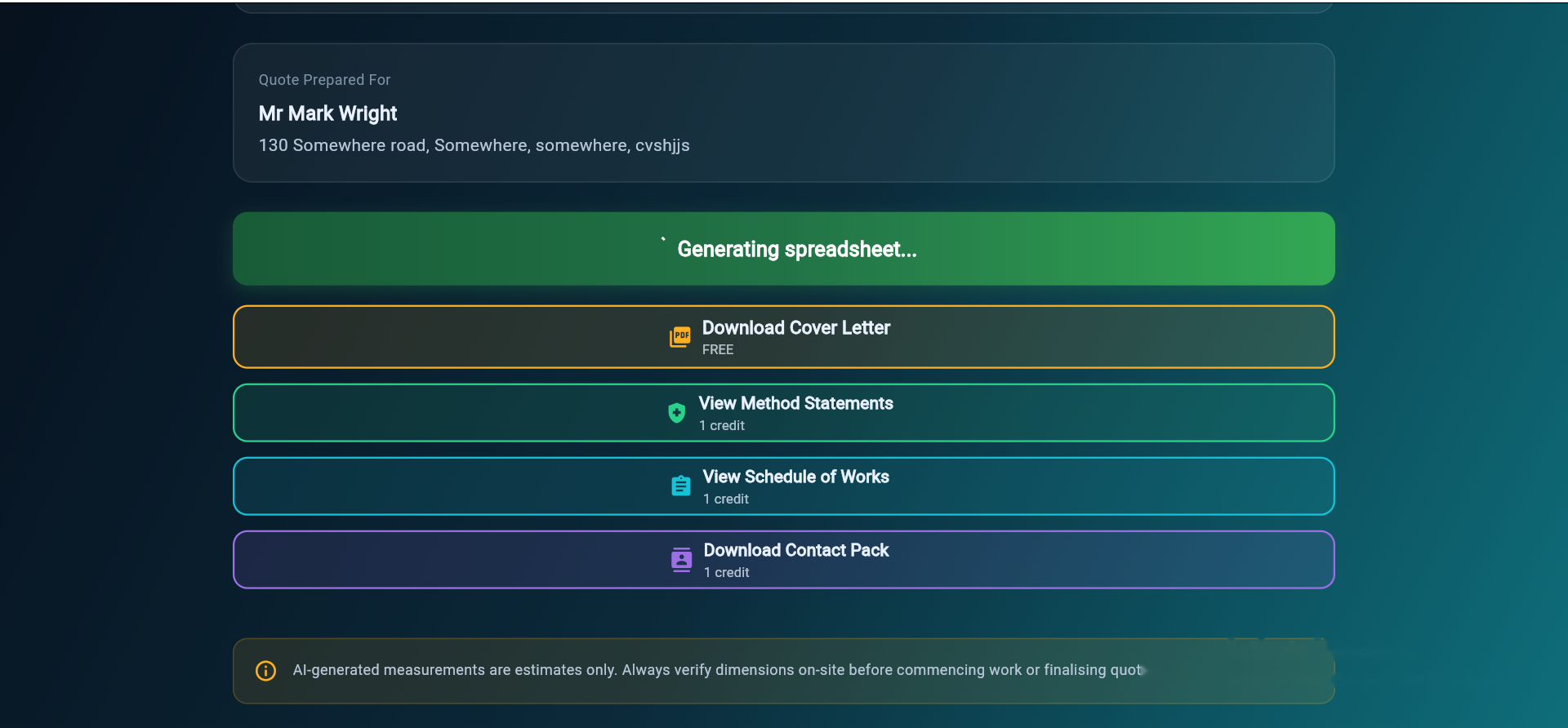
RenoCalc produces the cover letter free on all plans — and generates the full schedule of works, method statements and contract pack automatically from the floor plan. For most renovation quotes, the professional document is produced in the time it takes to upload the drawings.
3. Specific Scope
Clients are scared of the unknown. The biggest anxiety driving a client's decision is not "can I afford this?" — it's "what am I actually going to get, and what am I going to discover mid-job that I didn't know about?" Specificity in your scope is the most direct way to address that anxiety.
Compare these two quotes for the same bathroom renovation:
Version A: "Supply and fit new bathroom including full strip out, new shower, bath, toilet, basin, full tiling, electrics and plumbing. £12,500."
Version B: "Strip out and dispose of existing bathroom suite and tiles. Install new double shower tray and enclosure (client supply), wall-mounted bath (client supply), close-coupled WC and basin on half pedestal (client supply). First and second fix plumbing to all four appliances. Full tiling to walls above bath zone and shower enclosure, floor to entire bathroom — tiles client supply, adhesive and grout contractor supply. Install new extractor fan with timer. Install mains-wired shaving light. Redecoration of remaining wall area. Includes all waste disposal. Excludes supply of sanitaryware (client purchase). Programme: 8 working days. Price: £12,500."
Version B wins almost every time, even against a lower price for Version A. The client knows exactly what they're buying. The specific items that often cause disputes later (who supplies the tiles? who removes the old waste?) are explicit upfront. That specificity is trust — built through words, before the builder has touched a tool.
4. Right Price vs Lowest Price
Here's the uncomfortable truth about competing purely on price: the client who makes their decision based solely on the cheapest quote is the worst client you will ever have.
I've learned this the hard way. The client who calls three builders and awards to the cheapest is the same client who will query every invoice, request extras for free, dispute your standard payment terms, and leave a one-star review if anything doesn't go exactly as they imagined it would. They chose on price because price was their primary value — and they will hold you to that value at every turn.
Price your work correctly for the scope, the risk, and the quality you deliver. Don't artificially inflate for greed and don't artificially cut to win the job. If your price is right and you're still losing consistently to lower quotes, the issue is not your price — it's your presentation and trust level, which this guide addresses.
On being the highest quote
I have won jobs where I was the highest price of four quotes. The client said to me afterwards: "I felt most comfortable with you. I thought if something went wrong you'd be the one most likely to sort it." That comfort was built by the way I presented myself in the site visit, the quality of the quote document, and the fact that my scope was the most specific of the four.
Price your work properly and earn the premium. Don't race to the bottom.
5. References and Photos
Every quote should be accompanied by recent work photos and, where possible, a reference the client can call. This is particularly important for larger jobs — clients spending £30,000 or more on their property want to know you've done it before and done it well.
On photos: quality matters. A clear photo of a finished bathroom or kitchen, taken in good light with the space tidy, is worth twenty blurry mid-construction shots. Keep a folder of your best 10–15 project photos, updated quarterly. Include two or three in the quote document and make them available on your website or via a link.
On references: ask every satisfied client for permission to use them as a reference. Keep a short list of three to five who you know are genuinely happy and will answer a call. Different references for different project types — a reference for a bathroom refurbishment is more relevant to a bathroom prospect than a loft conversion reference.
A builder who has photos and references is a builder with a track record. A track record is the most powerful trust signal there is.
6. Follow Up Intelligently
Most builders either follow up too little (submit the quote and wait forever) or too much (calling every two days and creating pressure). The right structure is:
- Day 3: A brief message — "Just checking the quote arrived safely and happy to answer any questions." This is not a chase. It's a service touch. It also confirms they have the document.
- Day 7: A follow-up call if no response to the day 3 message. Keep it brief and non-pressured: "I wanted to check in on the bathroom project — are you at the point where you're ready to make a decision, or is there anything in the quote I can clarify?"
- Day 14: A final message for significant jobs. Beyond this, most decisions have been made. A gracious close: "I'll leave the quote with you — we're starting bookings for [month] if the timing works."
One thing that works particularly well: follow up with something useful. "I was reading about whether your property would qualify for the reduced VAT rate on bathroom conversions — wanted to check in case it's relevant." See HMRC's guidance on VAT for building contractors for the actual qualifying conditions — knowing this and sharing it with a client is a genuine value-add. A follow-up that gives value rather than just asking for a decision stands out from every other builder who's just calling to chase.
7. The Intro Meeting: What to Say
The site visit or initial meeting is where the job is won or lost — not at quote stage. By the time the client has three quotes on the table, they've already made a shortlist in their head based on how each builder came across at the site visit. The quote is usually confirmation of a decision already forming, not the decision itself.
What to do in the first five minutes
Listen. Don't start talking about how you'd approach it until you've understood exactly what they're trying to achieve. Ask: "What does the finished project need to do for you?" Not "what do you want" — what does it need to do. Kitchen clients say they want more space; what they actually need is for the family to be able to cook and eat together without the chaos of a small galley. That's what you're solving.
What to say on the site visit
Point out things they might not have noticed — potential issues, things that will affect the spec or cost. I always do this. Not to scare the client, but to show them that I'm looking at the job properly. If you find a potential damp issue and mention it at the site visit, you're demonstrating that you're thorough. If they discover it mid-job and you didn't flag it, you're now the builder who missed something obvious.
"I noticed [the existing waste pipe runs under the joist here] — that'll need to be re-routed to where you want the new position. Worth knowing for the programme." Ten words that show you know your trade. That's what builds trust before you leave the driveway.
What not to do
Don't quote a number at the site visit. Not even a ballpark. Tell them you'll review the drawings, do a proper calculation, and come back with a detailed quote. A builder who quotes on the spot looks like they've guessed — because they have. A builder who says "I need to sit down with the drawings and price this properly" looks like they're taking it seriously.
Video: What a Professional Building Quote Looks Like
This video shows the RenoCalc quote pack output — the kind of professional document that makes the difference between winning and losing a building job at the quote stage.
Frequently Asked Questions
Why do builders lose jobs even when they're not the most expensive?
The most common reason is that the client doesn't trust them enough to say yes. Trust is built through speed of response, professional presentation, specific scope (which shows competence), relevant references and photos, and how the builder handled the initial site visit and conversation. A slightly higher price from a builder who feels trustworthy will beat a lower price from one who feels uncertain.
How quickly should a builder send a quote to win the job?
Within 48 hours of the site visit, ideally the same day or next day for smaller jobs. The first credible quote often sets the reference point against which every subsequent quote is judged. Being chronically slow — a week or more after the site visit — consistently loses jobs to builders who quote faster.
Should I compete on price to win more building jobs?
Only if you want to attract clients who will cause you the most problems. The client who makes their decision purely on price is the one most likely to dispute invoices, demand extras for free and leave a difficult review. Price competitively — but price your value, not a race to the bottom. The right clients choose the right builder, not just the cheapest one.
What should a professional building quote include to win more jobs?
A professional quote should include a cover letter addressing the client by name, a detailed schedule of works showing exactly what is and isn't included, material specifications, payment terms, your insurance and accreditation details, and recent references or project photos. A quote that looks professional — structured, clearly laid out, free of typos — signals the quality of your workmanship before a single brick is laid.
How many times should I follow up after submitting a quote?
A structured follow-up is: a call or message 3 days after sending to confirm receipt; a second contact 7 days later if no response; a final message at 14 days for significant jobs. Beyond 14 days without response, most jobs have been decided — move on without burning the relationship.
Does FMB membership help win more building jobs?
FMB (Federation of Master Builders) membership is a credibility signal that some clients actively look for, particularly on larger residential projects. It indicates the contractor has been vetted, carries appropriate insurance, and operates to a code of practice. It helps most when included prominently in your quote document and on your website. It doesn't replace speed, presentation and specific scope — but for clients who search for FMB members specifically, it gets you on the shortlist.
Win More Jobs by Being the Builder Clients Trust
The seven points in this guide aren't complicated. They're consistent. The builders who win the most jobs in competitive markets are not the best tradespeople — they're the best at presenting themselves as someone a client can trust with their home and their money.
Speed, presentation, specificity, right price, references, intelligent follow-up, and a strong first meeting. Get these right and your conversion rate will improve — regardless of what's happening with competitor pricing in your area.
Start with the quote document — it's the most visible signal of your professionalism. RenoCalc generates the full quote pack automatically from a floor plan, including the cover letter, schedule of works and contract.
Win More Jobs with a Professional Quote Pack
RenoCalc produces a professional cover letter, itemised schedule of works, method statements and contract pack from your floor plan in under 3 minutes. The document that wins the job — built for UK builders.
Try RenoCalc Free