How Long Does a Building Quote Take? (And How to Do It Faster)
Quick Answer
A building quote takes 1–4 hours for a small job (under £10,000), 4–16 hours for a medium renovation (£10,000–50,000), and 2–5 days for a large or complex project (£50,000+). The biggest time sink is the quantity takeoff and material pricing. Industry best practice is to respond within 48–72 hours of a site visit — delays beyond this significantly reduce win rates.
There's no single answer — how long a building quote takes depends on the size of the job, the complexity of the scope, how good your systems are, and how prepared the client is. A bathroom renovation quote looks nothing like a full house renovation or a commercial fit-out in terms of the time it takes.
What I can give you is a realistic breakdown by job size, an honest account of what actually eats the time, and practical ways to cut that time without cutting corners on accuracy. I've been quoting building jobs for 32 years — here's what the numbers look like from the inside.
See also: building quote templates UK to speed up your document production.
Quoting Time by Job Size
These are realistic estimates based on preparing a proper, itemised quote — not a text message with a number at the end of it.
| Job Size | Typical Value | Quoting Time | Main Tasks |
|---|---|---|---|
| Small job | £2,000–£10,000 | 1–4 hours | Site visit, measure, price, write up |
| Medium job | £10,000–£50,000 | 4–16 hours | Full takeoff from drawings, trade-by-trade pricing, structured document |
| Large job | £50,000+ | 2–5 days | Detailed takeoff, subcontractor quotes, programme, prelims, risk register |
These ranges assume one person doing the quoting. On large jobs, experienced estimators often work the takeoff and the pricing simultaneously, which can compress the timeline — but not by much, because the measuring still has to be done.
What Eats the Most Time
1. The material quantity takeoff
This is almost always the biggest time cost. Working through the drawings, measuring every element by trade, applying waste factors and listing quantities before you can even begin pricing — this can take half the total quoting time on a medium-sized job. A renovation of a 3-bedroom house with full refurbishment across all trades might need 6–8 hours of takeoff work before you price a single item.
2. Pricing materials
Once you have quantities, you need current prices. Calling your merchants, checking your trade account pricing online, getting quotes for specialist items — this adds hours. Prices change, so you can't rely on last month's invoice for this month's quote.
3. Writing the document
Many builders underestimate how long it takes to produce a professional-looking quote document. A typed-up schedule of works with clear line items, a cover letter, payment terms, your company details — done properly, this takes 1–3 hours even when all the numbers are ready. Doing it in a text editor from scratch every time is the slowest approach.
4. Chasing subcontractor prices
On any job that involves trades you subcontract — electricians, plumbers, groundworkers — you're dependent on their turnaround time. Waiting for a subie quote can hold up your main quote for days. Either build in your own rates for standard subie work, or get subie quotes in parallel during the site visit stage.
How to Speed Up Your Quotes
The builders who quote fastest — without compromising accuracy — have three things in place:
A template library
A master quote document that you fill in rather than create from scratch every time. Your company branding, standard terms, payment schedule, health and safety preamble — all in one template. You're only writing the job-specific scope each time. This alone cuts document production time by 50–70%.
Saved rate cards
Your standard labour rates by trade, set out in a reference table you can apply quickly. Your day rate for a plasterer, your rate per m2 for tiling, your rate per metre for skirting. Revisit these quarterly — they drift with wage inflation — but the structure stays constant. Once you have a rate card, labour pricing for a medium job takes minutes rather than hours.
AI tools for the quantity takeoff
This is where the biggest time saving now comes from. Tools like RenoCalc read your floor plan using AI and complete the material quantity takeoff automatically — measuring room areas, calculating wall areas, identifying every trade element, applying waste factors and pricing from a UK material library. The takeoff that would take 4–8 hours manually is done in under 3 minutes.
Related: how to write a building quote, how to quote a building job, how to do a material takeoff, and how to calculate renovation costs. The Federation of Master Builders (FMB) recommends all contractors aim to respond to quote requests within 48 hours as part of good professional practice.
The Client Side of Quoting Time
Quoting time isn't just about how fast you can produce the document — it's also about how long the client takes to give you what you need to start, and how long they take to make a decision.
What slows the quote down on the client's side
- No drawings — you have to arrange a full measured survey before you can do a takeoff
- Vague or changing scope — "we might want to extend as well" means you can't finalise the spec
- Missing information — no confirmed material choices, no confirmation on specification level
- Unresponsive to follow-up — questions go unanswered for days
What to do about it
Build a standard enquiry form or site visit checklist that gets the key information before you start quoting. Floor plan or dimensions, scope of works, material choices (or a decision on whether you'll specify), planning status, access constraints, preferred start date. Getting this at the site visit rather than in follow-up emails saves significant time.
Decision timelines
Most residential clients take 1–3 weeks to decide between quotes. Don't mistake that for indecision — they're usually comparing multiple quotes, talking to partners or family, and checking finances. A polite follow-up at 3 days and again at 7 days is standard practice. Beyond 14 days with no response, move on unless the job is significant enough to warrant a third contact.
Industry Benchmark: When to Send Your Quote
The general rule in the UK building trade is to quote within 48–72 hours of the site visit. This isn't arbitrary — it reflects how quickly clients move on. Beyond 72 hours, many clients have already spoken to two or three other builders and the front-runner is taking shape. Get your quote in after a week and you're often fighting uphill.
The fastest quote isn't always the winning quote, but chronically slow quoting is a reliable way to lose jobs. If you're regularly taking a week or more to quote medium-sized jobs, the bottleneck is worth fixing — either through better systems or through tools that compress the takeoff time.
For smaller jobs (up to £10,000), same-day or next-day quoting is achievable and gives you a distinct advantage. Clients are often pleasantly surprised to get a professional quote the same day as a site visit, and that alone builds confidence in you as an organised, professional contractor.
How RenoCalc Changes the Maths
RenoCalc's AI reads your floor plan and produces the calculation portion of a renovation quote — quantities, material prices, trade breakdowns — in approximately 3 minutes. That's the part of quoting that normally takes the most time.
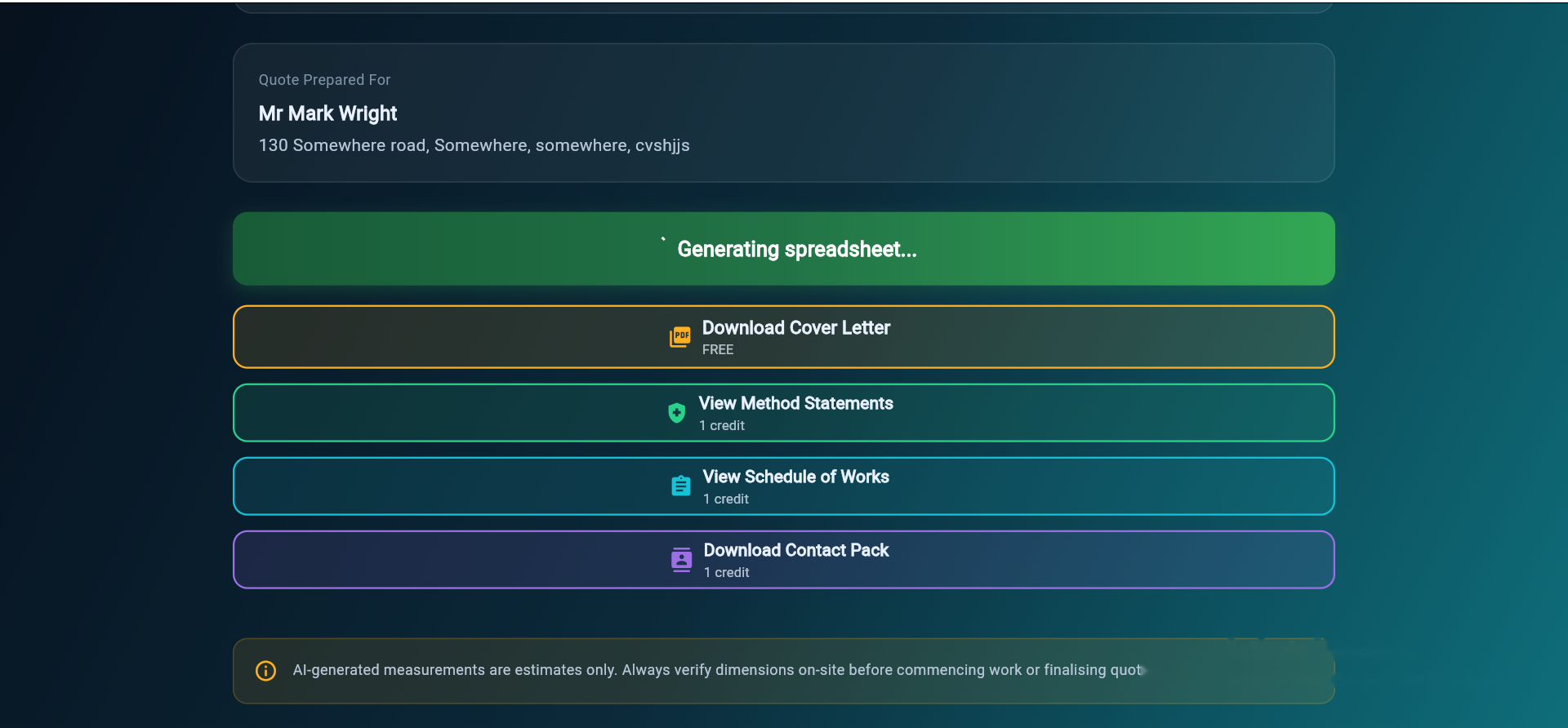
The outputs are a structured quote pack: a cover letter (free on all plans), schedule of works, method statements and a contract pack. The numbers come from a UK material price library and a construction spreadsheet with 40,000+ formulas. You review the output, adjust for anything job-specific, and send.
For renovation quoting — where the floor plan captures most of what you need to measure — this compresses a half-day job into a 15–30 minute review. That changes the economics of how many quotes a builder can realistically submit in a week, which directly affects how many jobs they win.
Video: Quote from Floor Plan in Minutes
This walkthrough shows exactly how RenoCalc compresses the quoting process — from floor plan upload to finished quote pack in under 3 minutes for the calculation stage.
Frequently Asked Questions
How long should a building quote take to prepare?
It depends on the job size. A small building job (£2,000–£10,000) typically takes 1–4 hours to quote properly. A medium job (£10,000–£50,000) takes 4–16 hours. A large project (£50,000+) can take 2–5 days. The biggest time cost is the material quantity takeoff, followed by pricing each item and writing the quote document.
How quickly should a builder respond with a quote?
The industry benchmark for responding to a quote request is within 48–72 hours of the site visit. Beyond 72 hours, clients often start calling other builders and you risk losing the job. For smaller jobs where the scope is clear, same-day or next-day quoting is achievable and gives you a significant advantage.
What takes the longest when writing a building quote?
The material quantity takeoff is typically the most time-consuming part — measuring every element from drawings, applying waste factors and pricing each item. Writing the document (formatting the quote, cover letter, schedule) comes second. Pricing labour rates is usually faster if you have an established rate card.
How can I speed up my building quotes?
The three biggest time savers are: a template library (a reusable quote format you fill in rather than creating from scratch), saved rate cards (your standard labour rates by trade, ready to apply), and AI tools for the quantity takeoff (RenoCalc reads a floor plan and completes material quantities in minutes). Used together, these can cut quoting time by 70–80%.
Does quoting faster mean quoting less accurately?
Not if you're using the right tools. Manual quoting done slowly isn't necessarily more accurate — it's just slower. AI-assisted takeoffs from floor plans can be more accurate than manual methods because they don't make transcription errors or miss elements. Speed and accuracy aren't in opposition — the right system delivers both.
Is a builder's quote legally binding in the UK?
A written, accepted quote is legally a contract in the UK — it binds both parties to the price and scope stated, subject to any qualifying conditions in the document. An estimate (as opposed to a quote) is not binding and can change. Make clear in your document whether it is a fixed-price quotation or an estimate. Include a validity period (typically 30 days). The Federation of Master Builders recommends always using written contracts for any building work.
Quote Faster Without Compromising Your Numbers
Quoting is one of the most time-consuming parts of running a building business — and also one of the most commercially important. The builder who quotes well and quotes fast wins more work. The builder who takes a week to produce a basic renovation quote loses opportunities while they're still working on the document.
The calculation part of a renovation quote — the part that normally takes the most time — is exactly what RenoCalc is built to accelerate. Try it on your next renovation enquiry.
Quote Your Next Job in Minutes
RenoCalc turns a floor plan into a full renovation quote pack in under 3 minutes. Professional cover letter, itemised schedule, method statements and contract — built for UK builders.
Try RenoCalc Free