How to Estimate Construction Costs: A Practical Guide for UK Builders
Quick Answer
To estimate construction costs: define the scope precisely from drawings or a measured survey, do a full quantity takeoff (measuring every element), apply current material rates from your supplier, apply realistic labour rates per trade, add plant costs, preliminaries (site management, welfare, insurance), and an appropriate margin. For renovation work, add 10–15% contingency for unknowns.
Estimating is the difference between a profitable construction business and one that's always chasing its tail.
I don't mean that lightly. I've seen builders with full order books and empty bank accounts. I've seen builders working seven days a week on jobs that are making them less per hour than a site labourer. In most of these cases, the problem wasn't that they couldn't build. The problem was that they couldn't estimate. They priced jobs on gut feel, on what they thought the market would bear, on what competitors were charging — not on what the job actually cost.
Good estimating is a discipline. It's methodical, it's time-consuming when done properly, and it requires up-to-date information on material prices and labour rates. But it's learnable. And with the right tools, it's much faster than most builders think it needs to be.
This guide covers the complete eight-step construction estimating process — from scope definition through to final sanity check — including how AI tools are changing the speed and consistency of steps that used to take the longest.
Step 1: Define the Scope Precisely
You cannot estimate what you haven't defined. This sounds obvious, but the most common estimating errors I see come from starting the numbers before the scope is clear — and then having to revise the estimate when the scope turns out to include something that wasn't accounted for.
Scope definition starts with the drawings and the specification. If there are no drawings, there is no basis for a fixed-price estimate — only a rough indication. For any job over about £20,000, you should be working from a floor plan or structural drawing at a minimum. For complex jobs, you should have an architect's drawing package and a written specification describing materials, finishes, and standards.
Write down what is in scope and what is explicitly excluded. The exclusions list is as important as the scope itself — it's what protects you when a client argues that something you didn't include was "obviously" part of the job.
Step 2: Do the Quantity Takeoff
The quantity takeoff (QTO) is the process of measuring every element in the scope from the drawings or from the site, and recording the quantities in a structured format. This is the most labour-intensive part of construction estimating, and it's where most of the time goes when estimating is done manually.
Work systematically — trade by trade, room by room. For each element, record:
- The element description (e.g., 12.5mm plasterboard to walls)
- The unit of measurement (m², m, nr, t)
- The quantity, measured from the drawings with waste allowance applied
Common elements and their typical units:
- Plasterboard, floor finishes, insulation, roofing membrane: m²
- Timber framing, pipework, guttering, skirting: linear metres (m)
- Doors, windows, sanitary fittings, light fittings: number (nr)
- Concrete, screed, hardcore fill: cubic metres (m³)
- Structural steels: kg or tonnes (priced by fabricator)
Apply waste factors. On board materials and sheet goods, 10% waste is typical. On cut materials like tiles, allow 12–15%. On bulk materials like sand and aggregate, 5% covers normal waste.
Step 3: Apply Material Rates
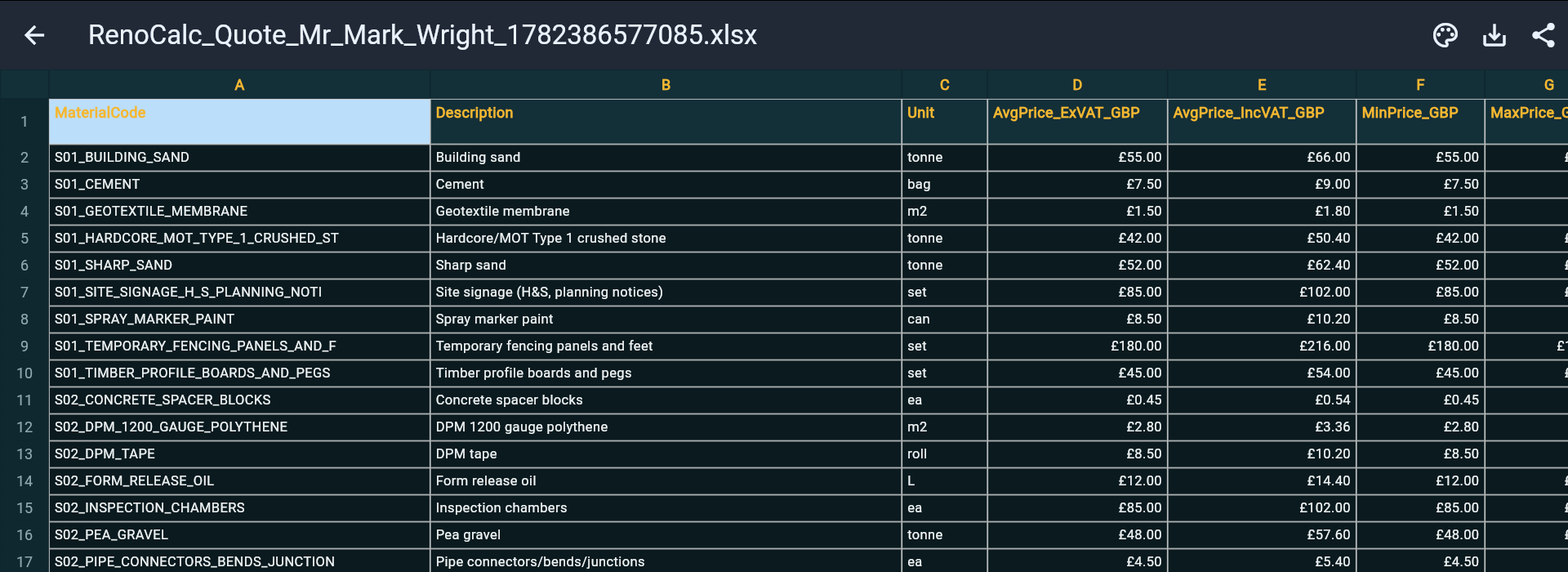
Apply your quantities against current material prices. The operative word is current. Material prices in the UK construction industry move more than most builders account for — timber prices have been particularly volatile since 2020, and insulation and copper have both seen significant movements.
Use your supplier's actual price list, not prices from memory or from a previous quote. For significant quantities, call the merchant and get a written price. For standard items, use a current trade price list or a materials price database that is regularly updated.
Include fixings, adhesives, primers, and sealants as a separate allowance — typically 1–3% of the main materials cost. These small items are individually trivial but collectively significant on a large renovation. The builder who doesn't include them is either absorbing the cost from margin or buying them out of their own pocket.
Don't price materials at the retail price. You're a trade customer — your merchant prices should be 20–40% below retail depending on your volume and relationship. If they're not, that's a conversation worth having with your supplier.
Step 4: Apply Labour Rates
Labour is typically the largest component of a construction estimate — often 40–60% of the total build cost on a renovation. Getting it right matters more than any other single element.
For each trade package, estimate the number of hours or days required. This comes from experience — from knowing how long it takes a plasterer to skim a room, how many hours a plumber needs for a bathroom first-fix, how many days a team of two need to strip and re-roof a bay extension. If you don't have this experience yourself, ask your subcontractors before you price the job.
Apply your actual costs: your subcontractors' rates, your own day rate, and the cost of employed labour including employer's NI and any other on-costs. Don't price your own time at zero because you're the business owner. If you do the work yourself, you're foregoing other opportunities — the cost is real even if it doesn't appear in your accounts.
Include allowances for supervision time, snagging, and end-of-job tidying. These aren't priced as separate line items usually, but they need to be factored into your labour hours. A job that looks finished takes another 5–10% of the build time to actually finish.
Step 5: Add Plant and Equipment
Plant costs are frequently underestimated or forgotten entirely. On a domestic renovation or extension, plant and equipment costs typically include:
- Scaffolding — erect, weekly hire, and strike. On a standard extension, budget £1,500–£4,000 depending on height and duration
- Concrete mixer — hire if not owned, or allow for ready-mix delivery and pump if volumes are significant
- Dumper — for moving materials on site where access is tight
- Powered access — scissor lift or cherry picker for high-level work
- Compactor — for hardcore filling and paving beds
- Temporary power supply — generator hire if mains isn't available at the outset
Price each item separately and for the duration you'll need it. Scaffolding in particular is often under-hired — the job runs long, the scaffold company bills for additional weeks, and the cost comes out of your margin. Allow for overruns in your hire durations.
Step 6: Add Preliminaries
Preliminaries are the costs of running the project that aren't tied to a specific trade element. They're often referred to as "prelims" and they're one of the most commonly underestimated components of a construction estimate.
On a domestic renovation or extension, prelims typically include:
- Site management — your time or a dedicated site manager's time running the project
- Skip hire — for demolition waste, packaging, and general site clearance throughout the project
- Site welfare — portable toilet if the property is unoccupied or bathroom is out of action
- Builders' risk insurance for the project duration
- Health and safety costs — any required documentation, COSHH assessments, temporary barriers
- Temporary protection — floor protection, door protection, dust sheets
- Builder's clean on practical completion
- Deliveries and distribution on site
On a straightforward domestic renovation, prelims are typically 10–15% of the direct construction cost. On complex projects with difficult access, extended duration, or significant site management requirements, prelims can exceed 20%.
Step 7: Apply Margin
Margin is applied to the total estimated cost — materials, labour, plant, and prelims — to arrive at your tender sum. The margin covers your overhead (office costs, vehicle, insurance, accountancy, software, telephone) and your profit.
The important distinction to understand is between markup and margin. A 20% markup on your costs is not a 20% margin. If your costs are £100,000 and you add 20% markup, you charge £120,000 — and your margin on that selling price is 16.7%, not 20%. If you're targeting a 20% margin, you need to charge £125,000 on £100,000 of costs (125,000 × 80% = 100,000).
Most UK domestic builders work on a net margin of 15–25% depending on the type of work, the risk profile of the job, and the competitive environment. Renovation typically commands higher margins than new build because the unknowns are greater. Specialist or complex work — listed buildings, phased occupied renovations, technically demanding structural projects — should carry higher margins still.
Know your margin target. Apply it consistently. And don't reduce it to win a job without understanding exactly what you're giving up.
Step 8: Sanity Check Against Cost per m²
Before the estimate goes out, check your total against current UK construction cost per m² benchmarks. These figures aren't how you price a job, but they're how you check that your pricing hasn't gone badly wrong somewhere.
Current UK benchmarks for 2026 (excluding London uplift of 25–40%):
| Project Type | Cost per m² Range | Notes |
|---|---|---|
| Light renovation — kitchen, bathroom, decoration | £500–£900/m² | Floor area of property |
| Full renovation — mid-range specification | £800–£1,400/m² | All trades, structural included |
| Full renovation — high specification | £1,400–£2,200/m² | Premium finishes, bespoke elements |
| Single-storey rear extension | £1,800–£2,800/m² | Extension floor area |
| Two-storey extension | £1,600–£2,400/m² | Extension floor area (per floor) |
| New build residential | £1,500–£2,500/m² | Gross internal area |
If your estimate is significantly below the lower end of the range for the type of project, investigate what you might have missed. If it's significantly above the upper end, check that you haven't priced something twice or applied margin on top of margin. A 10–15% deviation in either direction is worth examining before the quote goes out.
What Makes Construction Estimating Hard
Every Job Is Different
Unlike manufacturing, where the same product is produced thousands of times with predictable costs, every construction project is unique. Different site conditions, different existing structures, different client briefs, different specifications. Experience helps enormously — a builder who has done fifty bathroom renovations can estimate a bathroom renovation much faster and more accurately than one who has done five. But experience can also create blind spots, where you assume the job will be like the last one and miss the ways in which it isn't.
Material Prices Change
Material prices in UK construction move constantly. Timber prices have been particularly volatile since 2020. Copper prices track global commodity markets. Insulation prices have moved with energy policy and manufacturing capacity. An estimate prepared from last year's prices can be significantly wrong by the time work starts, especially if there's a gap between estimate and start date. Build a validity period into every quote — and if material prices move significantly between quote and start, have a mechanism in your contract to address it.
The Labour Market Is Tight
Finding competent subcontractors at consistent rates is increasingly difficult in UK construction. Rates that were current three months ago may no longer be available from the same subcontractor — particularly in electrical, plumbing, and structural steelwork. Get updated rates from your subcontractors before pricing a significant job. Don't assume last year's rates are still available.
How AI Changes the Estimating Process
The traditional estimating process for a mid-size renovation job takes a full day when done properly: measuring from drawings, calculating quantities, applying material prices from a price list, working out labour hours, adding prelims and margin, writing it all up. That's before the quote document itself is produced.
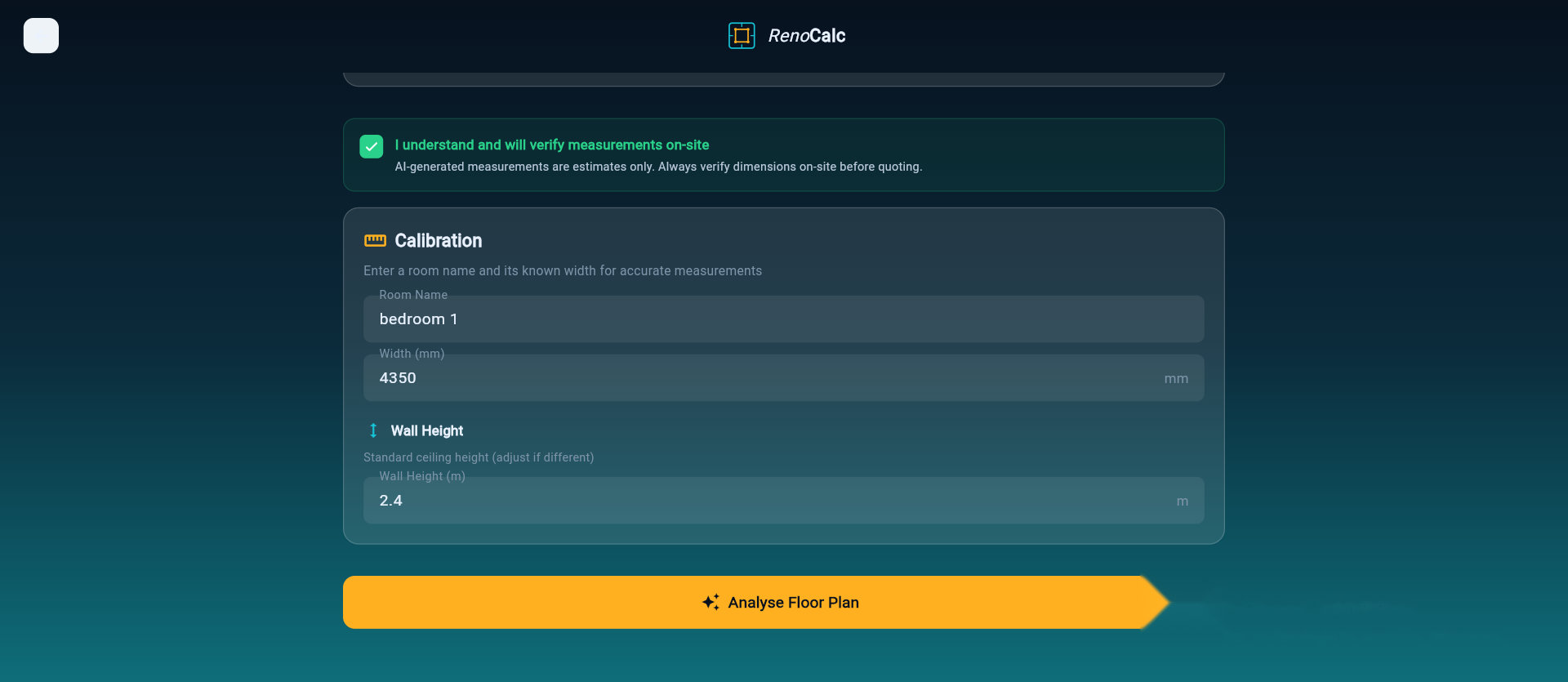
AI-powered estimating tools — specifically ones that can read floor plans — automate the most time-consuming parts of this process. RenoCalc scans your floor plan, identifies every room and element, measures quantities, applies current UK trade material prices, calculates labour by trade, adds prelims, and applies your margin — in under three minutes.
That doesn't mean AI replaces the judgement of an experienced estimator. You still need to review the output, adjust for site-specific conditions, update rates for your actual subcontractors, and apply your knowledge of what this particular job is going to involve. But the hours of manual calculation — the part that's mechanical rather than intellectual — are handled automatically.
The result is faster estimates, more consistent pricing across multiple jobs, and the ability to respond to more enquiries without scaling your estimating overhead.
Estimate Your Next Construction Job in Under 3 Minutes
RenoCalc automates the quantity takeoff and pricing — materials at UK trade rates, labour by trade, prelims, margin — from your floor plan. Full quote pack included. Free to start, no card required.
Start Your Free EstimateFrequently Asked Questions
What is a quantity takeoff in construction estimating?
A quantity takeoff (QTO) is the process of measuring every element of a construction project from drawings or a site survey and recording the quantities — square metres, linear metres, cubic metres, individual items — that will be used to price materials and labour. A thorough quantity takeoff is the foundation of an accurate estimate. Errors in the takeoff — missed elements, wrong measurements, wrong units — propagate through the entire estimate and result in under- or over-pricing.
How accurate is construction cost estimating?
The accuracy of a construction cost estimate depends directly on the quality of the scope definition and the quantity takeoff. An estimate prepared from detailed drawings and a full specification, using current market prices, should be accurate to within 5–10% of the final construction cost — assuming no major unforeseen conditions arise. Estimates prepared from rough sketches, verbal descriptions, or cost per m² benchmarks alone should be treated as indicative figures, not fixed prices.
What should be included in construction preliminaries?
Construction preliminaries typically include: project management and site management time; site welfare facilities (toilets, canteen if required); scaffolding and access equipment; skip hire and waste disposal; site security; temporary electricity, water, and other services; builder's risk insurance for the project duration; health and safety obligations; and builder's clean on completion. On a domestic renovation, prelims typically add 10–15% to the direct construction cost. On larger or more complex projects, prelims can be significantly higher.
What is the difference between construction estimating and quantity surveying?
Construction estimating is the process of calculating the probable cost of a construction project — typically carried out by the builder or a specialist estimator. Quantity surveying is a broader profession that includes cost planning, procurement, contract administration, valuations, and final account settlement — usually carried out by a qualified Quantity Surveyor (QS). For domestic building work, most builders do their own estimating without a QS. For larger commercial projects, a QS is typically involved throughout the project lifecycle.
How does AI change construction cost estimating?
AI-powered tools like RenoCalc can automate the most time-consuming parts of the estimating process — scanning floor plans, measuring quantities, and applying current trade prices — in minutes rather than hours. This doesn't replace the judgement of an experienced estimator, but it removes the manual data entry and calculation work that takes up most of the time. The result is faster estimates, more consistent pricing, and the ability to quote more jobs without increasing overhead.