How to Price a Renovation Job: What 32 Years on the Tools Taught Me
Quick Answer
To price a renovation job accurately: survey the existing condition before pricing anything, scope it trade by trade, cost materials from your actual supplier prices, apply realistic labour rates including your overhead, add a profit margin (not markup — they are different), include a contingency of 10–15% for renovation unknowns, and sanity-check against the cost per m² for that type of work.
The number one reason builders lose money on renovation jobs is not bad luck. It's not difficult clients. It's not material prices going up. It's pricing the job before they properly understand it.
I've been on both sides of this. Early in my career, I priced a full house renovation on a Victorian terrace in Coventry based on what I could see. What I couldn't see — behind the chimney breast, under the suspended timber floors, inside the walls I was stripping — cost me three weeks of unprogrammed work and wiped out every penny of margin on the job. I finished it. I didn't make a penny on it. The client was happy. I was not.
That was an expensive lesson. Thirty-two years later, I price renovation jobs very differently. This guide covers the complete process — eight steps from understanding the brief to presenting the final quote — with the hard-won knowledge of what happens when you skip any of them.
Step 1: Understand What the Client Actually Wants
The brief and the budget are two different things, and both need to be established before you set foot on site with a laser measure. I've been to site visits where the client described a "light renovation" that turned out to mean a complete gut-and-rebuild. I've been to others where the client's wish list was £150,000 worth of work and their budget was £60,000.
Ask direct questions. What does the finished property need to achieve — family home, rental, sale? What is your total budget including VAT? What is your timeline? Who makes the final decision? Have you had other builders look at this? These aren't impolite questions — they're the questions that determine whether there's a viable job here and whether you're the right builder for it.
If the brief and the budget are fundamentally mismatched, you can save everyone time by saying so early. It's not rude. It's professional.
Step 2: Survey the Existing Condition
On new build, you're working to drawings. On renovation, the existing building is part of the price — and the existing building has a habit of hiding things from you until you've committed to a fixed price.
I always look behind, under, and inside. Remove an access panel to see what's going on with the services. Lift a floor board in the bathroom to check the joists. Look at the chimney breast closely — is it hollow? What does the loft hatch reveal about the structure? Where are the soil pipes running? Is there any evidence of damp, rot, or movement that might indicate something larger going on?
Photograph everything you can access. These photographs become your record of the pre-existing condition — invaluable if the client later claims you caused a defect that was already there when you arrived.
The things you can't access or investigate are why contingency exists. But you should access and investigate everything you reasonably can before setting your price.

Step 3: Scope It Trade by Trade
Once you have your site notes and your understanding of what's there, structure the scope as a list of trade packages. This is the most reliable way to make sure nothing is missed.
Go through every trade systematically: demolition and strip-out, structural works, roofing (if applicable), drainage, first-fix carpentry, first-fix plumbing, first-fix electrics, insulation, plastering, second-fix carpentry, second-fix plumbing, second-fix electrics, tiling, flooring, decoration, external works. For each package, ask: is there work in this package on this job? If yes, what specifically?
The elements that catch people out are the ones that sit between trades — the work that's nobody's primary responsibility. Making good after a new steel beam is installed. Sealing around new pipework penetrations. Skimming the patch after a new socket is chased in. These small items add up quickly across a whole-house renovation and need to be included in someone's package.
Step 4: Price Materials from Your Supplier or Price List
Get current prices. Not prices from memory. Not prices from a quote you did earlier in the year. Material prices in the UK — particularly timber, insulation, and copper — move more than most builders account for.
For significant quantities, call your merchant and get a written price. For smaller items, use a current trade price list. Apply your waste allowances — 10% on board materials and tiles, 15% on cut items like timber, 5% on bulk materials like sand and cement. Don't forget fixings, adhesives, primers, sealants, and all the consumables that are easy to overlook individually and significant collectively across a full renovation.
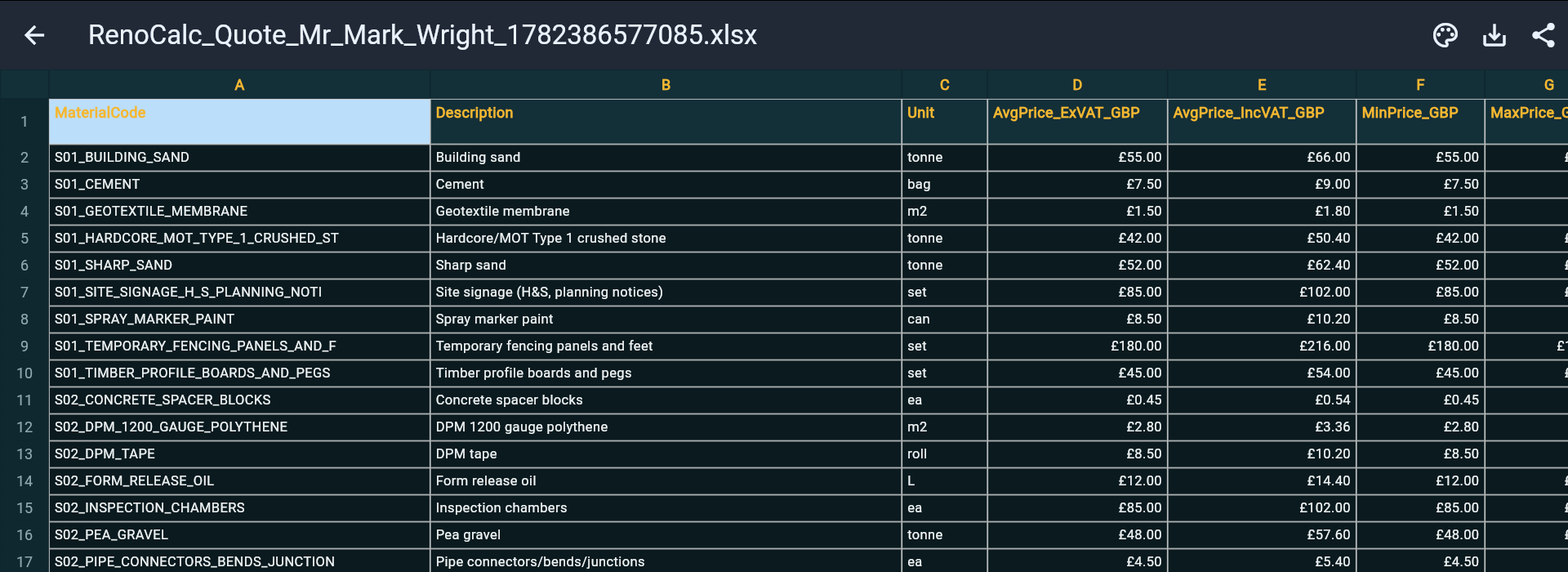
The RenoCalc materials price library is updated regularly with UK trade prices and covers the full range of renovation materials — which means when you generate a quote from a floor plan, the material pricing is current, not from last year's memory.
Step 5: Price Labour at Your Actual Costs
Be honest about your costs. If a subcontractor charges you £250 a day, that's what their work costs — regardless of what you think the going rate is or what you wish it was. If you're doing the work yourself, your day rate is the cost — not zero because you're the business owner.
Estimate hours or days for each trade package based on the scope. If you're uncertain, talk to your subcontractors before pricing — most will give you a steer on time for a specific scope, even informally. Better a slightly over-estimated labour figure than one that assumes everything goes perfectly.
Remember that labour costs include time for things that aren't direct trade work: site management visits, organising deliveries, dealing with problems on site, coordinating inspections, and the time you spend managing the job from the office. These hours are real costs even if no work is physically being done.
Step 6: Add Profit Margin — Not Markup
This distinction trips up a significant number of builders who have been in the trade for years, so it's worth being precise about it.
Markup is a percentage added on top of your costs. If your costs are £50,000 and you add a 20% markup, you charge £60,000. Your profit is £10,000.
Margin is a percentage of your selling price. If you want a 20% margin, your selling price needs to be such that £10,000 represents 20% of it — meaning you charge £62,500 on a £50,000 cost base.
The reason this matters: overhead targets, business planning, and industry benchmarks are all expressed as percentages of turnover (selling price), not cost. If you're targeting a 20% profit margin on your turnover but applying a 20% markup, you're actually achieving a 16.7% margin and wondering why the business isn't as profitable as it should be.
On renovation work in the UK in 2026, most established builders work on a net margin of 15–25%. New build is typically lower; renovation is higher because the risk is higher. Know your number and apply it consistently.
Step 7: Check Against Cost per m² Benchmarks
Once you have a total, check it against current UK renovation cost per m² benchmarks. These figures won't be your pricing method, but they're your sanity check — the test that tells you whether your detailed pricing has landed in a credible range or whether you've made an error somewhere.
Current UK benchmarks for 2026 (excluding London uplift):
- Light renovation — new kitchen, bathroom, replaster, decoration: £500–£900 per m² of floor area
- Mid-range full renovation — structural works, all trades, mid-range finishes: £800–£1,400 per m²
- High specification renovation — premium materials, bespoke joinery, high-end bathrooms: £1,400–£2,200 per m²
- Add 25–40% in London and the South East
If your detailed pricing comes out at £300 per m² on a mid-range renovation, you've missed something. If it comes out at £2,500 per m² on a light renovation, you've either priced something twice or your margin is significantly higher than you intended. Use these benchmarks as a sense-check before the quote goes out — not as a substitute for proper pricing.
Step 8: Present as a Proper Quote, Not a Ballpark
A ballpark figure commits you to nothing and wins you nothing. "Somewhere between £80,000 and £120,000 depending on what we find" is not a quote. It tells the client you haven't done the work yet and it gives you no competitive advantage over anyone else who sends a vague number.
A proper renovation quote has a clear scope (what you're doing), a clear exclusions list (what you're not doing), a payment schedule, a validity period, and a total price broken down by trade or category. It arrives as a professional PDF, not a plain email. It has a cover letter that summarises your approach and answers the questions the client is likely to have. It arrives within a week of the site visit — ideally within three to four days.
That combination — detailed, professional, fast — is what wins jobs in a competitive market.
Mistakes That Cost Builders Money
Underpricing to Win
The temptation to cut your margin to win a job you want is understandable. I've felt it. The problem is that a job you're doing at zero margin or below it is worse than no job — you're borrowing money, materials, and management time from a profitable job you could be doing instead. The money you lose underpricing one job is the money that should be funding your business, your equipment, and your next hire. Underpricing to win is a short-term fix that creates long-term damage.
Not Including Enough Contingency for Renovation Unknowns
Every experienced renovation builder has stories like mine — the hidden rot, the unexpected structural defect, the asbestos nobody mentioned, the services that aren't where the drawing says they are. Renovation is inherently more uncertain than new build. Price that uncertainty in. A 5–10% contingency is not greed; it's experience. If you don't use it, you can return it to the client or carry it to profit. If you need it, you'll be glad it's there.
Pricing Without Seeing the Property
I won't price a renovation from photographs, videos, or floor plans alone. Not accurately. The floor plan tells you the layout. The photographs tell you what it looked like on the day they were taken. Neither tells you what's behind the walls, under the floors, or above the ceilings. A brief site visit — even 30 minutes — is worth more to your pricing accuracy than any amount of document review.
How RenoCalc Changes the Pricing Process
The survey and the investigation of the existing condition are always yours. But once you have your site notes and your scope, RenoCalc takes your floor plan and generates a full renovation pricing breakdown in under three minutes — materials priced at current UK trade rates, labour calculated by trade, prelims included, margin applied.
The output is a complete quote pack: schedule of works, method statements, contract pack, and a free cover letter. What used to take a full day now takes an afternoon to generate and review. That means you can quote more jobs, faster, with more consistent pricing.
Price Your Next Renovation Job in Under 3 Minutes
Upload your floor plan and RenoCalc generates a complete, accurate renovation quote — materials, labour, prelims, margin, cover letter and contract. Built for UK builders by a builder with 32 years in the trade.
Start Your Free EstimateFrequently Asked Questions
What profit margin should a builder charge on a renovation job?
Most UK builders working on domestic renovation aim for a net profit margin of 15–25% on their turnover. The confusion usually comes from the difference between margin and markup: a 25% markup on costs gives you a 20% margin on the selling price. On renovation work specifically, margins need to be higher than on new build because the unknowns are greater — there's more that can go wrong, more that's hidden, and more variation in what you find on site. Many experienced builders will not take on renovation work for less than 20% margin.
What is the difference between margin and markup in construction?
Markup is calculated as a percentage of cost. Margin is calculated as a percentage of selling price. If your costs are £10,000 and you apply a 25% markup, your selling price is £12,500 — but your margin on that selling price is 20% (£2,500 / £12,500). This distinction matters because overhead absorption and profit targets are typically expressed as percentages of turnover (selling price), not cost. If you target a 25% profit margin but apply a 25% markup, you'll fall short.
How do I price a renovation job I've never done before?
Break it down into the individual elements you have priced before. You may not have priced an entire house renovation, but you've priced plastering, you've priced a bathroom, you've priced electrical first-fix. Price each trade and element individually, price the materials accurately, add your prelims and your margin, then check the total against current UK cost per m² benchmarks for the type of renovation you're doing. If the number is significantly outside the typical range, investigate why before sending the quote.
How much contingency should I include in a renovation quote?
On renovation work, include a contingency of 5–10% of the build cost as a named line item. The contingency covers genuinely unforeseen conditions — rot behind cladding, asbestos in textured ceilings, underfloor voids, services that aren't where they should be. On a property you've never seen inside before, 5% is the minimum. On an older property with limited drawings and unclear history, 10% is more realistic. Explain to the client what the contingency is for — most will understand. Those who insist it's removed are telling you something about how they'll behave if something unexpected happens on site.
What is a typical cost per m² for a full house renovation in the UK?
A full house renovation in the UK in 2026 typically costs £800–£1,400 per m² of floor area for a mid-range specification, and £1,400–£2,200 per m² for a high specification. Basic renovation — new kitchen, bathroom, replaster, electrics and decoration — runs £500–£900 per m². These are UK averages; London and the South East add 25–40% to these figures. Use cost per m² as a sanity check, not as a pricing method — it's not granular enough to price from, but it's useful for checking that your trade-by-trade total is in the right range.