Building Quote Sample Format: Section-by-Section Guide for UK Builders
Quick Answer
A building quote sample format in the UK should follow this structure: (1) Quote header with reference and date, (2) client and site details, (3) executive summary, (4) scope of works by trade, (5) exclusions and assumptions, (6) itemised costs, (7) provisional sums, (8) payment schedule, (9) terms and conditions summary, (10) signature block. Each section serves a specific commercial and legal purpose.
There is a difference between knowing what a building quote needs to contain and knowing exactly what goes in each section, in what order, and why. This guide covers the format — the structure itself. Not a worked example (that is the A14 guide) and not the cover letter (that is the A13 guide). This is about the bones of the document: what each section is called, what it must contain, and what it tells the client.
Ten sections. For each one: what it is, what to write, and what weak quotes get wrong. Use this as your structural checklist whenever you are setting up or reviewing your quoting format.
RenoCalc outputs all ten sections automatically from your floor plan — that is what the tool is for.
Quote Header
Reference number, dates, company identity
The header is the administrative identity of the quote. It appears at the top of the first page and is referenced throughout the document. Its function is to make the quote traceable, time-stamped and attributable to a specific company.
What it is
The quote's unique reference, issue date, validity period, and the contractor's company name, address, registration details, VAT number and insurance summary.
What to write
Quote Ref (unique, sequential), Date Issued, Valid Until (typically 30–90 days), company name, registered address, company number, VAT number, PL insurance level and insurer. Logo if you have one.
What weak quotes miss
No reference number. No validity date (the client holds you to the price six months later). No insurance or company details. Looks like a personal letter, not a business document.
Client and Site Details
Who, where, and when you visited
This section confirms exactly who the quote is addressed to, the property where the work will take place, and the basis on which you prepared the price. It is the reference point if there is ever a question about which project, which drawings, or which client the quote relates to.
What it is
Client name and address, site address (if different), client contact number, site visit date, drawing references used to prepare the quote, and the name of any architect or designer involved.
What to write
Full name, address, postcode. Site address if different. Reference the specific drawing set by number and date. Note the site visit date. Include the architect's or designer's name and drawing ref.
What weak quotes miss
Omitting the drawing reference means you have no evidence of what you priced when the client later says the layout was different. Omitting the site visit date invites scope creep claims.
Introduction Paragraph
Scope in plain English, before the detail
The introduction paragraph sits immediately after the client details and before the technical scope. Its job is to describe the project in plain English — what you are building, where, and on what basis. Think of it as the executive summary of the job. The client should be able to read this paragraph and know immediately whether you understood what they asked for.
What it is
A short, plain-English description of the project type, location, scale and any key design features. References the attached schedule of works for detail.
What to write
"This quotation covers the construction of a single-storey rear extension at [address], approximately [footprint] in area, as shown on drawings [ref]. Full details are set out in the attached Schedule of Works." One or two sentences. Clear and specific.
What weak quotes miss
Jumping straight to the price list without any prose introduction. The client does not know whether you read the brief or just sent a generic template. An introduction signals that you engaged with the project.
Scope of Works
Itemised by trade — the technical core of the quote
The scope of works is the most important section of the quote. It defines what work is included, trade by trade. Everything in this section is in the price. Everything outside it is not. The specificity of this section is directly proportional to the number of disputes you will have on site — the more precisely you describe each item, the harder it is for either party to misinterpret it.
Organise by trade: groundworks, structure, steels, roofing, glazing, first-fix electrics, first-fix plumbing, plastering and boarding, second-fix electrics, second-fix plumbing, tiling, flooring, decoration, externals. Each item should describe the specific task, the material or specification, and where applicable, the area or quantity.
What it is
A line-by-line breakdown of every element of construction work included in the price, grouped by trade or work phase. The technical backbone of the document.
What to write
Specific descriptions. Not "brickwork" but "external cavity wall — facing brick outer leaf to match existing, block inner leaf, 100mm PIR insulation — approx 18 lineal metres." Every item specific, every specification stated.
What weak quotes miss
"Works as discussed." "Extension as agreed." Vague descriptions that leave both parties free to interpret them differently. This is the single greatest source of variation claims and disputes in residential building work.
See the full worked building quote example for a complete scope of works table with costs against each item.
Exclusions and Assumptions
What is not in the price, and what you have assumed
Exclusions are as important as inclusions. If something is not mentioned in the scope of works and is not in the exclusions list, a client will often assume it is included. A clear exclusions section removes that ambiguity. Assumptions serve a related function — they document what you took for granted when pricing, so that if those conditions turn out to be wrong, you have grounds to raise a variation.
What it is
A list of items and work types that are outside the quoted price, plus a list of conditions assumed to be true when the price was prepared. Both are protective documents.
What to write
Typical exclusions: kitchen and bathroom fittings, floor coverings in unaffected rooms, planning and party wall fees, specialist surveys, any work to existing services unless stated. Typical assumptions: ground conditions as per site visit, no asbestos present, access available throughout.
What weak quotes miss
No exclusions section at all. The client assumes the price covers everything they can think of. The builder then either absorbs the cost or raises a variation — both of which damage the relationship. State what is not included and protect yourself.
Itemised Costs
Labour and materials separated, with running totals
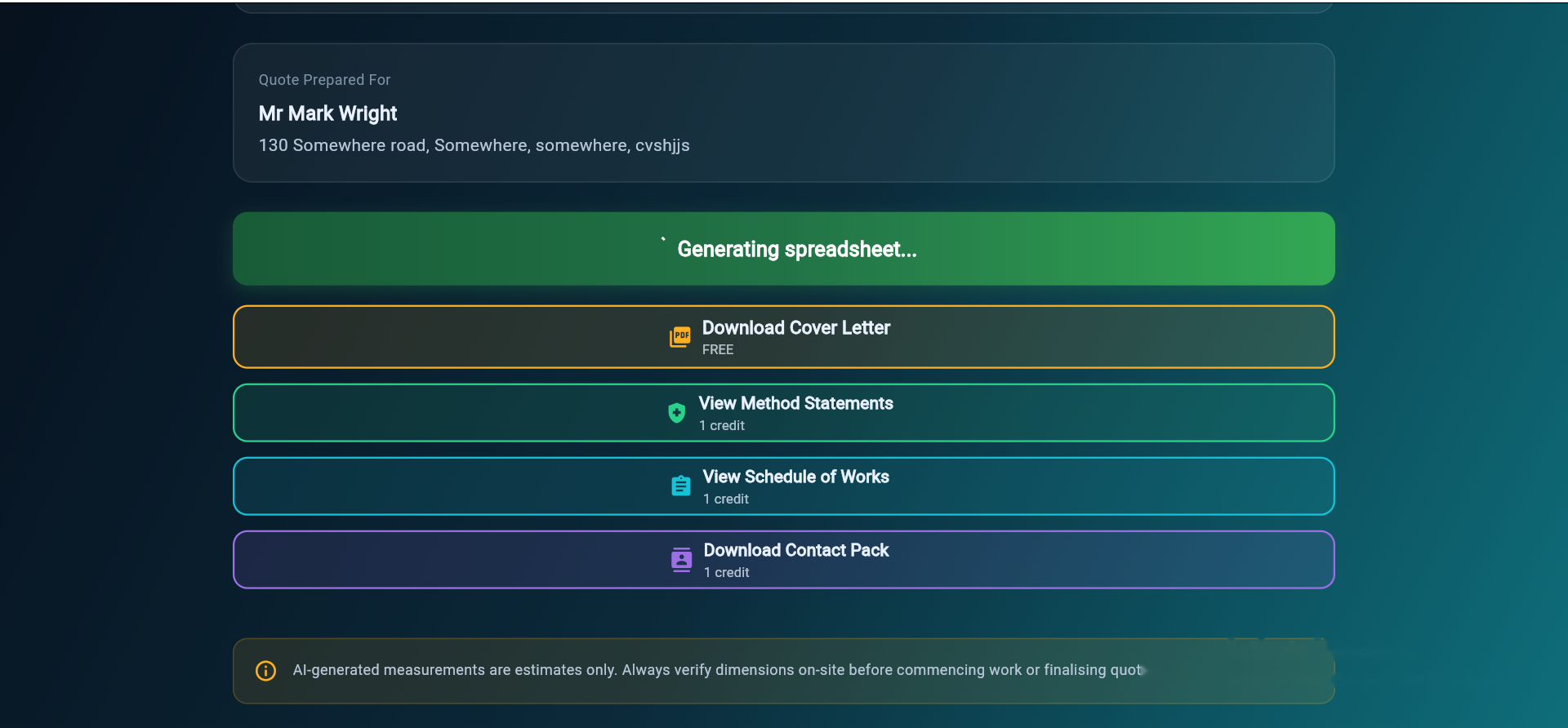
The itemised cost section takes the scope of works from Section 4 and puts a price against each line. Ideally, labour and materials are shown separately — this lets the client understand the build-up of the price and gives them a reference point if they want to supply materials themselves or query a specific trade cost. Running subtotals by trade section make it easier to review.
What it is
The financial breakdown of the scope of works. Each line item from the scope gets a labour cost, a material cost, and a combined total. Trade sections are subtotalled. Prelims, contingency and VAT are added to reach the final figure.
What to write
Column structure: Item description | Labour | Materials | Total. Group by trade section with a subtotal row. Add a Preliminaries section with its own subtotal. Add contingency (5%). Add VAT. Grand total last. Every number traceable to a line item.
What weak quotes miss
A single lump sum per trade — or worse, a single number for the whole job. No breakdown. The client cannot see where the money is going and cannot sense-check the price. A transparent itemised breakdown builds more trust than a lower single number.
Provisional Sums
Estimates for unconfirmed items — in the total, to be adjusted
A provisional sum (PS) is an estimated allowance for an item that has been identified as part of the project but which the client has not yet specified or confirmed. Common examples include kitchen units, bathroom sanitaryware, floor tiles, a roof lantern, or landscaping. The provisional sum is included in the quote total so the client has a realistic overall budget — but it will be adjusted to the actual cost on the final account.
What it is
A named line in the cost breakdown labelled "PS" — an estimate for an unspecified item that is part of the project. It is in the total but will be reconciled when the actual cost is known.
What to write
"Kitchen unit supply — Provisional Sum £3,500 (to be confirmed on client selection)." The label PS must be explicit. The client must understand that this is an estimate and will change. Never leave a PS unlabelled.
What weak quotes miss
Confusing a PS with an exclusion. A PS is in the total; an exclusion is not. Mixing the two is a source of serious disputes. Also: setting PS values without any basis — a PS for kitchen units set at £500 when mid-market kitchens cost £3,000+ is misleading to the client.
Payment Schedule
Stage payments tied to defined milestones
A payment schedule protects both the builder and the client. For the builder, it ensures cash flow is maintained throughout the project without needing to fund the whole job before receiving payment. For the client, it ensures payments are tied to measurable progress milestones — not to the contractor's needs. Stage payments are the professional standard for residential building work in the UK.
What it is
A table of payment stages linked to specific completion milestones, with the amount due at each stage expressed as a percentage or fixed sum, and the cumulative total to date.
What to write
Typical stages: Deposit on instruction (10–15%) — Foundations complete (20%) — Structure and roof watertight (25–30%) — First fix complete (15–20%) — Practical completion (remaining balance less retention). Retention 2.5–5% released after defects liability period.
What weak quotes miss
No payment schedule at all — just an invoice when the job is done. This creates cash flow problems for the builder and removes the client's incentive to pay promptly at each stage. Or worse: a payment schedule front-loaded with large early payments that give the client no protection against a builder who disappears after the deposit.
Terms and Conditions Summary
Key contractual provisions in plain English
The full contract lives in the contract pack — RenoCalc generates a 12-page contract document as part of the output. But the quote should include a summary of the key terms so the client understands the basis on which the price has been prepared and the project will be managed. This is not a substitute for the contract — it is an orientation document.
What it is
A brief summary of the key terms governing the project: the basis of the price, how variations are handled, the defects liability period, dispute resolution, and any insurance or warranty provisions.
What to write
Include: variations to be agreed in writing before work proceeds; defects liability period (typically 12 weeks from practical completion); price based on current material costs and subject to the validity period; insurance arrangements; which standard form of contract applies (JCT Minor Works, FMB contract, or your own terms).
What weak quotes miss
No mention of variations. The builder carries out additional work and is then unable to raise an invoice for it because there was no agreed mechanism for variations in the original quote. This is one of the most common reasons builders are not paid for legitimate additional work.
Sign-Off
Acceptance mechanism and direct contact
The final section of the quote should contain two things: a mechanism for the client to accept the quote, and direct contact details for the person who prepared it. Do not make the client ring a general company line or send an email to an inbox. Make it easy — and make it clear what accepting the quote means and what happens next.
What it is
An acceptance signature block (client signature, print name, date) with a brief statement of what acceptance means — usually that the client agrees the quoted price, scope and terms and instructs the contractor to proceed. Plus the lead contact's direct details.
What to write
"I/We accept this quotation and instruct [Company] to proceed on the terms stated above. Signed: ___________ Date: ___________" Plus: the name, direct number and email of the person to call with questions. Not the general company number — a direct line.
What weak quotes miss
No acceptance mechanism. The client says "we want to go ahead" verbally and the builder starts work. When a dispute arises six weeks later, there is no written record of the client accepting the scope and price. A signed acceptance page is basic protection that many builders skip.
RenoCalc — All 10 Sections from a Floor Plan
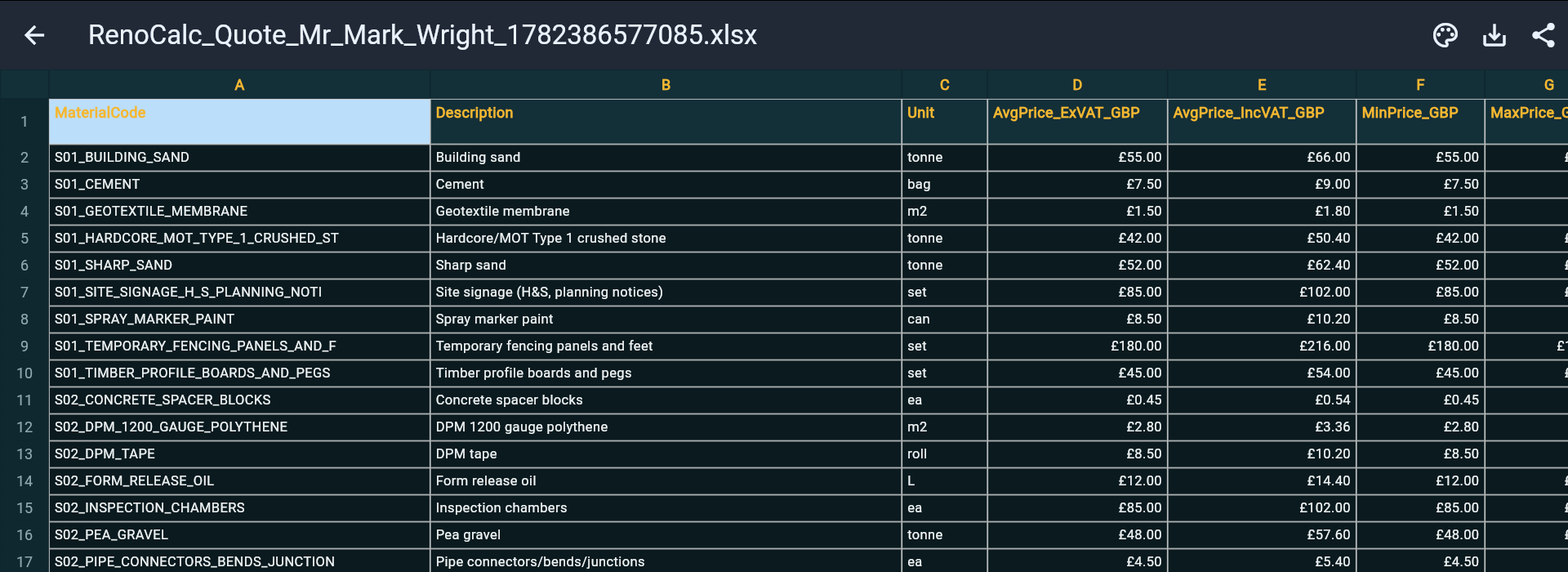
Every section described in this guide is generated automatically by RenoCalc from your floor plan. You upload the drawing, set the project type, and RenoCalc produces the full document structure — scope, costs, cover letter, schedule, contract — in under 3 minutes.
Get All 10 Sections from Your Floor Plan in Under 3 Minutes
RenoCalc builds the complete quote pack — scope, costs, cover letter, schedule of works, HSE method statements and 12-page contract — automatically from your floor plan. Start free, no card required.
Start Your Free QuoteFrequently Asked Questions
What is the correct format for a UK building quote?
A professional UK building quote should follow this format: 1. Quote header (reference, date, validity period, company details including VAT and insurance). 2. Client and site details. 3. Introduction paragraph (scope summary, drawing references, site visit date). 4. Scope of works itemised by trade. 5. Exclusions and assumptions. 6. Itemised costs with labour and materials separated. 7. Provisional sums for items not yet confirmed. 8. Payment schedule. 9. Terms and conditions summary. 10. Sign-off with direct contact details. The cover letter precedes the pack and is kept to one page.
What should be in the exclusions section of a building quote?
The exclusions section should list everything the client might reasonably expect to be included but which is not in the price. Common exclusions for residential building work include: kitchen and bathroom appliances and fittings (often treated as provisional sums); floor coverings in rooms outside the main scope; decoration beyond the primary work area; making good to areas disturbed but outside the extension or conversion footprint; planning application fees (if applicable); and party wall surveyor fees. Stating exclusions clearly protects both the builder and the client from later disputes.
How should a payment schedule be structured in a building quote?
A payment schedule for residential building work should be stage-based, tied to clearly defined completion milestones rather than to calendar dates. Typical stages for an extension or conversion include: deposit on instruction (10–15%); foundations complete (15–20%); structure and roof watertight (25–30%); first-fix complete (15–20%); second-fix and plastering complete (10–15%); practical completion (5–10%). The final retention — typically 2.5–5% — should be released after a defined defects liability period, usually 12 weeks after practical completion. Never front-load payments beyond the deposit stage.
What is the difference between a provisional sum and an exclusion?
A provisional sum (PS) is an estimated allowance included in the quote total for an item that has been identified but not yet fully specified — for example, a kitchen appliance package or a roof lantern where the client has not yet selected the product. The PS is in the total; it will be adjusted on the final account when the actual cost is known. An exclusion is something that is completely outside the quote — it is not in the total at all and will be charged separately if required. Both must be clearly labelled. Confusing the two is a common source of disputes.
What company information must appear on a UK building quote?
A UK building quote header should include: the builder's legal trading name, address, telephone number, email address, VAT registration number (if VAT registered), and public liability insurance details. Limited companies must also show their registered company number and registered address. Including Federation of Master Builders membership or TrustMark registration strengthens the document further. Missing company information makes a quote look informal and can create problems if the document is needed for insurance or dispute resolution purposes.
Do VAT rates differ for different types of building work?
Yes. The VAT rate on construction work depends on the type of project. Standard residential repairs, renovations, and extensions are charged at 20%. Converting a commercial building to residential use, or renovating a property that has been empty for at least two years, typically qualifies for the 5% reduced rate. New-build residential construction is zero-rated. The quote format section should clearly state which VAT rate applies and why. For full details see HMRC's VAT construction industry guidance.
What should the terms and conditions summary in a building quote cover?
The terms and conditions summary in a building quote should cover: the variations procedure (how changes to the scope are priced and authorised); the dispute resolution process (adjudication clause referencing the Housing Grants, Construction and Regeneration Act 1996 for contracts over £1,000); the defects liability period (typically 12 weeks after practical completion); insurance obligations on both parties; and the payment terms including any right to suspend works for non-payment. This summary does not replace a full contract — it should reference the full contract document attached to the quote pack.
Why does quote format matter legally?
A building quote, once accepted by the client, forms the basis of a contract. The format matters legally because it determines what is contractually committed and what is not. A vague scope creates disputes about what was included; missing exclusions create claims for additional work; an absent payment schedule creates cash flow disputes. The 10-section format described in this guide covers all the elements needed to produce a legally sound and commercially clear document. If disputes arise, the quote is the primary reference document — it must be unambiguous.