Our Estimating Methodology: The Construction Logic Behind RenoCalc
This page explains the construction estimating methodology that RenoCalc uses to calculate renovation costs. It is intended for builders, developers and construction professionals who want to understand how the numbers are derived — not just what they are. Transparency about methodology is part of what makes an estimating tool trustworthy.
Cost Structure: Trade, Room and Element
RenoCalc structures every estimate in three dimensions simultaneously: by trade, by room, and by element. This mirrors how a well-organised construction estimate is reviewed and how building work is actually procured and managed on site.
By Trade
The primary breakdown of any renovation estimate is by trade: plastering, electrics, plumbing and heating, tiling, flooring, joinery, carpentry, decorating, kitchen fitting, bathroom fitting, stud partitions, and structural works where applicable. Each trade is priced separately, with its own material costs and labour costs. The trade-by-trade breakdown allows a builder to compare the system's rates against their own subcontract prices, adjust individual trades where they have better rates, and understand where the cost sits across the project.
The trade breakdown also drives the schedule of works, which sequences the trades in the order they would work on a real project. The estimate and the programme are linked: changing the scope of a trade changes both the cost and the programme.
By Room
Within each trade, costs are allocated to individual rooms. A plastering cost, for example, is not presented as a single lump sum — it is broken down into living room, kitchen, bedroom 1, bedroom 2, bathroom and so on, each with its own wall area and ceiling area calculation. This room-by-room breakdown serves two purposes. First, it allows the client to understand where the cost sits and make informed decisions about scope. Second, it allows the builder to check the quantities against their own site knowledge of the property.
By Element
Within each room and trade, the estimate breaks down to element level: skim coat to walls, skim coat to ceilings, angle beads, making good around openings, and so on. This is the level at which a builder actually buys materials and measures work. An estimate that shows only "plastering — living room — £580" is not as useful as one that shows the wall area, the ceiling area, the rate per square metre and the items that make up the total. RenoCalc works at element level throughout.
Material Quantities and Takeoffs
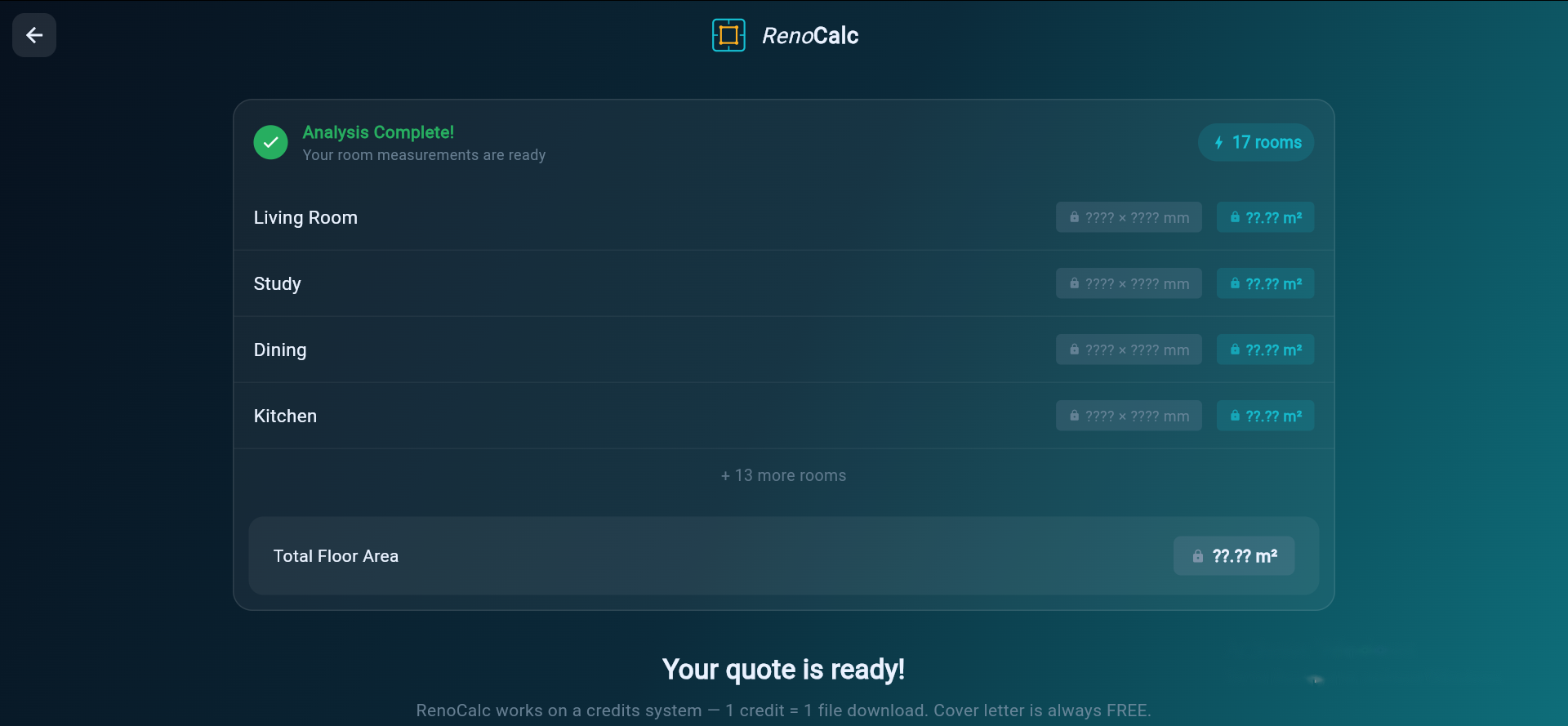
A takeoff is the process of deriving material quantities from dimensions. RenoCalc automates the takeoff stage using the calibrated dimensions from the AI floor plan analysis.
Area-Based Takeoffs
Trades and items that are priced by area — plastering, flooring, tiling, painting and decorating, insulation, boarding — use the floor area or wall area calculated from the calibrated room dimensions. For wall area, the calculation is: sum of wall lengths multiplied by room height, minus the area of door and window openings. For floor area, the calculation uses the plan area of the room directly from the AI analysis.
Standard room heights are applied as defaults: 2.4 metres for post-war residential (most 1930s–1980s semis and terraces), 2.7 metres for Victorian and Edwardian properties, and 2.5 metres as a general default for mixed-era properties. Room height can be adjusted per room by the user before generating the estimate.
Linear Takeoffs
Items priced by linear metre — skirting board, architrave, coving, pipe runs, cable runs, guttering, fascia — are calculated from the perimeter measurements of each room. Cable and pipe runs include a routing allowance for drops to outlets and connections to appliances: typically 20–30% added to the straight-line perimeter for electrical first-fix, and 15–25% for plumbing runs depending on the bathroom or kitchen configuration.
Item-Count Takeoffs
Items priced per unit — socket outlets, light fittings, switches, radiators, door sets, sanitaryware items — are calculated using density rules applied to room type and area. A bedroom of 12 square metres receives a standard allocation of socket outlets, light points and switches based on current electrical regulations guidance. A bathroom receives standard sanitaryware items based on the room area and the indicated bathroom type (full bathroom, en suite, shower room, WC).
These density rules are defaults based on typical UK residential fit-out standards. They can be overridden by the user where the project specification differs from standard — for example, a high-spec kitchen with an extended socket run, or a cinema room with bespoke lighting circuit requirements.
Waste Factors
Waste factors are applied to all material quantities to reflect the reality of site purchasing: materials are cut, offcuts are generated, some material is damaged or unusable. RenoCalc's waste factors are applied at the material category level:
| Material Category | Waste Factor Applied |
|---|---|
| Ceramic and porcelain tiling | 10% |
| Engineered timber flooring | 8–12% (direction-dependent) |
| Laminate flooring | 8% |
| Sheet vinyl flooring | 5% |
| Plasterboard | 5% |
| Plaster materials (skim and basecoat) | 5% |
| Blockwork | 10% |
| Brickwork | 5% |
| Timber studwork | 10% |
| Paint and coatings | 5% |
| Tile adhesive and grout | 10% |
These waste factors are based on real purchasing patterns on UK domestic renovation projects, not published industry averages. They reflect what a builder actually needs to order to complete the work without running short, while not over-ordering to an extent that creates significant material waste cost.
Labour Rates
Labour is the most variable component of a renovation estimate and the most sensitive to regional differences. RenoCalc applies labour rates at the trade level, using a base rate system with regional uplift factors.
How Base Rates Are Set
Base labour rates in RenoCalc reflect Midlands pricing — specifically the rates applicable in Coventry, Birmingham and the surrounding region, where the software was built and has been most extensively used. These are the rates a builder operating in this region would pay a subcontractor or employed tradesperson for each type of work.
Labour rates are expressed per unit of measure matching the takeoff: per square metre for area-based trades (plastering, tiling, flooring, painting), per linear metre for linear trades (skirting, pipework, cabling), and per item or lump sum for installation-based trades (kitchen fitting, bathroom fitting, joinery items).
How Trade Rates Differ
Labour rates vary significantly between trades — not just regionally but by the nature of the work. Wet trades (plastering, tiling, concrete work) typically command different rates than dry trades (boarding, decorating, flooring). Trades requiring regulatory certification (electrics under Part P, gas work under Gas Safe) carry a premium reflecting the qualification cost and liability of the tradesperson. Trades requiring specialist equipment or significant setup time (suspended ceilings, specialist flooring systems) price differently than straightforward trades.
RenoCalc maintains separate labour rates for each trade category, reflecting these differences. A plastering rate per square metre is not the same as a tiling rate per square metre, even though both are area-based trades.
Preliminaries
Preliminaries are the costs of running a building project that are not directly attributable to a specific trade or measured work item. On commercial projects, preliminaries are typically priced as a percentage of the project value or as a detailed schedule of costs. On domestic renovation projects, the approach is simpler, but the costs are real.
What Is Included in Preliminaries
RenoCalc's preliminary allowances include: site management time (builder supervising trades and coordinating the programme), waste removal and skip hire, temporary protection measures (dust sheets, floor protection, stair protection), consumable site materials (masking tape, fixings, sealants used across multiple trades), and small plant and tool hire where required for a standard renovation scope.
These items are included within the estimate as a percentage of the measured works value, calculated separately and shown as a distinct line in the summary. For a standard full-house renovation, the preliminary allowance is typically 8–12% of the measured works cost.
What Is Excluded from Preliminaries
RenoCalc's preliminary allowances do not include: professional fees (structural engineer, architect, party wall surveyor), building control fees and inspections, planning application fees, statutory utility diversion costs, temporary accommodation if required, or abnormal site-specific costs such as asbestos surveys or structural investigation works.
These exclusions are flagged in the estimate summary. A builder using RenoCalc to price a job that includes any of these items should add them as separate provisional sums or fixed prices based on site-specific information.
Provisional Sums
A provisional sum is an amount included in an estimate for a specific item of work whose scope or cost cannot be determined precisely at the time of pricing. Provisional sums are common in renovation work because the full extent of certain work items — particularly structural and remediation work — cannot always be established without opening up the building.
How RenoCalc Handles Unknowns
RenoCalc includes provisional sum placeholders in the estimate for items that are commonly uncertain at the quoting stage. These include: structural engineer's assessment and calculations (required where structural work is involved), asbestos survey and removal (applicable to pre-2000 properties where asbestos-containing materials may be present), unexpected drainage issues identified during groundworks, rot and damp remediation discovered on strip-out, and party wall fees where the work requires a party wall agreement.
Each provisional sum is shown as a named line in the estimate with a suggested indicative range rather than a fixed price. This is transparent: the client can see what has and has not been priced, and the builder is not committed to a sum for work whose scope is not yet known.
Why Provisional Sums Matter
A renovation estimate that does not include provisional sums for uncertain items is not necessarily a lower-cost estimate — it may simply be one where the unknowns are hidden rather than disclosed. When the uncertainty materialises on site, the cost falls on either the contractor (if they absorb it) or the client (if it is presented as a variation). Either outcome is worse than agreeing a provisional sum at the outset.
RenoCalc's approach is to make the unknowns visible. A builder who presents a client with a clearly labelled provisional sum and explains why it exists is having a more professional and more honest conversation than one who either ignores the uncertainty or buries it in a contingency figure.
Contingency
Contingency is a general allowance for risk and uncertainty in a project estimate. It is distinct from provisional sums (which are for specific identified unknowns) and from variation instructions (which are instructed changes to scope). Contingency is an acknowledgement that renovation projects, by their nature, rarely go exactly to plan.
When Contingency Is Recommended
RenoCalc recommends that users apply a contingency allowance on top of the measured estimate. The appropriate level of contingency depends on the nature of the project:
| Project Type | Recommended Contingency | Rationale |
|---|---|---|
| New fit-out of empty property (no strip-out) | 5% | Low unknowns — building condition already exposed |
| Full renovation of occupied or recently vacated property | 10% | Standard unknowns behind finishes |
| Renovation with structural works (extensions, loft, knock-throughs) | 10–15% | Higher structural unknowns on opening up |
| Older or historic property (pre-1950s) | 15–20% | Significant potential for unknown conditions behind fabric |
| Conversion project (redundant commercial, barn etc.) | 20%+ | High structural and services unknowns |
Contingency is shown as a separate line in the estimate summary and is not included in the measured works total. This allows the client and contractor to discuss and agree the contingency level separately from the priced scope of works.
How Contingency Should Be Managed
Contingency is not a bonus or a margin addition. It is a risk allocation. The correct approach is to hold the contingency in reserve during the project and use it only where genuine unforeseen conditions arise. Any unspent contingency at the end of the project should be returned to the client or discussed transparently. A professional contractor does not treat contingency as profit.
The Price Library
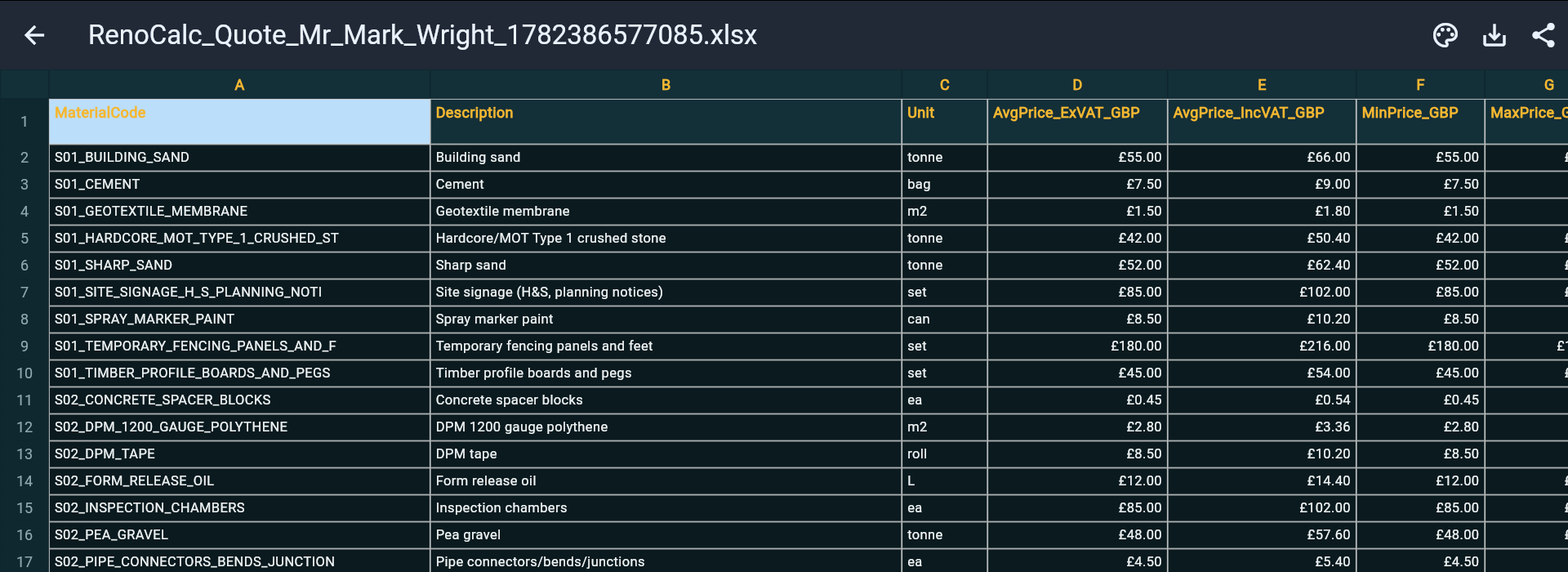
RenoCalc's material price library is the backbone of the pricing system. It contains over 40,000 priced items covering every trade and every material type used in UK residential renovation work. This section explains how the library is structured and maintained.
What the Library Covers
The library is organised by trade and by material category. Within each category, items are priced at the specification level that matters for accurate cost estimation: not "plasterboard" as a single rate, but 12.5mm standard plasterboard, 12.5mm moisture-resistant plasterboard, 15mm soundboard, and tapered-edge and square-edge variants at their respective prices. Not "paint" as a single rate, but matt emulsion, silk emulsion, eggshell, satinwood and gloss, each at its own rate.
The level of specificity in the library matters because material costs at specification level differ meaningfully. Specifying the wrong plasterboard type or the wrong paint sheen in an estimate creates a systematic error that compounds across the entire project area. The library is designed to price at the level of specificity that a builder actually purchases.
How the Library Is Maintained
Prices in the library are reviewed and updated regularly against current UK trade merchant pricing. The maintenance process checks current pricing from the major UK trade merchant networks — the suppliers that builders with merchant accounts use for day-to-day purchasing. Where significant price movements have occurred — as happened with timber, copper and insulation materials following the supply chain disruptions of recent years — prices are updated accordingly.
The library does not rely on published price books or index-linked adjustments alone. It is maintained against actual market prices because published price books can lag the market by six months to a year, during which period the estimate produced by using them may be systematically inaccurate.
Trade Pricing vs Retail Pricing
All prices in the library are trade prices — the prices a builder pays on a merchant account — not retail prices. The difference is significant: trade prices are typically 20–40% lower than equivalent retail prices for the same materials. An estimate built on retail prices will be systematically higher than the actual material cost to a professional builder, which distorts the quote and makes it harder to compete. RenoCalc is a tool for builders, priced at builder rates.
Regional Variation
Construction costs vary materially across the UK. The same job — same specification, same square footage, same trades — costs significantly more in London than in the Midlands, and the difference is not simply about materials (which are similar in cost across most of the country) but about labour rates, access and market conditions.
How London and Regional Uplifts Work
RenoCalc applies regional uplift factors to the labour component of the estimate based on the project location entered by the user. The base rates are Midlands rates. Uplift factors are applied as follows:
| Region | Labour Uplift |
|---|---|
| Inner London (zones 1–2) | +30–35% |
| Outer London (zones 3–6) | +20–25% |
| South East (Surrey, Kent, Berkshire, Herts, Essex) | +15–20% |
| South West | +5–10% |
| East of England | +10–15% |
| East Midlands | Base (0%) |
| West Midlands | Base (0%) |
| Yorkshire and Humber | -5 to 0% |
| North West | 0 to +5% |
| North East | -5 to -10% |
| Wales | -5 to 0% |
| Scotland | 0 to +5% |
Regional uplifts apply to the labour element only. Material costs are broadly similar across the UK for standard specification materials — the regional price differences in materials are small compared to the regional labour rate differences, and for most projects the material cost differential between Coventry and London is within the margin of uncertainty of the estimate itself.
Why Regional Rates Matter
A builder in London using a national average rate for plastering will produce an estimate that underprices the labour for their market. A builder in the North East using London rates will produce an estimate that overprices the labour and risks losing work to local competition. Regional rates matter because they reflect the actual market conditions a builder is operating in.
The regional factors in RenoCalc are based on observations of actual market pricing across the UK, not on published wage surveys alone. They are the rates that builders working in those regions recognise as reflective of their own market. They are reviewed periodically and adjusted where the market has moved.
See the Methodology in Practice
Upload a floor plan and see a full trade-by-trade estimate built on this methodology in under three minutes. The quantities, waste factors, labour rates and regional uplifts are all applied automatically — and the full Excel workbook lets you review and adjust every line.
Try Free — No Card NeededSee also: How the AI Calculates Quotes and 30 Years on the Tools for the full technical and personal story behind RenoCalc.