30 Years on the Tools: Why I Built RenoCalc
My name is Pindi Sahota. I have been in construction for 32 years. I started at the bottom — literally — carrying materials, mixing mortar, cleaning up after people who knew more than me. Over the years I worked my way through the trades, learned how work is actually done, built a construction company, and eventually built software to solve the problem that had cost me more time and money than anything else in my career: quoting.
This page is the honest version of why RenoCalc exists. Not a polished story about innovation. Just the truth about the problem and what it took to solve it.
Starting Out: Labourer to Builder
I started in construction at seventeen. No particular plan. I needed work and someone I knew needed a labourer. That was it. The first job was a ground floor extension in Coventry — digging out foundations, barrowing concrete, keeping the site tidy, doing whatever needed doing. The kind of work that teaches you very quickly that construction is physical, relentless and unforgiving of sloppiness.
What I didn't expect was how much I would learn just by being on site. Every trade that came through — the bricklayer, the plasterer, the electrician, the plumber — was doing something I hadn't seen before. I watched how they worked. I asked questions when they'd let me. I noticed what separated the ones who were fast and confident from the ones who were slow and uncertain. It was always the same thing: the experienced ones knew exactly what they were doing before they touched anything. They'd looked at the job, worked it out in their head, and then executed it. No wasted time. No second-guessing.
That lesson — understand the job before you start — stayed with me for thirty-two years. It applies to pricing a job as much as it applies to building one.
After a couple of years labouring I got into the fabric of the work — blockwork, brickwork, carpentry, boarding, basic plastering. Not at tradesman level, but enough to understand the process, the materials, the time it takes. Enough to know when a quote was right and when it wasn't.
The Jobs and Trades That Shaped My Thinking
Over the years I worked on everything from small residential repairs to full house renovations, extensions, new builds and commercial fit-outs. The Midlands building market is broad — Victorian terrace renovations in Coventry and Birmingham, 1960s and 70s semis all over the region, the occasional new build on an infill plot, commercial premises in various states of disrepair.
I worked with plasterers who could skim a room in two hours and make it look like glass. Electricians who first-fixed an entire house in a day. Plumbers who could rough in a bathroom in the time it took other trades to set up their tools. And I worked with builders who had no idea what anything cost, who priced jobs by gut feel, who won work at a loss because their estimate was built on hope rather than calculation.
I was on both sides of that line at different points in my career. When I was doing smaller jobs — working for myself, managing two or three sub-contractors — I had time to price carefully. When the business grew and the jobs got larger, the pressure to turn quotes around quickly began to create problems. A quote that should have taken a day to build properly was being done in a couple of hours. Gaps got left. Assumptions got made. Some of those assumptions were wrong.
The construction business teaches you the cost of under-pricing very quickly. You win the job. You start the work. You realise partway through that the margin you thought you had has been eaten up by a quantity you underestimated, a rate that's gone up since you priced it, or a scope item you forgot to include altogether. You finish the job, you get paid, and when you add it up you've worked for two weeks for close to nothing.
Every builder I've ever spoken to has had this experience. Usually more than once.
The Quoting Problem
The quoting problem is not unique to me or to construction. But it is particularly acute in residential renovation because of the nature of the work: every property is different, every client wants something different, the scope changes between site visit and start on site, and the trades overlap in ways that require experience to sequence correctly.
The traditional approach to quoting a renovation job looks like this. You visit the site. You take measurements — room by room, wall by wall, sometimes with a laser measure, sometimes with a tape, sometimes from memory if you're in a rush. You go back to your desk or your kitchen table. You open a spreadsheet. You type in the rooms, the trade headings, the items. You look up material prices — or use the prices you remember from last month, which may or may not still be accurate. You work out quantities, which requires you to multiply length by width, work out areas, apply waste factors. You estimate labour hours. You add up. You check. You add a margin. You write a cover letter. You send it.
For a full house renovation — plastering, electrics, plumbing, tiling, flooring, joinery, decorating, kitchen, bathroom — that process takes a half-day minimum. For a large project it takes a full day. For complex projects with multiple phases it takes longer.
And that is time you are not on site. Time you are not managing work. Time you are not looking at the next job. Time you are not being paid for, because you don't know yet if you've won the quote. Most builders quote three or four jobs for every one they win. Do the maths: for every job you win, you've spent two or three days on quotes that came to nothing.
Over thirty-plus years, I have spent hundreds of days of my professional life on quoting. Some of those quotes were accurate. Some weren't. The ones that weren't accurate cost me money. Not because I was careless — because the process of building a detailed estimate from scratch is inherently error-prone when you're doing it under time pressure, from memory, with manual calculations.
The Turning Point
The decision to build software rather than continue living with the problem came from a specific moment. I was pricing a full renovation of a three-bedroom semi in Coventry — new kitchen, new bathroom, full replaster, new electrics, new flooring, full decoration. A straightforward job, the kind I had done hundreds of times.
I spent an evening on the quote. I submitted it. I won the job. Three weeks in, I realised I had underestimated the plastering quantities on the ground floor because I had misremembered the ceiling height in the lounge. It was 2.7 metres, not the standard 2.4 metres I had assumed. The difference, across all the walls and ceiling on the ground floor, was around 18 square metres of extra plastering. At the rates I was paying, that was several hundred pounds of margin I hadn't allowed for.
It wasn't a disaster. The job finished profitable. But sitting there doing the revised calculation and seeing exactly where the error had come from — a single wrong assumption about a ceiling height, the kind of thing that's obvious when you're standing in the room but easy to get wrong when you're building a quote from notes and memory — I thought: there has to be a better way to do this.
I'd seen software for estimating. Most of it was designed for quantity surveyors, not builders. Complex, slow to learn, priced for large contractors. Nothing that a builder running his own business could use quickly on a real job.
So I set about building it myself. The first version was rough. The second version was better. The version that became RenoCalc is the result of years of iteration against real jobs, real errors and real feedback from builders who were having the same problem I had.
What 32 Years Means for the Software
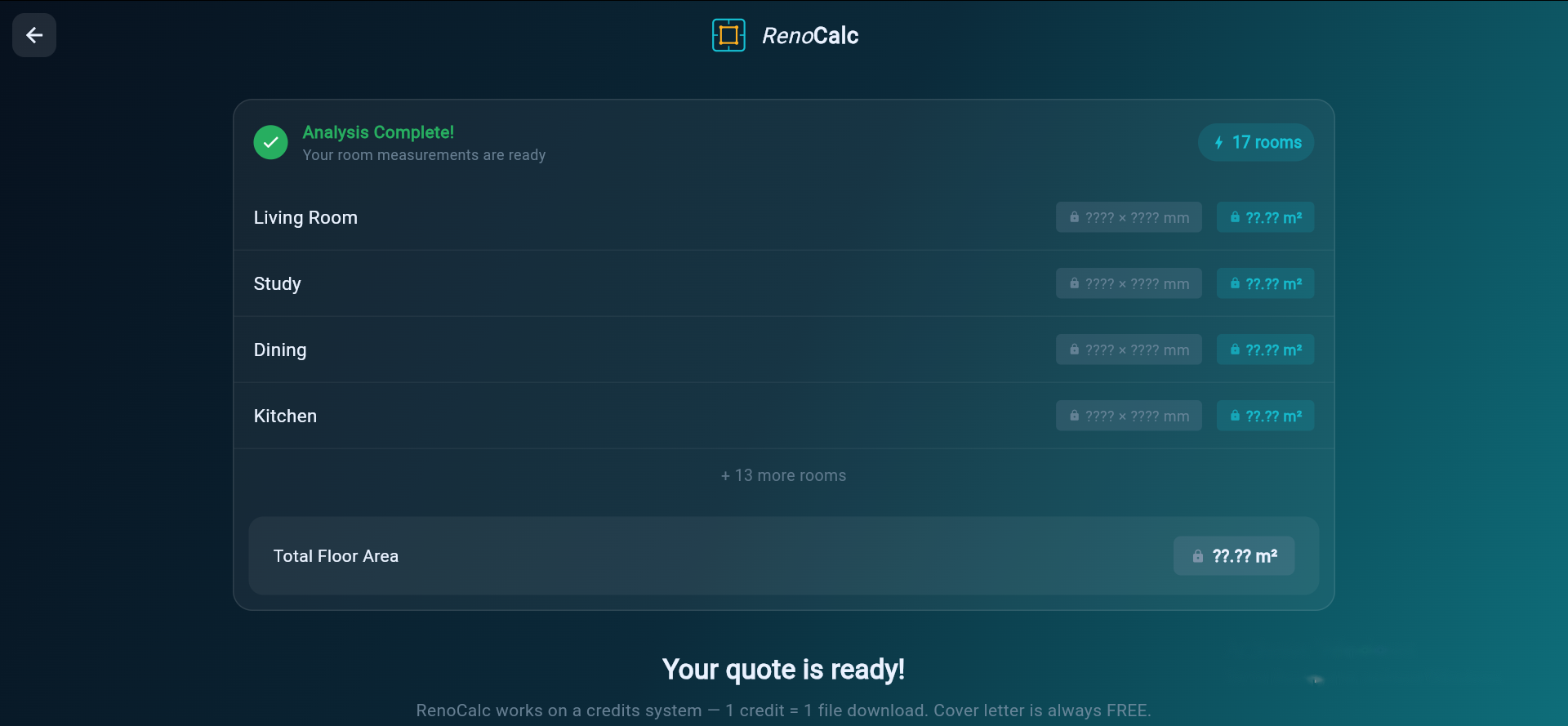
I am often asked how RenoCalc differs from other estimating software. Part of the answer is technical — the AI floor plan analysis, the document generation, the speed. But the more important part of the answer is this: the knowledge built into the software comes from doing the work, not from reading about it.
The Material Price Library
RenoCalc's material price library contains over 40,000 priced items. Every item in that library has been checked against real purchasing. Not a published price book, not a generic data feed — actual trade pricing from the suppliers a builder in the UK would use. The waste factors applied to material quantities are not textbook figures. They are the waste factors I have learned from years of ordering materials and knowing what arrives on site versus what gets used.
When the library prices 10mm plasterboard at a certain rate, it is because that is what a builder pays for 10mm plasterboard at a merchant account, not what a homeowner pays at a DIY store. The distinction matters because the whole point of the software is to produce a quote that reflects what the job will actually cost to build.
The Labour Rates
Labour rates are applied regionally. The base rates in RenoCalc are Midlands rates — the rates I have paid and been paid throughout most of my career. Regional uplifts are applied for London and the South East, where labour costs significantly more for the same trade. The rates are not theoretical averages. They are the rates a working builder can recognise as real.
The Method Statements
The method statements generated by RenoCalc describe how the work is actually done — the tools required, the PPE, the sequencing of operations within the trade, the safety measures on site. They were written by someone who has stood on a site and done the work, not by someone who has read HSE guidance and interpreted it from the outside.
The Trade Sequencing
The schedule of works that RenoCalc produces reflects the real order in which trades work on a renovation project. The reason first-fix electrics happen before boarding is not arbitrary — it is because the cables need to be in the wall before the plasterboard goes on. The reason plastering precedes second-fix joinery is not textbook convention — it is because trying to hang doors and fit skirting in a room that hasn't been plastered creates problems that cost time to fix. The sequencing in the software reflects thirty-plus years of managing projects where the trades had to be in the right order or the work suffered.
What RenoCalc Cannot Do
I want to be clear about the limits of the software, because I think clarity about limits is part of what makes something trustworthy.
RenoCalc cannot replace a site visit. The AI measures from a floor plan, not from the physical building. The floor plan may not reflect the actual condition of the property. It may not show the defects, the non-standard ceiling heights, the structural issues, the previous bodged repairs that will need sorting before the new work can go in. A site visit is irreplaceable.
RenoCalc cannot replace the professional judgement of a builder. The system applies standard assumptions — standard ceiling heights, standard waste factors, standard item densities per room type. On some jobs, those assumptions will be right. On others, the specific conditions of the property will require adjustments. A builder looking at the output knows which assumptions to check and which to adjust. A consumer using the software without construction knowledge might not.
RenoCalc cannot guarantee that the quote it produces will win the job, or that the job will be profitable at that price. Winning work at a profit requires knowing your own cost structure, understanding the competitive market in your area, and managing the work efficiently once you've won it. The software handles the quoting — the rest is down to you.
These are not apologies. They are honest statements about what a tool can and cannot do. A tape measure is an excellent tool. It can't tell you whether the wall you just measured is load-bearing. That requires knowledge and judgement that no measuring tool, however good, can provide.
Message to Builders
I built RenoCalc for the person I was twenty years ago: a builder running his own business, good at the work, struggling with the paperwork. Spending evenings on quotes instead of with his family. Winning jobs at prices that didn't reflect the real cost of the work because the estimate had been rushed. Losing jobs at prices that did reflect the real cost, because the competitor who won it had priced it faster and got there first.
If that sounds familiar, RenoCalc is for you.
The software will not make you a better builder. What it will do is give you back the hours you currently spend building quotes from scratch, so you can spend those hours on the things that actually move your business forward: more jobs, better client relationships, more time on site making sure the work is right.
Upload a floor plan. See what comes out. If it's not right for your business, that's fine — no one knows your costs better than you do. But give it a try. The people who have built their quoting process around RenoCalc tell me consistently that it has changed how their business runs. Not because the software is magic, but because the hours it saves are real.
Thirty-two years on the tools. This is the tool I wish I'd had at the start.
Pindi Sahota
Builder and Founder, RenoCalc
Future Build Cov Ltd, Coventry
See RenoCalc in Action
Upload a floor plan and get a full trade-by-trade renovation quote in under three minutes. No card required to try it.
Try Free — No Card Needed