Renovation Quote Template UK: What Every Builder Should Include
Quick Answer
A renovation quote template UK must account for uncertainties that new-build quotes don't face: hidden damp, asbestos, structural surprises, and occupied-property access restrictions. A good renovation quote includes provisional sums for unknowns, an explicit exclusions list, phasing notes for occupied properties, and a clear scope boundary to protect against scope creep. RenoCalc generates renovation quotes with schedules of works and method statements included.
Renovation quoting is not the same as quoting a new-build or a straightforward trade job. When you're working on an existing property, you're quoting against what you can see — but you're building against what's actually there. Those two things are often very different.
I've been building for 32 years. I've learned that lesson the hard way. A renovation quote that doesn't account for what you can't see isn't just optimistic — it's a liability. This guide covers what a proper renovation quote template must include: provisional sums for unknowns, a tight exclusions list, site-strip notes, and phasing logic for occupied properties. It also covers how RenoCalc handles these elements automatically, so your quotes are thorough without costing you hours of admin time.
Why Renovation Quotes Are Different
A new-build quote is relatively clean. You're working from engineering drawings, you know what's going in the ground, and the trades follow a logical sequence from foundations up. There are unknowns on any build site, but on a new build they're mostly weather, programme slippage, and material lead times.
On a renovation, the unknowns are structural. Strip a wall and you find a notched joist. Lift a floor and there's standing water. Open a ceiling and discover the wiring was done in the 1960s and needs full replacement. These aren't rare edge cases — they're part of the job. A renovation quote template that doesn't address them up front is incomplete, and an incomplete quote creates disputes.
The fix is not to quote higher to cover yourself (clients reject those quotes). The fix is to quote accurately for what you know, set provisional sums for what you don't, and spell out your exclusions explicitly.
A Real Example from 32 Years in the Trade
Early in my career I quoted a full downstairs renovation on a 1930s semi. Kitchen strip-out, new layout, replastering throughout, new electrics and plumbing, flooring throughout. I priced it all. The quote was detailed, the client accepted it, we started work.
When we stripped the kitchen back, we found a chimney breast that had been partially removed by a previous owner — no lintel over the remaining section, the upper floors relying on stud partitions that were never designed to carry that load. We also found asbestos in the artex on the kitchen ceiling. Neither was priced. Neither was excluded.
That job taught me two things. First: always include a provisional sum for structural surprises on anything built before 1980. Second: always list asbestos removal as an exclusion unless you've had a pre-start survey done and you know the scope. From that point on, those two items went into every renovation quote I produced, without exception.
What a Renovation Quote Template Must Include
Below are the elements that separate a professional renovation quote from a number on a page. These are the fields that protect you legally and commercially when the job goes differently from how it was quoted.
1. Provisional Sums for Unknowns
A provisional sum is a budget allowance for work that cannot be fully specified at quoting stage. In renovation quoting, they most commonly cover:
- Asbestos removal — cannot be confirmed without a licensed survey, but common in properties built before 2000
- Hidden damp — extent unknown until finishes are stripped
- Structural works uncovered during strip-out — notched joists, removed load-bearing elements, insufficient lintels
- Drainage condition — CCTV survey often needed before a firm price can be given
Set the provisional sum at a realistic figure based on your site assessment, and make it clear in the quote that the actual cost will be adjusted once the scope is confirmed. This is standard practice — clients who understand construction will recognise it as professionalism, not uncertainty.
2. An Explicit Exclusions List
Your exclusions list is not small print — it should be prominent in the quote document. Standard renovation exclusions include:
- Asbestos removal (unless a survey has been completed and scope confirmed)
- Structural engineer's fees and calculations
- Building Control application fees and inspections — check requirements on the Planning Portal
- Party wall surveyor's fees
- External works, garden reinstatement and boundary works
- Furniture removal and storage
- Decoration beyond first fix (unless specifically quoted)
- Any work not described in the schedule of works
List them, don't bury them. A client who disputes something not in your exclusions list is a client who never read the exclusions list because it wasn't clear enough.
3. Site-Strip Notes
Renovation work always starts with strip-out — removing existing finishes, fixtures and services before the new work begins. Your quote should specify what strip-out is included (and what isn't), who is responsible for skip hire and waste disposal, and whether hazardous waste requires separate handling. These are frequently overlooked and frequently disputed.
4. Phasing (for Occupied Properties)
If the client is staying in the property during the works, the quote must include a phasing note: which areas will be worked on, in which order, and what access to utilities will be maintained. Working in a phased sequence on an occupied property takes longer than an empty property — your quote should reflect this. If there is no phasing note and the client is surprised by how the works progress, the builder is in a weak position. For notifiable projects, the HSE CDM 2015 regulations require a pre-construction phase plan before work commences.
| Section | What to Include | Why It Matters |
|---|---|---|
| Project description | Scope, address, property type and age | Sets the context for everything that follows |
| Itemised costs | Labour and materials by trade and room | Shows the client how the total is built up |
| Provisional sums | Named items with budget allowances | Protects builder from unforeseen costs |
| Exclusions list | All items not included in the fixed price | Prevents disputes over scope |
| Site-strip notes | What demolition/strip-out is included, skip hire, waste | Avoids the most common source of extras |
| Phasing (if occupied) | Sequence and timeline by area | Manages client expectations and explains programme |
| Validity period | How long the quote price holds | Protects against material price changes |
| Payment terms | Stage payments or milestone-based | Ensures cashflow and confirms client commitment |
How RenoCalc Handles Renovation Quoting
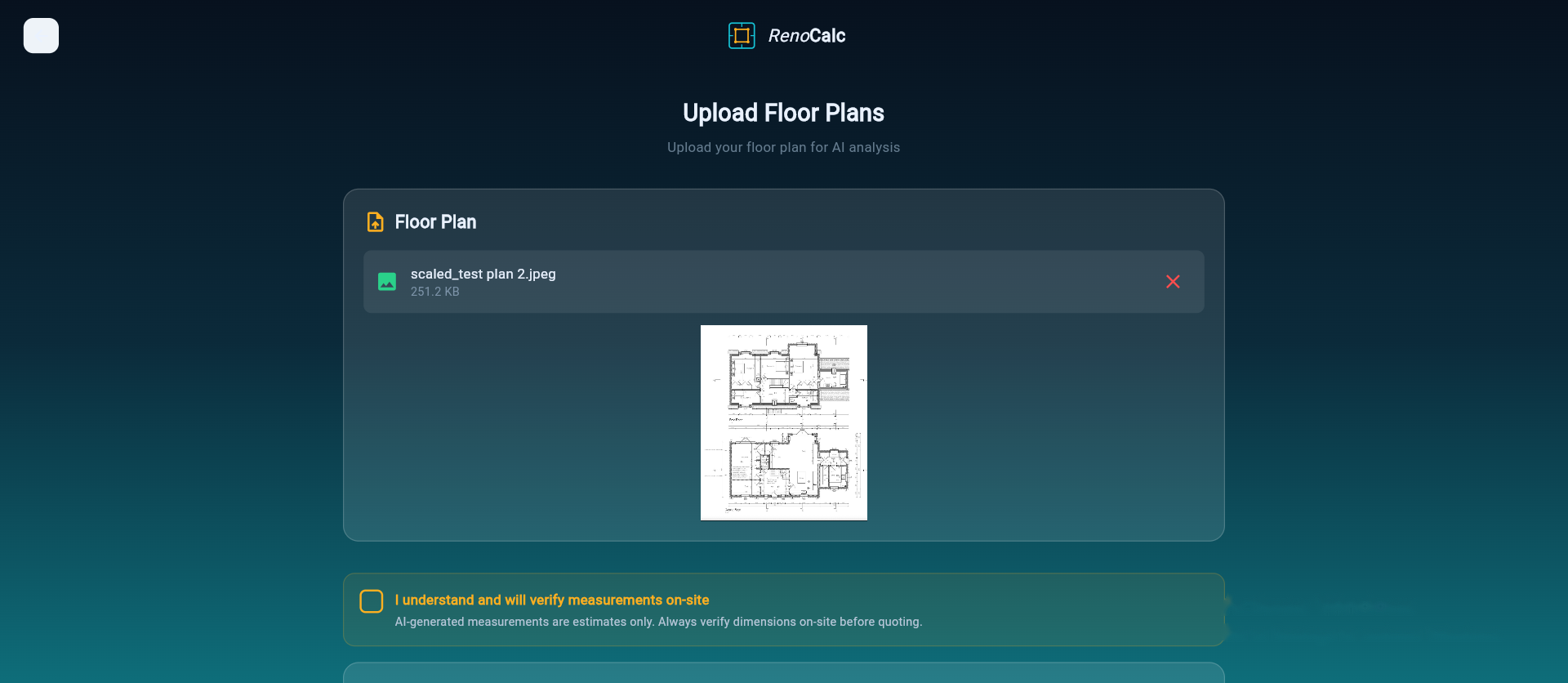
RenoCalc was built specifically for renovation quoting — not new-build, not commercial, not quantity surveying. Upload a floor plan, and the AI scans the rooms, identifies the trades required, and generates a full quote pack in approximately three minutes.
The output includes a RenoCalc Spreadsheet with room-by-room costs broken down by trade, a cover letter, a schedule of works (which functions as the phasing document), HSE method statements for 12 trades, and a 12-page contract pack. The schedule of works is the section that addresses phasing — it shows the client the sequence of works in plain language, which is exactly what an occupied-property renovation needs.
The contract pack covers exclusions, provisional sum handling, and variation procedures — the documents that protect you if the job changes after you start. Rather than writing these from scratch or adapting a generic template, the output from RenoCalc is a complete, professional renovation quote pack ready to hand to the client.
See more about what the full output looks like: building quote example UK and how to write a building quote.
See It in Action
This short walkthrough shows how RenoCalc takes a floor plan and produces a renovation quote pack — from AI scan to finished output.
Frequently Asked Questions
What should a renovation quote template include that a new-build quote doesn't?
A renovation quote template must include provisional sums for unknowns (asbestos, hidden damp, structural surprises), an explicit exclusions list, site-strip and demolition notes, and phasing details if the property is occupied. New-build quotes are linear and sequential — renovation quotes must account for what you cannot see until you start stripping out.
What is a provisional sum in a renovation quote?
A provisional sum is a budget allowance included in a quote for work that cannot be fully specified at quoting stage. In renovation quotes, provisional sums commonly cover asbestos removal, hidden damp or rot uncovered during strip-out, and structural works that depend on what is found behind existing finishes. The provisional sum is a placeholder, not a fixed price — the actual cost is adjusted once the scope is confirmed.
Why do renovation quotes need an exclusions list?
An exclusions list protects the builder by making explicit what is not included in the quote price. Without it, clients may assume the quote covers everything — including work that was never priced. Common renovation exclusions include asbestos removal, structural engineer's fees, Building Control applications, external works, furniture removal, and decoration beyond the first fix stage. Every renovation quote should list exclusions clearly, not bury them in small print.
How should a renovation quote handle phasing for an occupied property?
When a property is occupied during renovation, the quote must show the work broken into phases — typically by area or by trade sequence — so the client understands which rooms will be affected and when. Phasing affects cost: working room by room is slower than strip-and-complete, and the quote should reflect this with a phasing note or phasing allowance. If the client is staying in the property, utilities continuity (kitchen, bathroom access) must also be addressed in the programme section.
Can RenoCalc generate a renovation quote template automatically?
Yes. RenoCalc takes a floor plan, scans it with AI, and produces a full renovation quote pack in approximately three minutes. The output includes a RenoCalc Spreadsheet with room-by-room costs, a cover letter, schedule of works, HSE method statements for 12 trades, and a 12-page contract pack — everything a builder needs to present a professional renovation quote to a client.
Stop Quoting Blind — Build a Template That Protects You
A renovation quote template that accounts for unknowns, exclusions, site strip and phasing is not just good admin — it's the document that protects your margin when the job reveals what you couldn't see at quote stage. Thirty-two years in the trade has taught me that the disputes always come from what wasn't written down.
RenoCalc produces a complete renovation quote pack from a floor plan in under three minutes — covering every trade, every room, with the schedule and contract documents included. Try it free and see what a thorough renovation quote looks like.
Get a Full Renovation Quote Pack in 3 Minutes
Upload your floor plan. RenoCalc's AI scans it and produces a RenoCalc Spreadsheet, cover letter, schedule of works, method statements and contract pack — ready to send to your client.
Start Free — No Card Needed