HMO Conversion Cost UK: 4-Bed, 5-Bed and 6-Bed Breakdowns
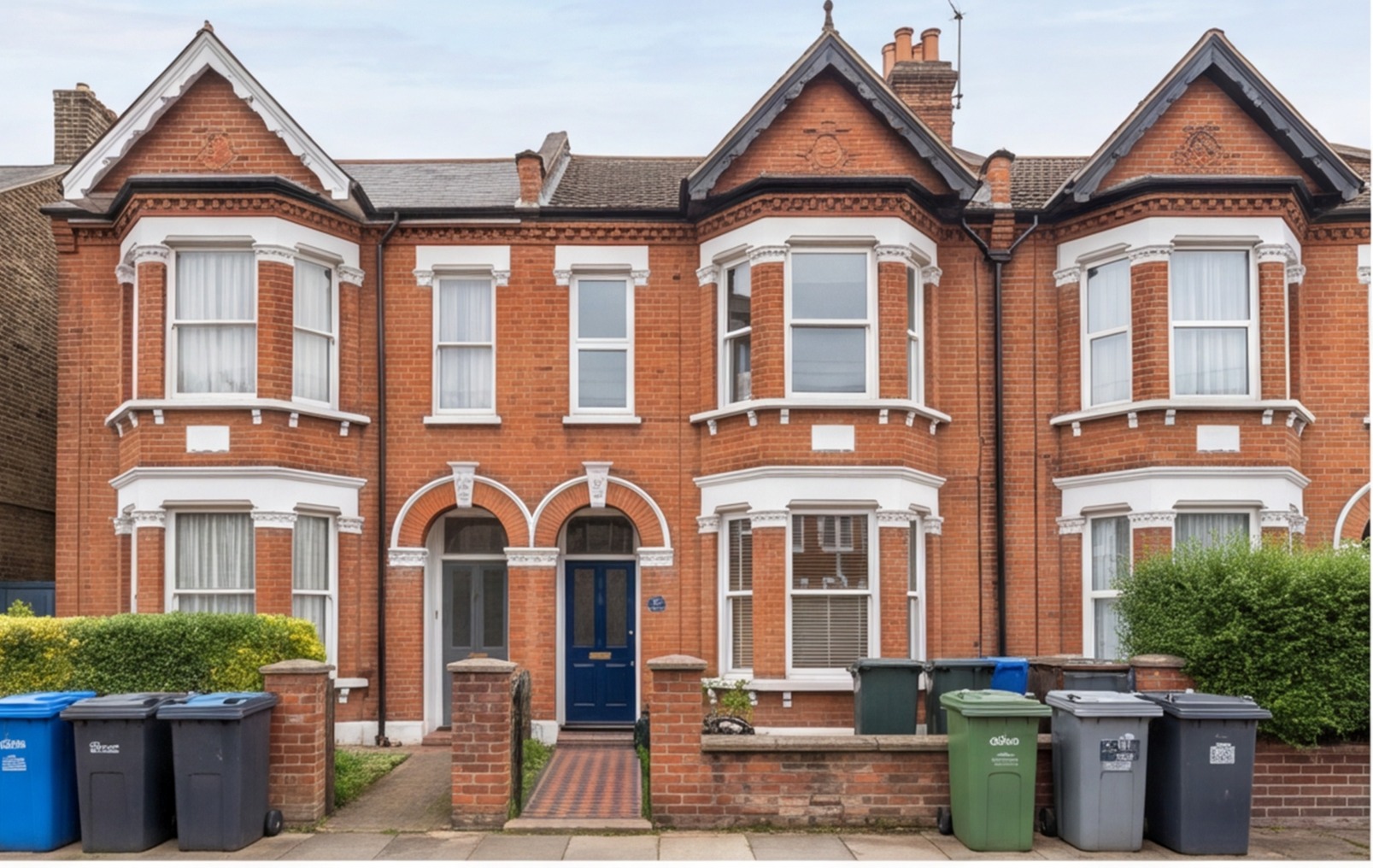
HMO conversion cost UK is a question that catches a lot of investors out. The building work itself isn't dramatically different from a standard renovation — but the compliance requirements unique to HMOs add meaningful cost that doesn't appear on a basic refurb quote. Fire doors throughout, a full mains-wired alarm system, emergency lighting, additional bathrooms, and a compliant kitchen spec can add £10,000–£25,000 on top of what a standard renovation would cost.
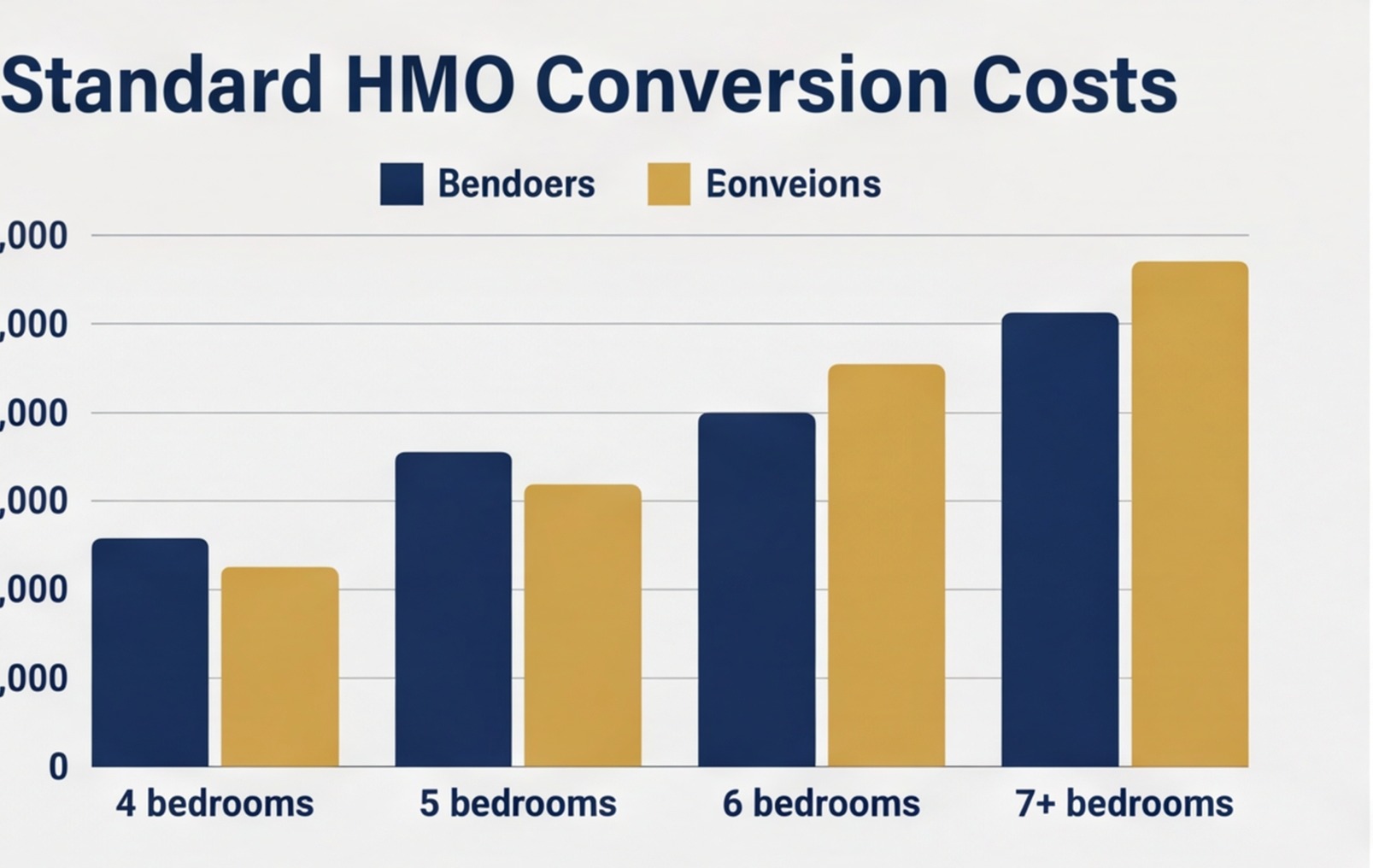
I've completed HMO conversions across the Midlands and I know where the money goes. In 2026, converting a standard 3-bedroom family house to a basic 4-bedroom HMO starts at around £25,000–£35,000 for a thorough job. A 6-bedroom conversion with en suites and a full fire safety package runs £60,000–£90,000 or more depending on the condition of the property and the standard of finish.
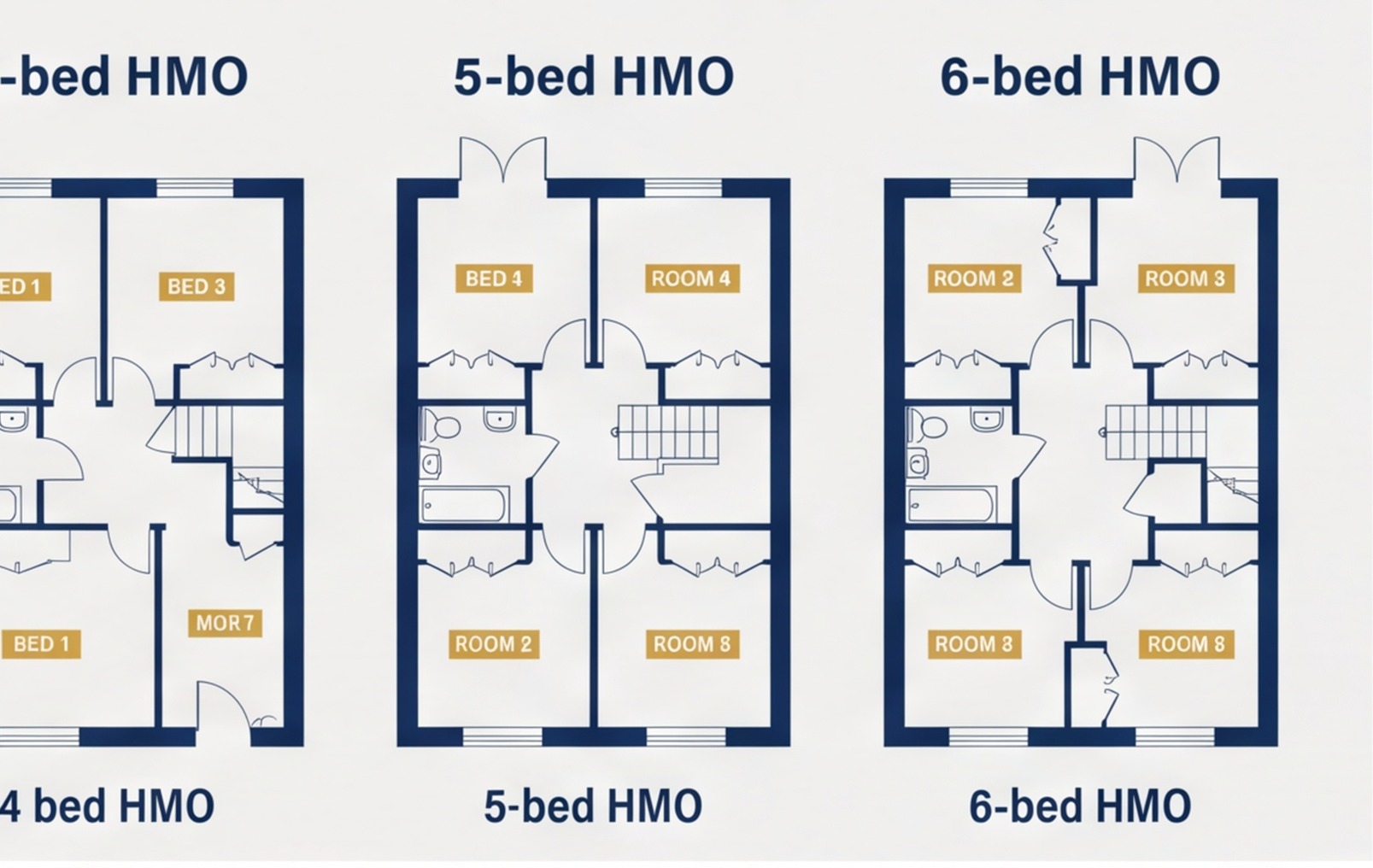
This guide breaks it down by bedroom count — 4-bed, 5-bed and 6-bed — and covers every HMO-specific cost item: fire doors, smoke detection, emergency lighting, bathrooms, kitchens, room sizes and licensing context. Note that HMO licensing requirements vary significantly between local councils — always verify the specific requirements with your local authority before starting work.
What Makes an HMO Conversion Different from a Standard Renovation
An HMO isn't just a house with more people in it. From a building perspective, the key differences are fire safety, bathroom provision, kitchen specification, room sizes, and ongoing compliance. These aren't optional extras — they're the conditions under which a property gets (and keeps) its HMO licence.
The Four HMO-Specific Cost Categories
- Fire safety: Fire doors to all habitable rooms, mains-wired interlinked alarm system, emergency lighting. This is the biggest differentiator from a standard renovation and the cost most investors underestimate.
- Additional bathrooms: HMOs need more bathroom provision than a family home. A 6-bed HMO with one bathroom won't pass licensing. You're often adding one or two bathrooms that a standard renovation wouldn't include.
- Room sizing and partitioning: Adding extra bedrooms often means partitioning larger rooms or converting existing non-habitable spaces. This means stud walls, soundproofing, new electrical circuits and redecoration.
- Kitchen specification: The shared kitchen needs to be large enough and spec'd properly for multiple occupants — commercial-grade surfaces, multiple appliances, adequate storage and ventilation. Basic domestic kitchens often aren't suitable without upgrade.
Beyond these four areas, the standard renovation work — replastering, rewiring, new flooring, redecoration — applies at least as comprehensively as any full renovation. HMOs in poor condition need everything that a standard full renovation needs, plus the compliance layer on top.
Fire Safety Compliance Costs
Fire safety is the non-negotiable cost in every HMO conversion. It's the one area where corners genuinely can't be cut — and where the cost is largely the same whether you're spending £30,000 or £80,000 on the renovation as a whole.
Fire Doors
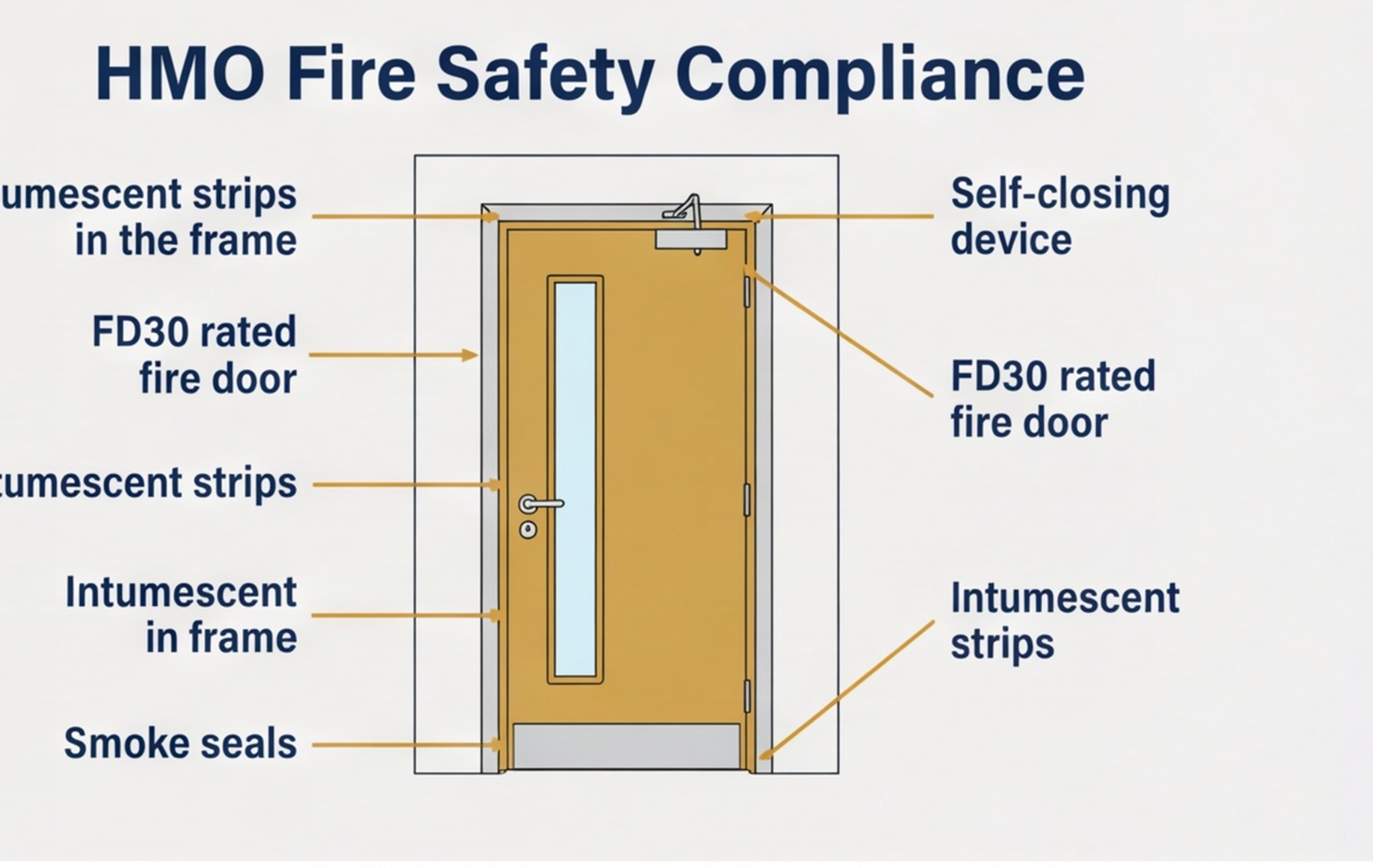
Every habitable room door in an HMO must be a fire door — typically FD30S (30-minute fire resistance with smoke seals) with a self-closing device. This includes all bedroom doors, the kitchen door, any bathroom doors that open onto the common escape route, and utility room doors where applicable.
| Fire Door Type | Supply Cost | Fit Cost | Total per Door |
|---|---|---|---|
| FD30S — standard internal (flush, painted) | £120–£200 | £80–£150 | £200–£350 |
| FD30S — with vision panel | £180–£280 | £80–£150 | £260–£430 |
| FD30S — solid oak or oak veneer | £250–£450 | £80–£150 | £330–£600 |
| Self-closing device (overhead closer) | £35–£80 | £25–£50 | £60–£130 |
For a 6-bedroom HMO, you're fitting 8–12 fire doors across the property (bedrooms, kitchen, bathrooms, any other habitable rooms). At £250–£400 per door including the closer, that's £2,000–£4,800 for fire doors alone — before you've started the renovation.
Fire Alarm System
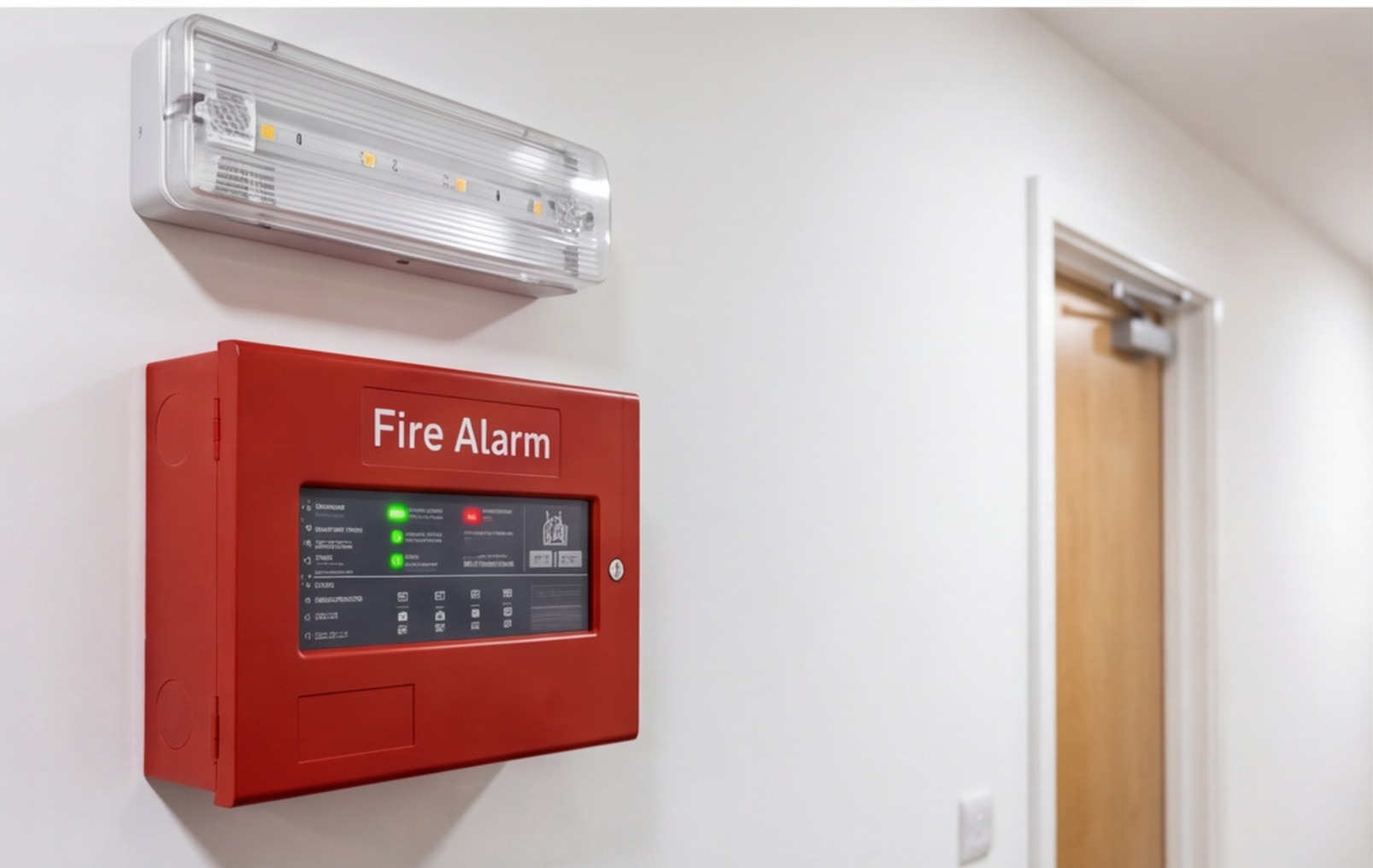
A mains-wired, interlinked fire alarm system is required in all licensable HMOs. The grade and category of the system depends on the property type and local council requirements — commonly Grade D Category LD2 (mains-wired detectors with battery backup) for smaller HMOs, or Grade A Category L2 for larger properties. Always confirm the required system specification with your local HMO licensing team before purchasing equipment.
Cost for a Grade D LD2 system for a 4–6 bedroom HMO: £800–£2,500 supply and install, depending on the number of detectors and panels required. A Grade A system with a central panel costs more — £2,000–£5,000 for a 6-bedroom property.
Emergency Lighting
Emergency lighting to escape routes (staircase, landings, hallways) is required in most HMOs, particularly those with three or more storeys. Self-contained emergency light fittings with maintained or non-maintained operation are the most common approach. Budget £600–£1,500 for emergency lighting supply and installation in a standard 3-storey HMO.
Total Fire Safety Package — Estimated Cost
| Element | 4-Bed HMO | 5-Bed HMO | 6-Bed HMO |
|---|---|---|---|
| Fire doors (supply and fit) | £1,600–£3,000 | £2,000–£3,500 | £2,500–£4,800 |
| Fire alarm system | £800–£1,800 | £1,000–£2,200 | £1,200–£2,500 |
| Emergency lighting | £500–£1,000 | £600–£1,200 | £700–£1,500 |
| Fire blanket and extinguisher | £100–£200 | £100–£200 | £100–£250 |
| Fire safety total | £3,000–£6,000 | £3,700–£7,100 | £4,500–£9,050 |
These fire safety costs sit entirely on top of the standard renovation costs. A builder quoting for an HMO who doesn't include a full fire safety package in their quote is either leaving it out deliberately or doesn't understand HMO compliance. Make sure fire safety is itemised in every quote you receive.
Bathroom Provision for HMOs
The standard guidance for bathroom provision in an HMO is one bathroom facility (WC plus bath or shower) for every four to five occupants. Local councils may specify different ratios — some require one bathroom per four occupants as a hard requirement, others allow more flexibility. Confirm with your local HMO licensing team.
In practice, market forces often drive bathroom provision beyond the minimum. En suites to individual rooms significantly improve lettability, reduce conflict between tenants, and justify higher room rates. In competitive HMO markets, rooms with en suites consistently let faster and at higher rates than rooms without.
For the costs of individual bathroom renovations, see our full guide on bathroom renovation cost UK. In the context of an HMO conversion, bathroom costs are:
- New shared bathroom (full renovation): £5,000–£9,000
- En suite addition per room (where space exists): £4,500–£8,500
- Cloakroom / WC addition: £2,500–£5,000
4-Bedroom HMO Conversion Cost
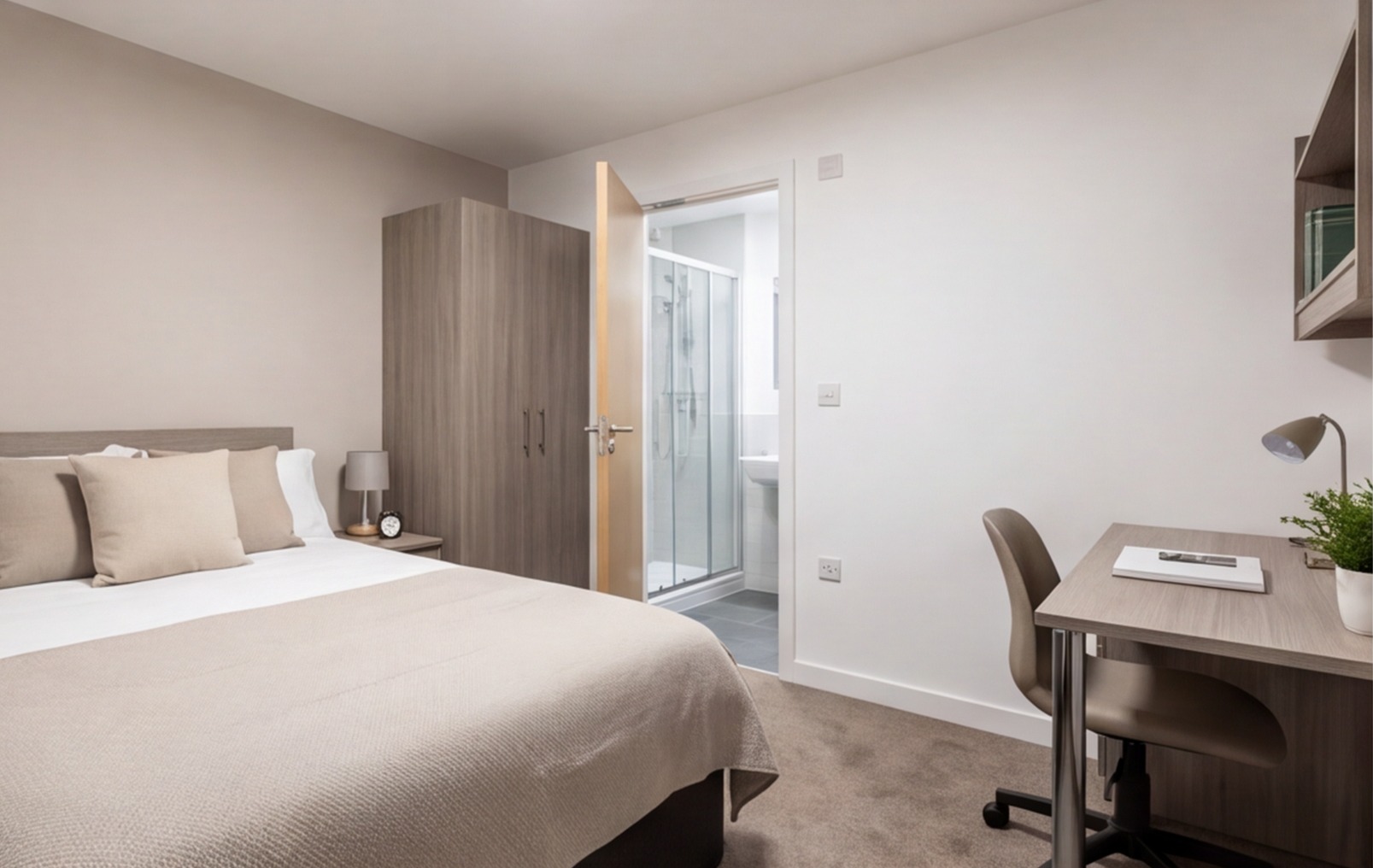
A 4-bedroom HMO is typically converted from a standard 3-bedroom family house with one larger room partitioned to create the fourth bedroom, or from a larger 4-bedroom house that needs a full compliance fit-out. This is the entry point for many HMO investors — below the mandatory licensing threshold in most areas (which typically kicks in at five occupants), more straightforward to manage, and less expensive to convert.
It's worth noting that even if mandatory licensing doesn't apply below five occupants, some councils operate Additional Licensing Schemes that cover 3 and 4-person HMOs. The compliance requirements under Additional Licensing are often similar to those for mandatory licensing. Always check your local council's position before committing to a 4-bed HMO strategy.
| Element | Cost Range |
|---|---|
| Full refurbishment (rewire, replumb, replaster, decorate) | £18,000–£30,000 |
| Bathroom renovation (1 bathroom) | £5,000–£8,000 |
| Shared kitchen renovation | £6,000–£12,000 |
| Room partitioning (if adding 4th bedroom) | £2,000–£5,000 |
| Fire safety package (doors, alarm, lighting) | £3,000–£6,000 |
| Flooring throughout | £2,500–£5,000 |
| Furniture and white goods (optional) | £3,000–£8,000 |
| Total — without furniture | £36,500–£66,000 |
| Total — furnished | £39,500–£74,000 |
The wide range reflects the condition of the starting property. A 4-bed HMO conversion from a recently maintained property in reasonable condition sits at the lower end. An older property needing full rewiring, replumbing and structural repairs sits at the top.
5-Bedroom HMO Conversion Cost
A 5-bedroom HMO crosses the mandatory licensing threshold in England — five or more occupants from two or more households requires a mandatory HMO licence from the local council. This triggers more formal compliance scrutiny: a licensing inspection, management conditions, and renewal every five years.
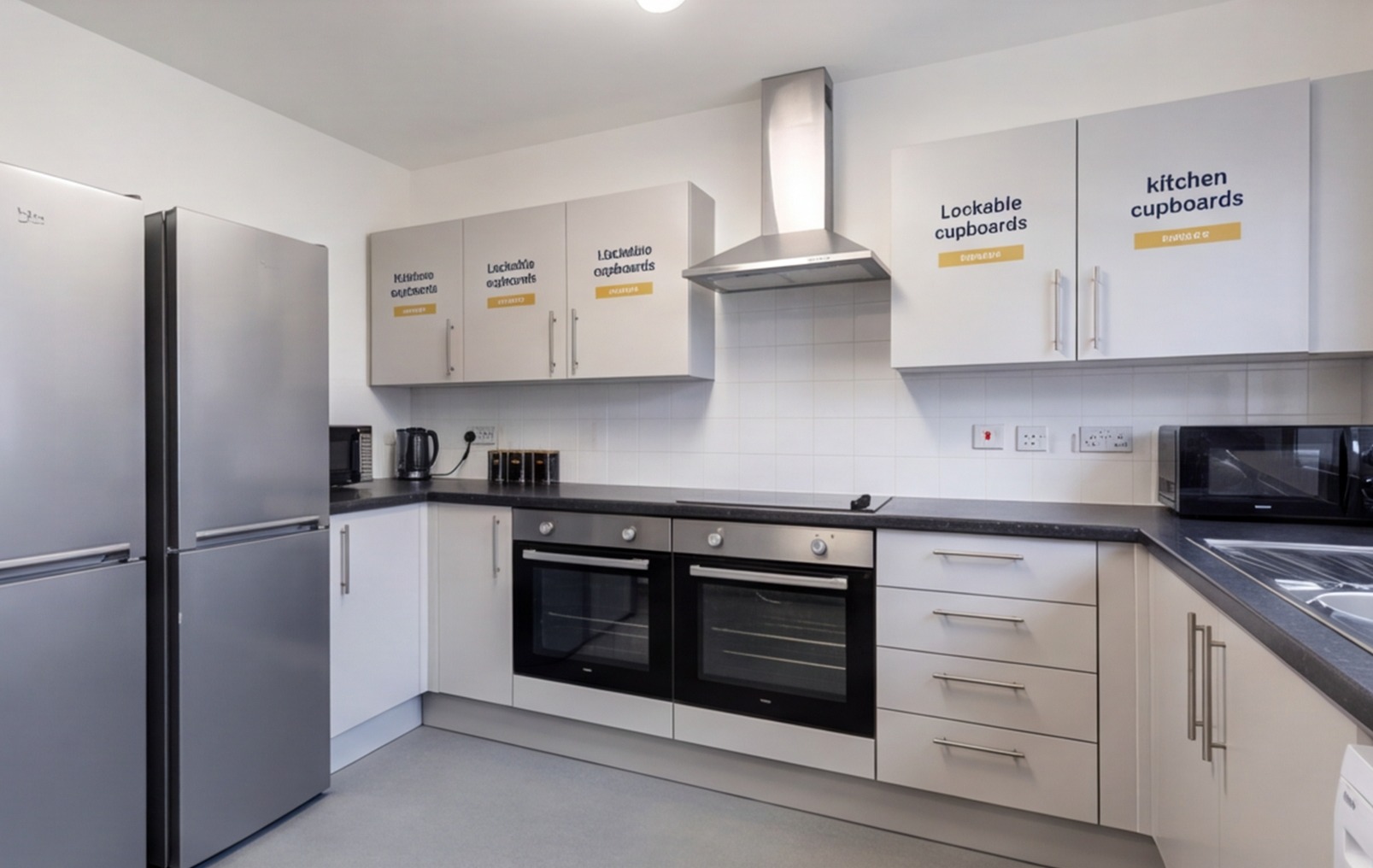
The conversion itself is more extensive than a 4-bed. You typically need two bathroom facilities (one bathroom per four to five occupants), a fully compliant shared kitchen with adequate storage and appliance provision for five occupants, and more extensive fire safety provision. The compliance cost scales significantly at this level.
| Element | Cost Range |
|---|---|
| Full refurbishment (rewire, replumb, replaster, decorate) | £22,000–£38,000 |
| Bathroom renovations (2 bathrooms) | £10,000–£18,000 |
| Shared kitchen renovation | £8,000–£16,000 |
| Room partitioning and reconfiguration | £3,000–£8,000 |
| Fire safety package (doors, alarm, lighting) | £3,700–£7,000 |
| Flooring throughout | £3,000–£6,000 |
| HMO licence application fee | £500–£1,500 |
| Furniture and white goods (optional) | £4,000–£10,000 |
| Total — without furniture | £50,200–£93,500 |
6-Bedroom HMO Conversion Cost
A 6-bedroom HMO is the maximum size that still falls within the C4 use class under permitted development (in most areas outside Article 4 Directive zones). Above 7 occupants you're into Sui Generis planning territory, requiring a full planning application regardless of location. For most residential HMO investors, 6 bedrooms represents the sweet spot of income versus compliance complexity.
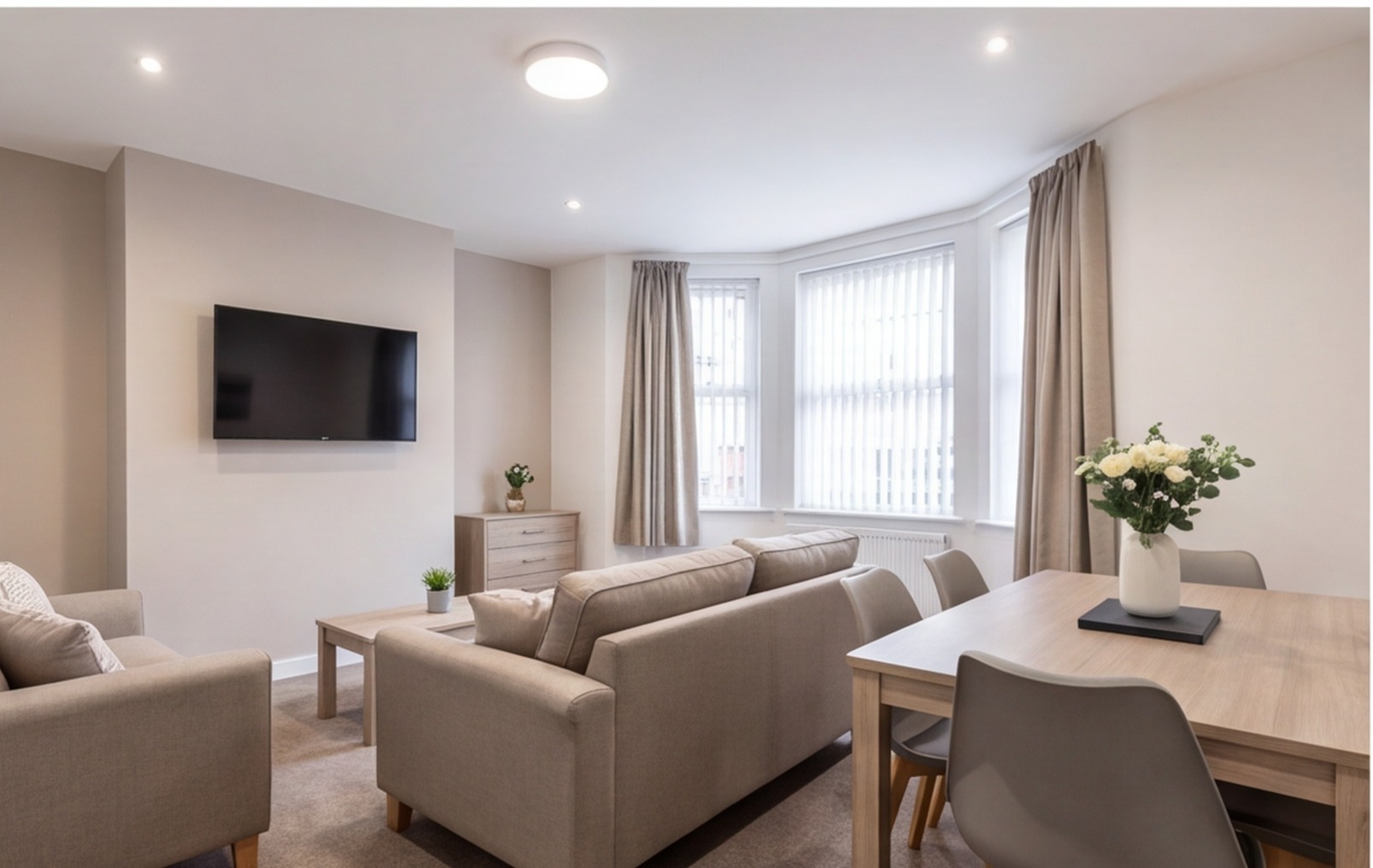
At 6 bedrooms, you're typically looking at two full bathrooms plus at least one additional WC, a larger shared kitchen, and a more extensive fire safety installation. En suites are increasingly common at this scale — they reduce bathroom queuing and improve the overall standard of the property, which helps with lettability and local licensing conditions.
| Element | Standard Finish | Premium Finish |
|---|---|---|
| Full refurbishment (rewire, replumb, replaster) | £25,000–£42,000 | £35,000–£55,000 |
| Bathrooms (2 shared bathrooms + additional WC) | £13,000–£22,000 | £18,000–£32,000 |
| En suites to select rooms (2–3 en suites) | — | £10,000–£25,000 |
| Shared kitchen (fully spec'd for 6) | £10,000–£18,000 | £15,000–£25,000 |
| Room reconfiguration / partitioning | £4,000–£10,000 | £5,000–£12,000 |
| Fire safety package | £4,500–£9,000 | £6,000–£12,000 |
| Flooring throughout | £4,000–£7,000 | £6,000–£12,000 |
| HMO licence application | £600–£1,500 | £600–£1,500 |
| Total — without furniture or en suites | £61,100–£109,500 | — |
| Total — premium with en suites | — | £95,600–£174,500 |
These are wide ranges because the starting condition of the property varies so much. An older Victorian terrace needing full rewiring, structural work and complete replastering will sit at the top of the range. A 1990s house in good structural condition needing primarily compliance and cosmetic work sits significantly lower.
If you want to model your specific property's conversion cost before making a purchase decision, RenoCalc lets you upload the floor plan and generate a trade-by-trade estimate — including HMO-specific line items for fire safety and additional bathrooms.
Licensing and Planning Considerations
This is the area where getting proper advice before you start is essential. Licensing requirements for HMOs vary significantly between local councils, and the planning rules around use class changes are increasingly complicated by Article 4 Directions. I can give you the general framework, but the specifics for your target area need to come from the local authority directly.
HMO Licensing
Mandatory HMO licensing in England applies to properties with five or more occupants from two or more households. The licence is issued by the local council, typically for five years, and requires the property to meet prescribed management and physical standards. Some councils operate Additional Licensing schemes that extend licensing requirements to smaller HMOs — including 3 and 4-person properties in some areas.
Licence fees vary widely between councils — from around £500 to over £1,500 for the initial application, with renewal fees applicable after five years. Factor this into your investment model as an ongoing cost, not a one-off.
Planning and Use Class
In England, a standard family house falls within the C3 use class. Small HMOs of up to 6 occupants fall within the C4 use class. Converting from C3 to C4 is permitted development in most areas — meaning no planning permission is required. However, many councils in high-demand areas have applied Article 4 Directions, removing permitted development rights and requiring a full planning application for any C3-to-C4 conversion.
Before purchasing a property for HMO use, check whether the local authority operates an Article 4 Direction for the relevant postcode. An unexpected planning application adds 3–6 months to your timeline and introduces planning risk that may affect your investment viability.
Room Size Standards
Minimum room sizes for HMOs are set by the Housing Act 2004 and associated regulations. Current national minimum sizes are: single person sleeping room — 6.51 m², two people sharing — 10.22 m². Many local councils apply additional room size standards that are more demanding than the national minimum as conditions of their local HMO licensing schemes. Check your council's HMO standards document before finalising your room layout.
For anyone using estimating software to model HMO conversion costs before purchase, our guide to construction estimating software covers tools that handle multi-room property estimating effectively. RenoCalc is specifically built for UK property investors and builders and handles HMO conversions as a standard use case.
Frequently Asked Questions
How much does an HMO conversion cost in the UK?
HMO conversion cost UK in 2026 ranges from approximately £25,000–£40,000 for a basic 4-bedroom conversion from a standard family house up to £60,000–£90,000+ for a 6-bedroom conversion with multiple en suites, full fire safety installation, new kitchen and bathrooms. The biggest costs beyond a standard renovation are fire safety compliance (fire doors, alarm systems, emergency lighting) and the additional bathrooms needed to serve multiple unrelated tenants. Always get a detailed scope-specific quote, not a per-room average.
What is an HMO and when do I need a licence?
An HMO (House in Multiple Occupation) is a property rented by three or more people from more than one household who share facilities such as a kitchen or bathroom. Mandatory HMO licensing in England applies to properties with five or more occupants from two or more households — these require a licence from the local council. Some councils operate Additional Licensing schemes covering smaller HMOs including 3 and 4-person properties. Always check with your local authority before purchasing a property for HMO use — licensing requirements vary significantly between councils.
What fire safety work is required for an HMO?
Fire safety requirements for an HMO include: FD30S fire doors with self-closers to all habitable rooms and the kitchen; mains-wired interlinked fire alarm system (grade and category specified by your local HMO licensing team); emergency lighting to escape routes; fire blanket in the kitchen. Local councils and fire services specify the exact requirements through the licensing process — never design the fire safety specification without confirming the requirements with your council's HMO team. Getting this wrong risks failing the licensing inspection.
How many bathrooms does an HMO need?
The standard guidance is one bathroom facility (WC plus bath or shower) for every four to five occupants, though local councils may specify different ratios. A 4-bedroom HMO typically needs at least one full bathroom — two is better. A 5 or 6-bedroom HMO should have at least two bathrooms or a combination of bathrooms and en suites. En suites to individual rooms are increasingly common as they improve lettability, reduce tenant conflict and justify higher room rates. Confirm the minimum requirement with your local authority.
Do I need planning permission to convert a house to an HMO?
In England, converting a family house (C3) to a small HMO of up to 6 occupants (C4) is permitted development in most areas — no planning permission required. However, many councils have applied Article 4 Directions removing this right in areas of high HMO concentration, meaning a full planning application is needed. For HMOs of 7 or more occupants you always need planning permission. Check your local council's planning policy before purchase — an Article 4 area can significantly affect your conversion timeline and risk profile.
What return on investment can I expect from an HMO conversion?
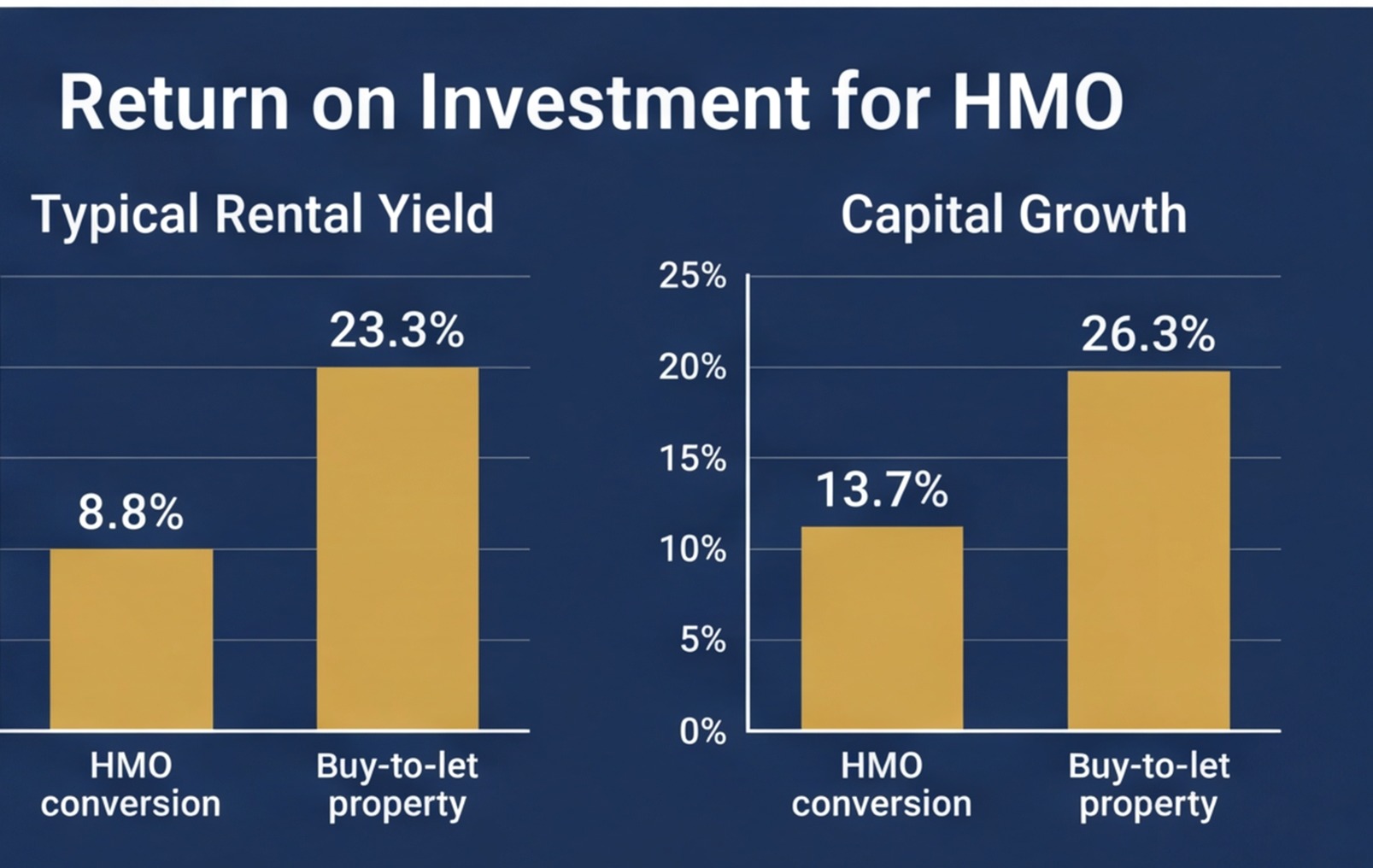
HMO investments typically generate significantly higher rental yields than single-let properties — gross yields of 8–15% are achievable in many UK cities compared with 4–6% for single-let buy-to-lets. The higher conversion cost is usually justified by the increased monthly income, with the uplift in income often recovering the additional conversion cost within 2–4 years. The key variables are purchase price, conversion cost, local room rates, void rates and management costs. RenoCalc helps you model the conversion cost accurately from your floor plan before you commit to a purchase.
Ready to Budget Your HMO Conversion?
HMO conversions aren't just renovation projects — they're compliance projects. The fire safety requirements, licensing conditions and additional bathrooms are non-negotiable, and they add meaningful cost on top of the standard renovation work. Budget for them properly from day one and you won't be caught out when the licensing inspection report comes back.
The cost ranges in this guide are based on real UK trade pricing in 2026 for properties of this type. Use them to build your investment model before you commit to a purchase — not after you've exchanged contracts. And if you want a room-by-room cost estimate based on your actual floor plan, try RenoCalc free.
Model Your HMO Conversion Cost Before You Buy
RenoCalc turns your floor plan into a full HMO conversion estimate — fire safety, bathrooms, kitchen, partitioning and full refurbishment all covered. Built for UK property investors and builders.
Start Your Free Estimate