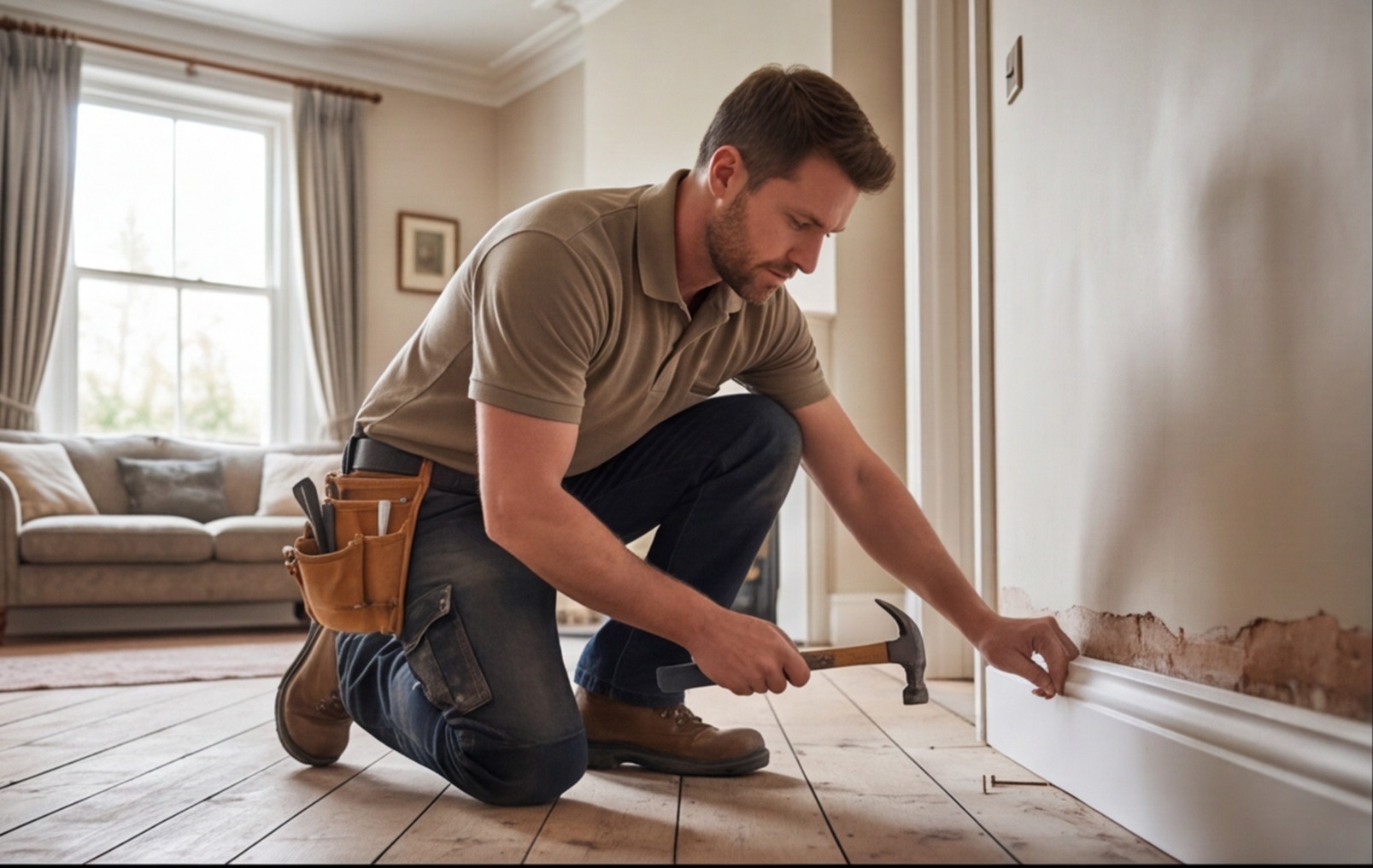
Second fix carpentry is one of those scopes that looks straightforward on paper but consistently gets underquoted. Builders who know how to quote second fix carpentry properly — counting every linear metre of skirting, every door lining, every piece of ironmongery, and pricing labour by item rather than guessing a day rate — avoid the margin squeeze that catches out the ones who don't.
This guide covers every element of second fix from skirting profiles through to sequencing, with realistic UK material and labour rates throughout. Whether you're pricing a single room refurbishment or the full second fix on a multi-bedroom renovation, the method is the same.
Measuring for Second Fix — What to Take Off
Before anything else, do a proper room-by-room take-off. Second fix carpentry involves multiple material types measured differently, so don't try to hold it in your head. Write it down or use your estimating app room by room.
Skirting — linear metres per room
Measure the perimeter of each room, then deduct all door openings. The opening width is the clear gap in the frame, not the architrave width. A standard single door opening is typically 762–838mm wide at the lining reveal.
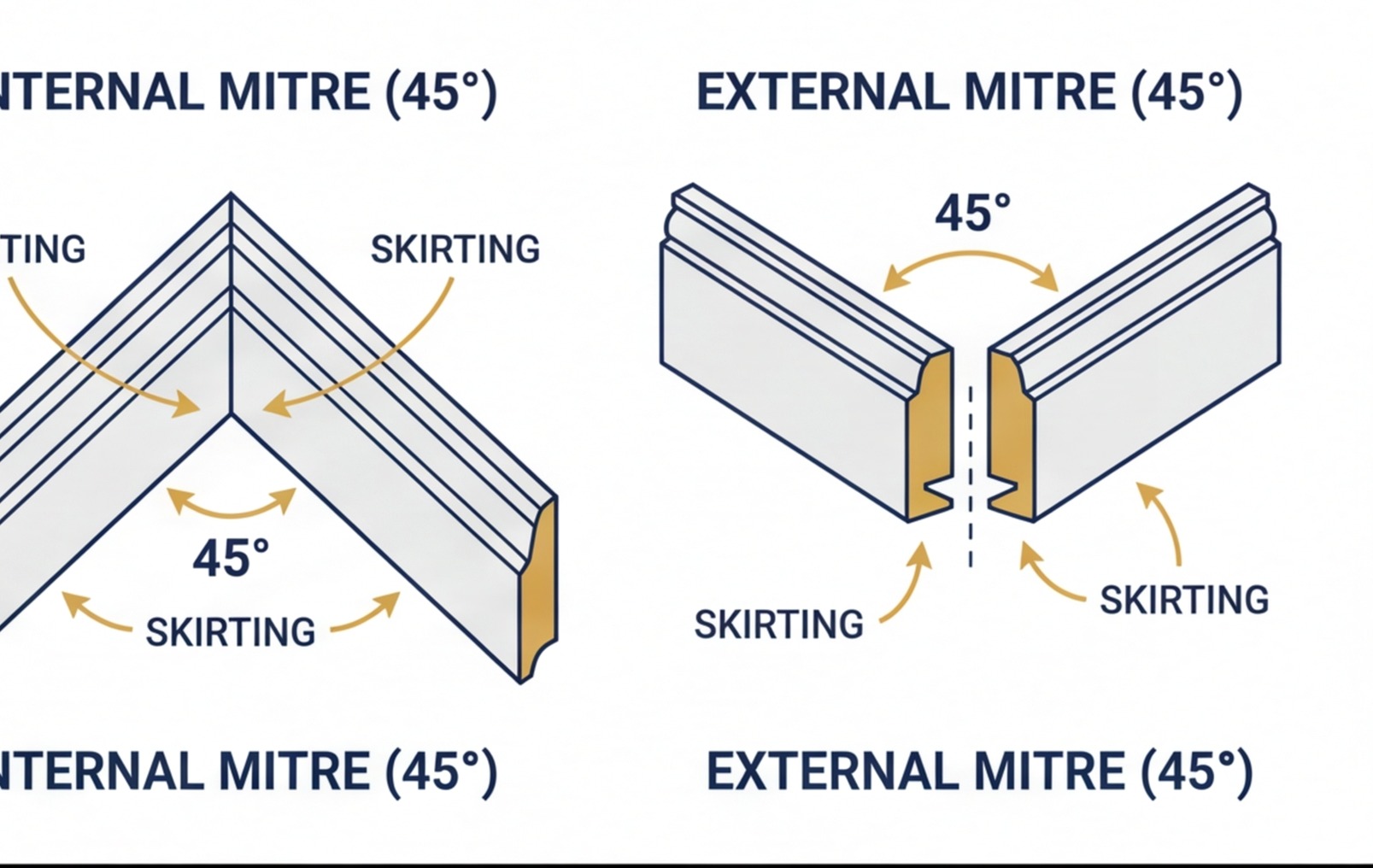
Example: a 4m × 3.5m bedroom = (4 + 3.5) × 2 = 15m perimeter. Deduct one door opening of 838mm = 14.16m of skirting. Always add 10–15% waste for mitres and cuts — you'll lose material on every internal corner.
Architraves — sets per door opening
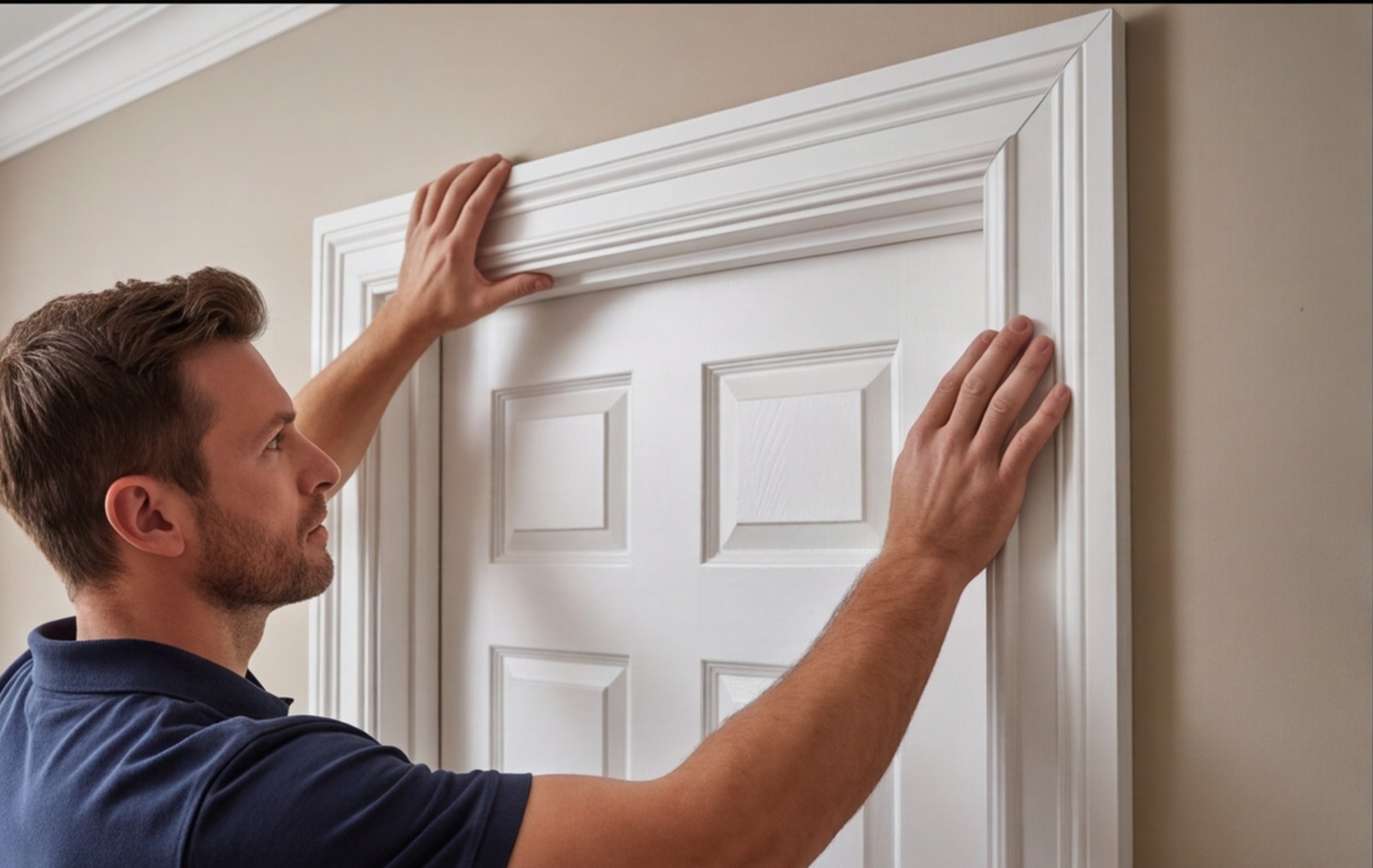
Each door opening takes architrave on both sides (so two sets per opening). A standard single door architrave set on one side = two legs at ~2100mm + one head piece at ~900mm = approximately 5.1m. Per opening, multiply by two sides. Add 10% waste for mitred joints.
Door linings — count per opening
Count each door opening. A standard door lining set = two jambs at 2100mm + one head = roughly 5.1 linear metres of lining per opening. On a renovation where you're also doing structural work, confirm whether any linings are structural and need fire-rated materials before pricing standard lining sets.
Doors — count per opening
Count each internal door opening. Note the size (762, 826 or 838mm wide is most common), door type (hollow core, solid core, FD30 fire door) and swing direction. These all affect supply cost and hanging time. If you're working from a floor plan, the guide to measuring from a floor plan covers how to read door swings and dimensions from drawings accurately.
Skirting Boards — Profiles, Lengths and Pricing
Skirting is priced per linear metre, supplied and fitted. Material cost depends on profile, height and material type.
Profile and material
MDF skirting is the most common choice on refurbishments — it takes paint well, comes in standard lengths and is significantly cheaper than hardwood. Hardwood (oak, pine, tulipwood) is used where the customer wants a natural finish or where MDF would be unsuitable (high-moisture areas, period properties with solid timber throughout).
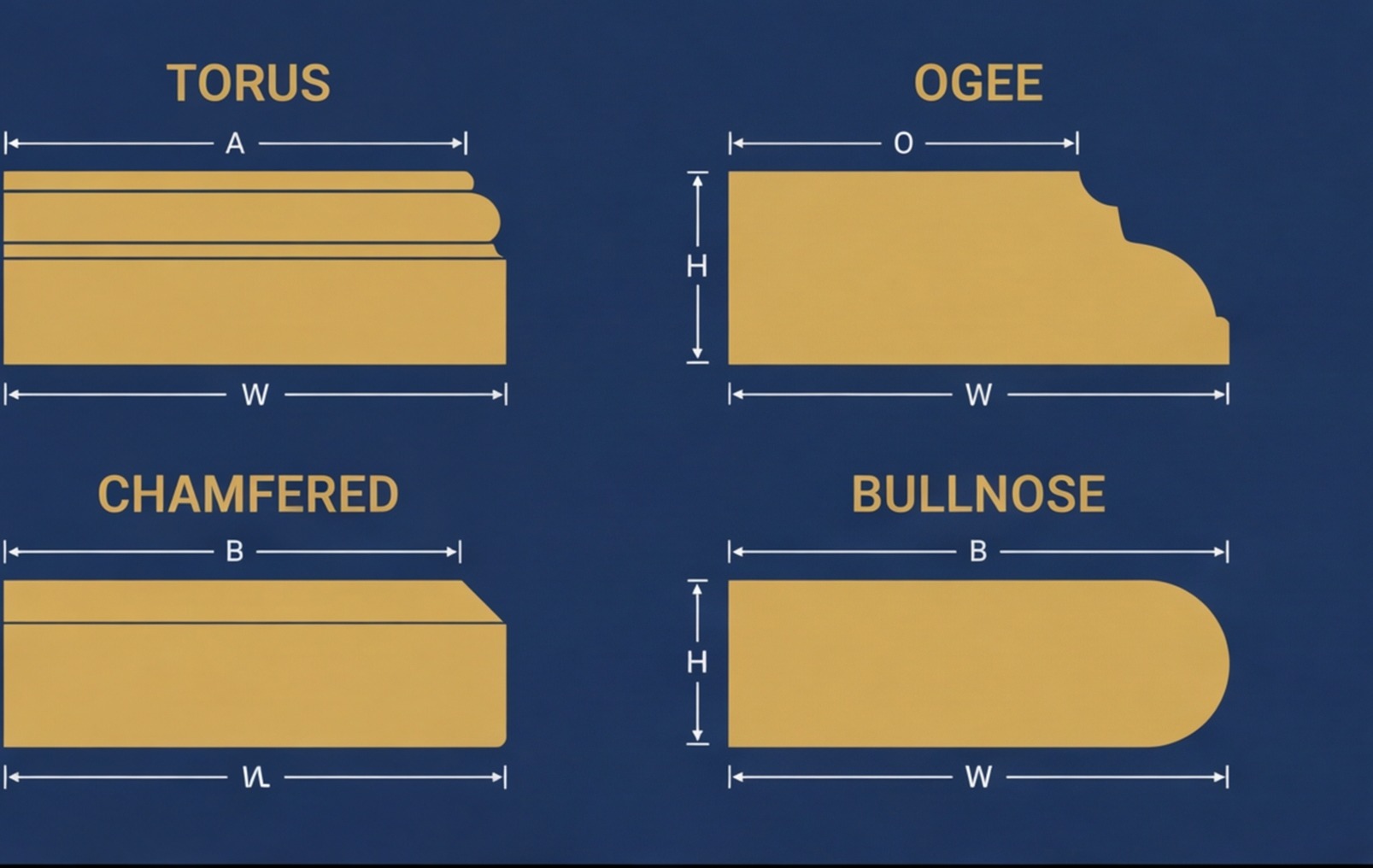
Common profiles:
- Pencil round / square edge — simplest to cut and fit, cheapest per metre
- Torus — the most common profile on UK builds, slightly shaped top edge
- Ogee — more elaborate profile, slower to fit neatly, more expensive per metre in hardwood
- Bullnose — rounded top edge, common in contemporary builds
Height affects cost. The standard is 94mm or 119mm. Feature skirtings at 144mm or 168mm can be two to three times the material cost of standard 94mm.
Supply cost per linear metre
| Material / profile | Height | Cost per linear metre (supply only) |
|---|---|---|
| MDF torus | 94mm | £1.50–£2.50 |
| MDF torus | 119mm | £2.00–£3.50 |
| MDF ogee | 119mm | £2.50–£4.00 |
| Hardwood (pine) torus | 94mm | £3.50–£5.50 |
| Hardwood (oak) profile | 119mm | £7.00–£12.00 |
Labour for fitting skirting: typically £5–£10 per linear metre supply and fix, depending on complexity, existing wall condition and whether the floor is level. Always add a waste factor to your material order — 10–15% is standard.
Architraves and Door Linings
Architraves
Architraves are priced per door opening, covering both sides. The material is very similar to skirting — usually MDF to match — and the profiles should always be consistent throughout the property unless the customer has specifically asked otherwise.
Standard architrave set per side of a door opening:
- Two legs at 2100mm = 4.2m
- One head piece at 900mm = 0.9m
- Total: ~5.1m per side, ~10.2m per full opening
On a room with multiple door openings, your architrave take-off adds up quickly. A 10-door house renovation needs 102m of architrave supply — plus 10–15% waste. That's material worth costing properly rather than estimating.
Labour for fitting architraves: typically included in a per-door rate or priced at £20–£40 per opening per side, depending on whether the lining is plumb and square. Out-of-plumb linings mean shimming and scribing, which adds time.
Door linings
A door lining (also called a door frame or door casing) sits inside the structural opening and provides the reveal into which the door is hung. Standard sets come in widths to match your partition thickness — most commonly 100mm or 119mm for a standard stud partition.
Lining sets are typically sold as a complete kit: two jambs and a head piece, pre-machined with a rebate for the door stop. On period properties or non-standard wall thicknesses, linings are cut from board and rebated on site — slower and more expensive.
Supply cost per lining set: £25–£60 for standard MDF/softwood, £80–£200 for hardwood or fire-rated sets.
Labour to set and fix a door lining: 1–2 hours per opening, depending on whether the structural opening is square and plumb. Budget for the worst case on older properties.
Internal Doors — Supply and Hanging
Doors are often the biggest single supply cost in a second fix package. Always clarify who is supplying — client supply, builder supply or a package deal — before submitting your quote.
Door types and supply costs
| Door type | Supply cost (per leaf) |
|---|---|
| Hollow core — plain white primed | £35–£65 |
| Solid core — white primed | £80–£150 |
| Solid core — oak veneer | £120–£250 |
| FD30 fire door — plain | £90–£180 |
| FD30 fire door — oak veneer | £150–£350 |
| Bifold set (pair, white primed) | £120–£400 |
Fire door requirements: FD30 doors are mandatory in certain locations in domestic properties under Part B of the Building Regulations — particularly between an integral garage and the house, on escape routes in HMOs, and in specific positions in buildings over two storeys. Don't assume standard doors throughout on a refurbishment without checking the building inspector's requirements. Getting it wrong means remediation.
Labour to hang a door
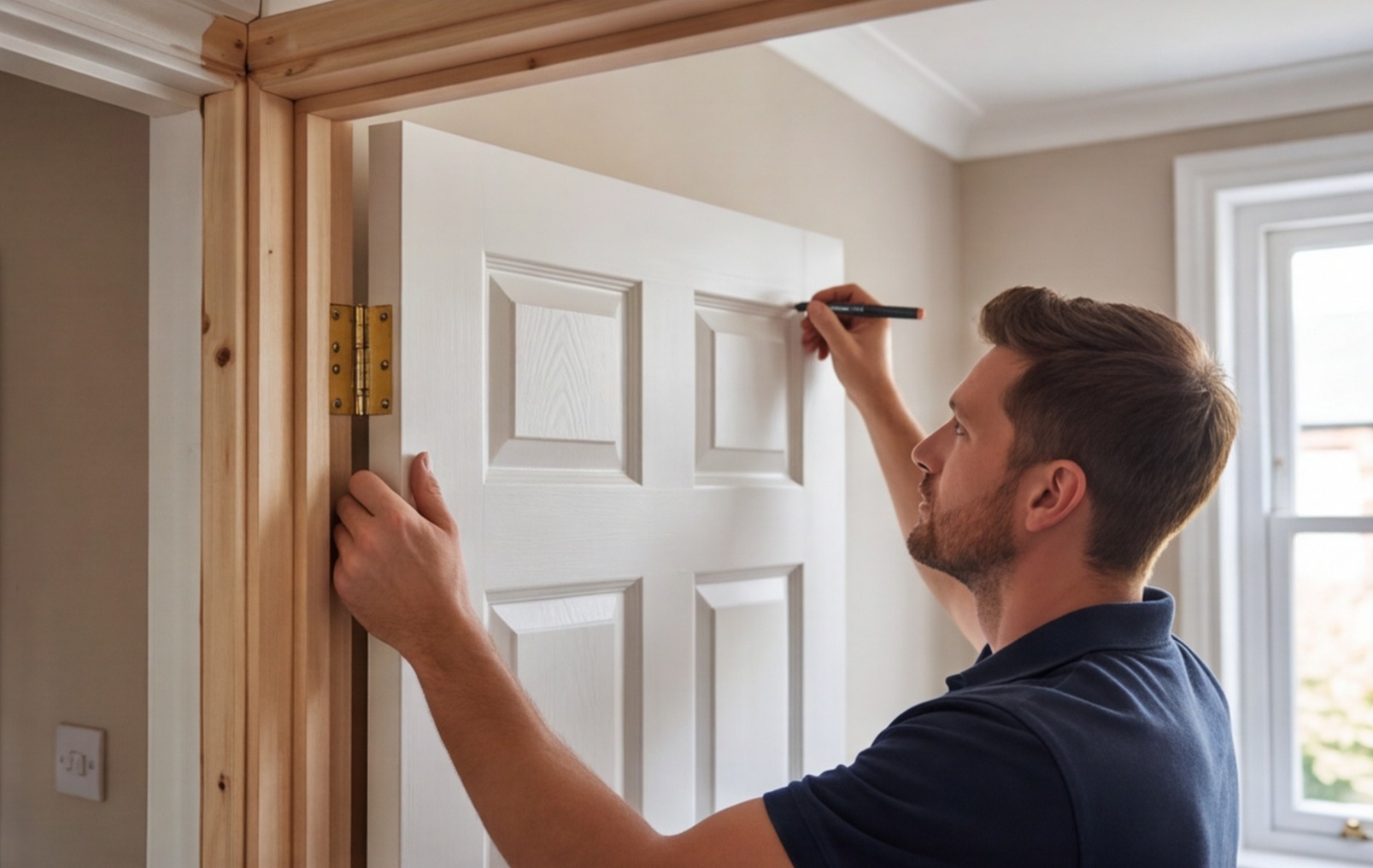
Hanging an internal door typically takes 1–2 hours per door for a straightforward hang — cutting to size if needed, marking and chiselling three hinge recesses, fitting the door and checking operation. Add time for:
- Planing and trimming — solid core and hardwood doors often need planing to size. FD30 fire doors must not be planed below a certain minimum thickness; always check the manufacturer's guidance.
- Non-standard openings — out-of-plumb linings, low ceilings, or awkward door positions add significant time.
- Bifold and sliding doors — track fitting, alignment and adjustment can take twice as long as a standard hang.
Typical labour to hang a standard door (excluding ironmongery): £50–£90 per door. FD30 or specialist doors: £80–£150 per door. These are supply-only labour rates; adjust if you're also supplying the door.
Ironmongery, Thresholds and Window Boards
Door ironmongery
Ironmongery gets missed on quotes more often than almost anything else in second fix. Every door needs, at minimum:
- Hinges — three per door is standard practice (two on hollow cores is acceptable but three is correct for longevity). Budget £5–£25 per set of three depending on quality and finish.
- Latch or lock — tubular latch for standard doors (£5–£20), mortice lock where security is required (£20–£80).
- Handle set — lever handle sets typically £15–£80 per door depending on finish (polished chrome, satin nickel, antique brass). Don't forget that you need a handle set on both sides of the door.
- Door stop / draught excluder — on fire doors, intumescent strips and cold smoke seals are mandatory. Budget £8–£25 per door.
- Door closer — required on all FD30 doors in most domestic applications. Budget £15–£40 per door supply only.
On a full house renovation with 10 internal doors, ironmongery alone can be £600–£1,500 in materials depending on specification. Always present this as a separate line item in your quote. It makes the cost transparent and protects you if the customer upgrades the spec after the quote is submitted.
Threshold strips
Every doorway where the flooring changes material (carpet to tile, timber to LVT, etc.) needs a threshold strip. Standard aluminium threshold strips are £5–£15 per opening. Ramp thresholds for level access are slightly more. Count every opening and price them in.
Window boards (window sills)
Window boards are priced per linear metre, supply and fix. MDF window boards run £8–£20 per metre supply; hardwood oak cills £20–£50 per metre. Fitting time is around 30–45 minutes per window including scribing to the wall and finishing the ends. Budget for fitting sealant under the board too — it prevents movement and stops draughts.
Labour Rates and Sequencing
Second fix sequence
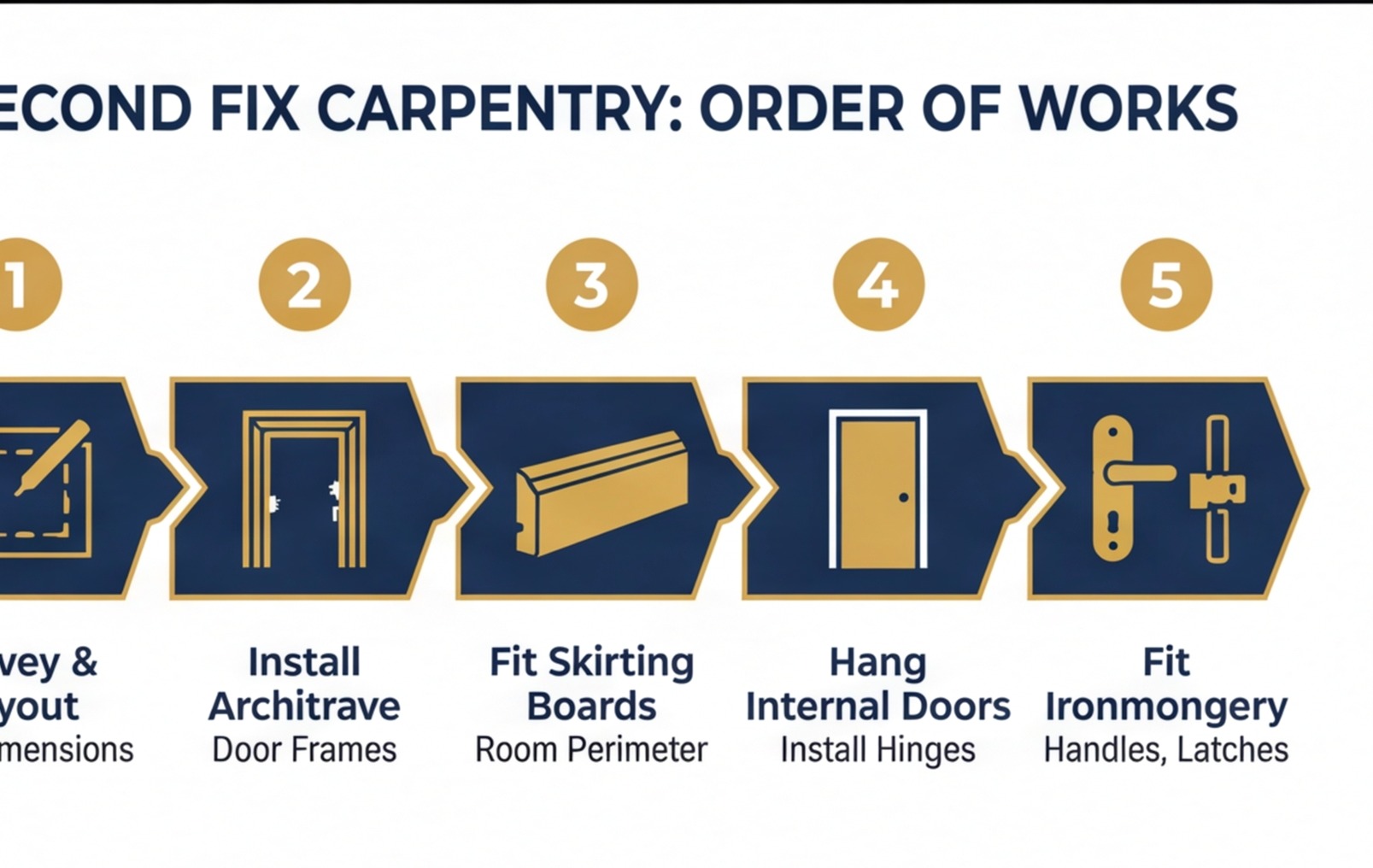
Second fix carpentry follows plasterers off the walls and precedes decorators. That sequence is tight and any delay in your programme costs everyone money. The correct order within second fix is:
- Fix door linings (before plasterers skim where linings are set into reveal)
- Hang doors (after plastering is complete and dry)
- Fit skirting boards
- Fit architraves
- Fit window boards
- Fit ironmongery (handles, latches — hinges are fitted at door-hang stage)
- Fit threshold strips (often last, after floor finishes are installed)
Getting this sequence wrong costs you time. Fitting architraves before plastering is complete means the decorator paints over filler on the reveal face — and you may be called back to fix the gap that opens when the plaster dries. A clear schedule of works that sequences second fix against the wider build programme avoids these issues.
Typical labour rates
| Item | Labour rate |
|---|---|
| Skirting board — supply and fix | £5–£10 per linear metre |
| Architrave — supply and fix (per side) | £20–£40 per opening side |
| Door lining — supply and fix | £60–£120 per opening |
| Internal door — hang only (no supply) | £50–£90 per door |
| FD30 door — hang and certify | £80–£150 per door |
| Ironmongery — fit only (per door) | £30–£60 per door |
| Window board — supply and fix | £15–£35 per metre (supply and fix) |
| Threshold strip — supply and fix | £10–£25 per opening |
A good carpenter covering a full four-bedroom house second fix — 10 doors, full skirting and architraves, 8 window boards — will typically take 5–8 days. Cross-check your itemised rates against that day-rate sanity check every time.
Sample Second Fix Carpentry Quote
Here's a worked example for a three-bedroom house second fix — nine internal doors, full skirting and architraves throughout, eight window boards.
Take-off summary:
- Internal doors: 9 (7 standard hollow core, 2 FD30)
- Skirting: 95 linear metres (after deductions for door openings, plus 12% waste)
- Architraves: 9 openings × 10.2m both sides × 1.12 waste = 103 linear metres
- Door lining sets: 9
- Window boards: 8 × 900mm average = 7.2 linear metres
- Ironmongery: 9 door sets (hinges, handles, latches) + 2 door closers (FD30)
- Threshold strips: 5 (at floor finish changes)
| Item | Quantity | Supply rate | Labour rate | Total |
|---|---|---|---|---|
| Hollow core doors (7 No.) | 7 | £55 each | £70 each hang | £875 |
| FD30 fire doors (2 No.) | 2 | £130 each | £120 each hang | £500 |
| Door lining sets (9 No.) | 9 | £40 each | £80 each fix | £1,080 |
| MDF torus skirting 119mm | 95 lm | £2.80/lm | £7/lm fit | £931 |
| MDF torus architrave 69mm | 103 lm | £1.80/lm | £6/lm fit | £803 |
| Window boards — MDF 295mm | 7.2 lm | £12/lm | £25/lm fit | £266 |
| Ironmongery — 9 door sets | 9 sets | £45/set | £45/door fit | £810 |
| FD30 door closers (2 No.) | 2 | £30 each | — | £60 |
| Threshold strips (5 No.) | 5 | £10 each | £15 each fit | £125 |
| Net total (before margin) | £5,450 | |||
A typical margin on materials of 15–20% brings this to a quoted price of around £6,000–£6,500 for the full second fix package on this house. The exact numbers shift with spec and region, but the method stays the same: count everything, price every item separately, never lump it all into a day rate.
If you're building this into a broader renovation estimate, have a look at how a proper bill of quantities structures these items — second fix carpentry should always appear as distinct line items with quantities, units and rates clearly broken out.
For second fix on larger projects or where you're quoting speed and accuracy matter, RenoCalc generates material schedules from floor plans so you're not manually counting linear metres room by room. For a wider view of what construction estimating software can do for your quoting process, that comparison covers the main options for UK builders.
Second fix carpentry rewards careful take-off. Count every item, use consistent rates, price ironmongery as a separate line, and always check your total against a day-rate cross-check. Builders who treat it as an afterthought pay for it in margin. Builders who price it properly build a reputation for clean, accurate quotes that win jobs at the right price. Get started with RenoCalc to generate full renovation estimates from your floor plan in under 3 minutes.