Domestic Building Contract UK: What Every Builder Must Include

I have been building in the UK for over 30 years, and the number of builders I have seen get burned — badly — because they had nothing in writing would fill a book. A domestic building contract template UK that actually covers the right clauses is not about being awkward or litigious. It is about being professional. It sets out exactly what you are doing, what you are charging, when you are getting paid, and what happens if things go sideways. Get that right and most disputes never even start. Get it wrong — or have no contract at all — and you are one awkward client away from a very expensive argument.
This guide is not legal advice. It is builder-to-builder guidance on what a solid domestic contract should contain and why each clause matters in the real world.
Why Every Builder Needs a Written Contract
Let me be blunt: "we agreed it verbally" is not a defence in a dispute. It is an invitation to spend months arguing about what was said on a driveway six months ago. A written domestic building contract template UK does three practical things: it records exactly what was agreed, it sets clear expectations on both sides, and it gives you something to point to when a client starts moving the goalposts.
The Consumer Rights Act 2015 gives residential clients significant legal protection regardless of what is written. They can challenge unreasonable charges, sub-standard workmanship and misleading descriptions. That protection exists with or without a contract. What a contract does is give you an equal footing — your obligations are clear, and so are theirs.

For domestic work, the key risks are:
- Client denies agreeing to certain works
- Client disputes the final price after completion
- Client withholds final payment claiming defects
- Scope creep — client adds work and then objects to being charged for it
- Delays caused by the client, then blamed on the builder
A robust contract addresses every one of those risks before you start work. It also signals professionalism. Clients who see a clear, well-written agreement before a spade goes in the ground tend to take the job — and the builder — more seriously.
Not yet using a structured quoting system to feed your contracts? Try RenoCalc free to generate detailed job breakdowns that form the backbone of a watertight scope of works.
Scope of Works: The Core of the Document
The scope of works is the most important part of any domestic building contract. It defines exactly what you are doing and — equally importantly — what you are not doing.
A good scope of works is specific enough that a stranger could read it and understand precisely what work is included. Avoid vague language like "general building works" or "renovation as discussed." Those phrases are worthless when a client claims the scope included things you never costed.
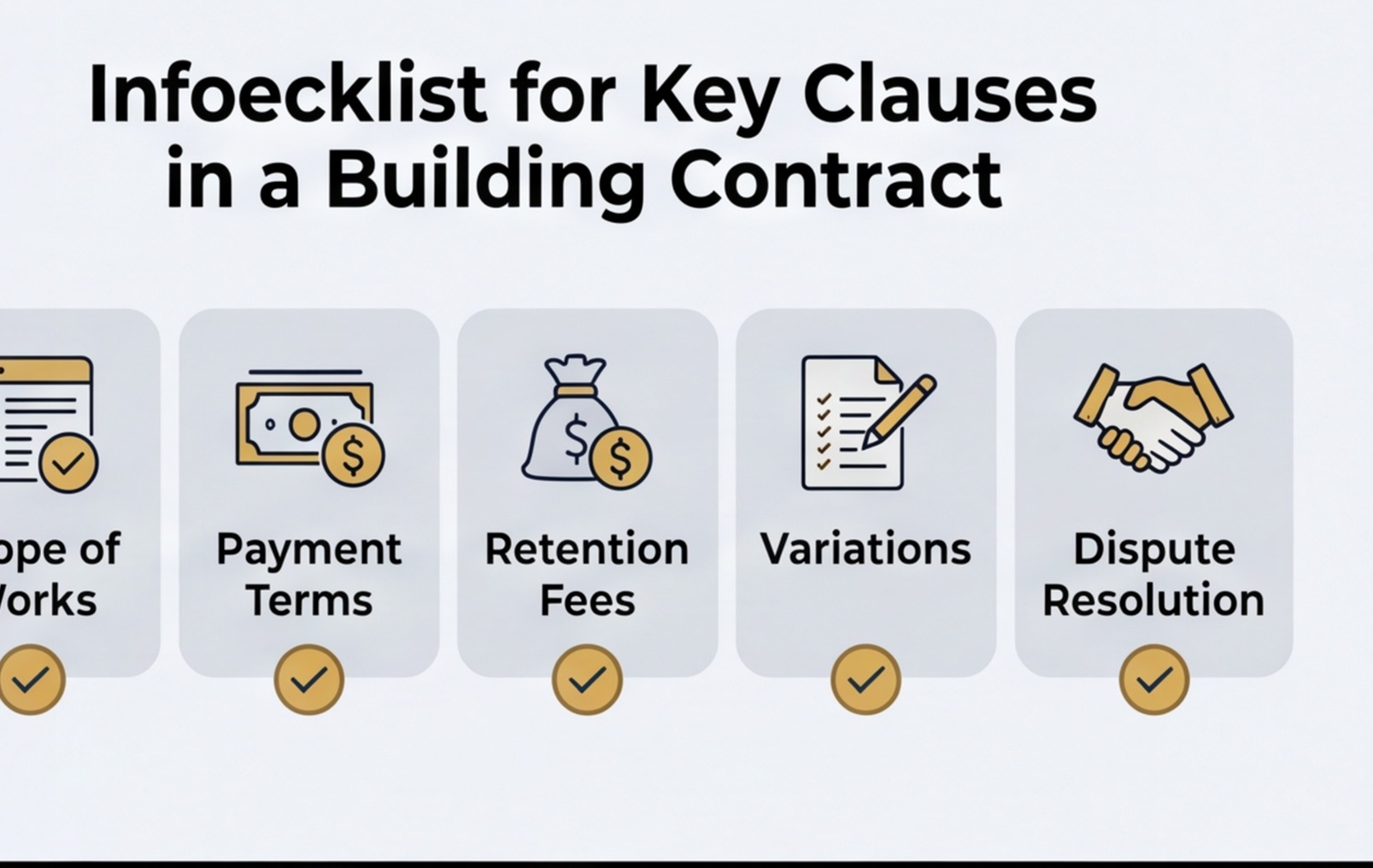
What the Scope Must Specify
| Element | Example of weak wording | Example of strong wording |
|---|---|---|
| Location | "The property" | "12 Elm Road, Coventry, CV1 2AB" |
| Rooms affected | "Kitchen area" | "Ground floor kitchen (approx. 14m²) including removal and disposal of existing units" |
| Materials | "New plumbing" | "22mm and 15mm copper pipework in accordance with client-supplied layout drawing dated 10/04/2026" |
| Supplied items | "Tiles as agreed" | "Wall tiles supplied by client. Contractor to supply adhesive, grout and fixings." |
| Finishes | "Paint ready" | "Plaster finish throughout to receive decorator's finish. Decorating not included." |
Listing Exclusions Explicitly
After the scope, include a clear exclusions list. This is where you state what is not included. Common exclusions on domestic projects:
- Making good following removal of existing fixtures not listed above
- Structural investigation works beyond the agreed scope
- Asbestos removal (requires licensed contractor)
- Connection to live services beyond first fix
- Landscaping, fencing or external works not listed
- Furniture removal or storage
- Redecoration of areas not directly affected by the works
- Works to areas found to require additional repair once opened up (subject to variation)
The "opened up" exclusion is particularly important in older properties. Walls that look solid from the outside can hide rot, damp, crumbling brickwork or illegal wiring. State clearly that investigation findings may result in additional quotations.
Payment Stages and How to Structure Them
Payment stages are where most contracts fall down. Either they are too vague (no clear trigger for each stage) or they are front-heavy — too much money paid up front, leaving you exposed if a client disputes the final payment.
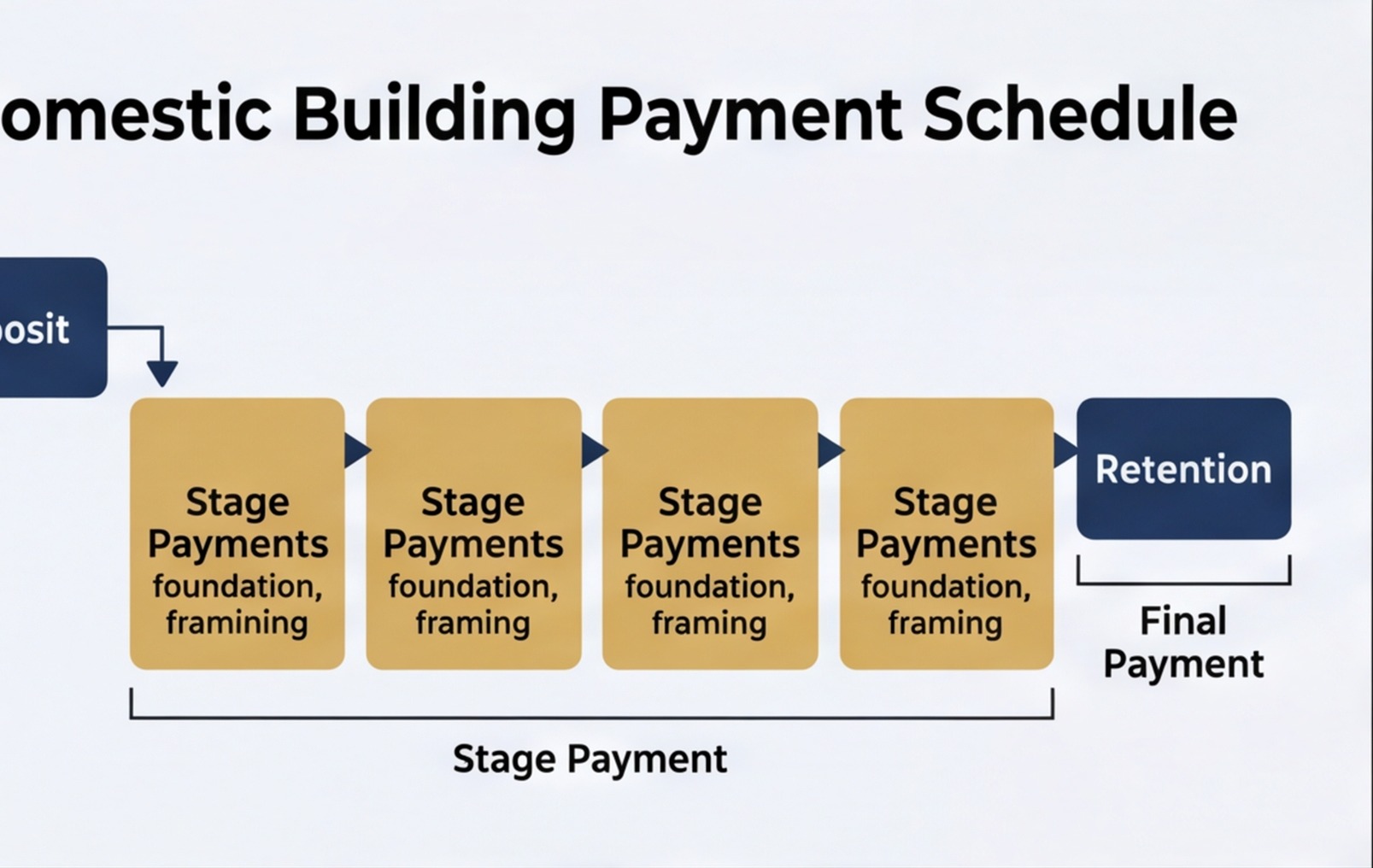
Typical Domestic Payment Structure
| Stage | Trigger | Typical % |
|---|---|---|
| Deposit | Contract signing | 10–25% |
| Stage 1 | Strip-out / groundworks complete | 20–25% |
| Stage 2 | First fix complete (structural, plumbing rough-in, cables in) | 20–25% |
| Stage 3 | Plaster dry / second fix underway | 20% |
| Final | Practical completion, less retention | 10–15% less retention |
| Retention release | Defects liability period expiry | Retention (2.5–5%) |
Each trigger must be observable — something you can point to physically on the day. "First fix complete" should be defined as something measurable: all structural steelwork in, all waste runs below floor, all 2.5mm ring mains chased and clipped. Not "roughly first fixed."
Payment Terms and Late Payment
Specify your payment terms clearly. The standard commercial position under the Late Payment of Commercial Debts Act does not automatically apply to domestic clients. For consumer contracts, state a clear payment due date — typically 7 or 14 days from invoice — and include a simple clause stating that continued delay in payment entitles you to suspend works. Do not include punitive interest terms on consumer contracts without taking advice; the Consumer Rights Act can make unfair terms unenforceable.
Using a proper quoting tool from day one makes building payment stage documents much faster. RenoCalc generates stage breakdowns based on your line-item quote, so your contract and your quote always match.
Variations: Changes That Kill Margins
Variations are where good jobs turn bad. A client asks you to move a socket, swap a radiator, add an extra door. Each one is small. By the end of a long job, those small variations are four weeks of extra work you have done for free because you never wrote them down.

The Variation Order Process
Your contract must include a variation clause. The clause should state:
- No variation to scope, specification or programme is instructed verbally.
- All variations are documented on a numbered variation order.
- The variation order states the description of work, the additional cost or saving, and the impact on the programme.
- No variation work starts until the client has signed the variation order.
- Variation order totals are added to the contract sum and invoiced at the relevant payment stage.
In practice, getting a signature on a variation order before starting additional work feels awkward at first. Do it anyway. Explain to your clients at contract signing that this is how you manage all variations — for their protection as much as yours. Frame it as "this way you always know what something extra will cost before we go ahead." Most clients respond well to that.
Day Rate vs Fixed Variation Pricing
If a variation involves work that is genuinely difficult to price in advance — opening up a wall to find the true extent of rot, for example — include a provision for time and materials pricing at an agreed day rate. State the day rate in the contract. That way, when you invoice for day-rate variation work, the client already knows the basis on which you are charging.
Exclusions, Access and Third-Party Delays
A domestic renovation often depends on things outside your control. The kitchen units arrive damaged. The structural engineer is late with drawings. The client's joinery subcontractor is stuck on another job. Each of these can hold up your programme, and your contract needs to deal with what happens in each case.

Access Provisions
State clearly what access you need. For a full internal renovation, you typically need:
- Access from 7:30am–5:30pm Monday to Friday (check local authority guidance for restrictions)
- Secure storage of materials on site or in a lockup agreed in writing
- Mains power and water during working hours
- A sanitary facility on site or within agreed walking distance
If the client restricts access — moving your start time, locking you out for a week for family events, refusing to vacate during asbestos works — that is a client-caused delay. Your contract should state that client-caused delays may result in revised completion dates and, where the delay extends beyond a certain number of days, an extension of time claim at your agreed day rate.
Client-Supplied Materials
Be specific about client-supplied items. If the client is supplying sanitaryware, a kitchen, tiles or timber, state:
- The specification or description of each supplied item
- The date by which the item must be on site
- That delays caused by late supply are the client's responsibility
- That you will quote separately for any additional labour caused by incorrect or damaged supplied items
Defects Liability and Retention
A defects liability period (DLP) is standard on any properly run domestic contract. It is the period after practical completion during which you agree to return and fix genuine defects in your workmanship at no additional cost.
Practical Completion
Practical completion is reached when the works are substantially complete and the property is fit for its intended use, even if minor snagging items remain. It is not the same as perfect completion. Your contract should define practical completion clearly and state that a snagging list issued at practical completion does not delay the final payment or release of the majority of funds.
At practical completion, issue a certificate or letter confirming the date. This starts the DLP clock and gives you a clear record of when your liability for defects began.
What the DLP Does and Does Not Cover
| Covered by DLP | Not covered by DLP |
|---|---|
| Plasterwork cracking due to workmanship failure | Hairline shrinkage cracks in new plaster (normal movement) |
| Leaks from pipework joints installed by your team | Leaks from pipework disturbed by client's own trades after handover |
| Doors that were not hanging correctly at handover | Doors swelling due to subsequent damp from client's use |
| Roof covering failure where flashing was installed by you | Storm damage beyond normal exposure |
| Tile adhesion failure on tiles you installed | Tiles cracking from impact after handover |
Retention — typically 2.5–5% of the contract value — is held until the DLP expires and all defects on the snagging list are rectified. Once released, it closes out the financial side of the contract. Never walk away from a job without formally closing it out.
Dispute Avoidance and Termination Clauses
The best dispute is the one that never happens. A well-written contract creates clear expectations, which prevents most disagreements from escalating. But you still need provisions for when things genuinely go wrong.
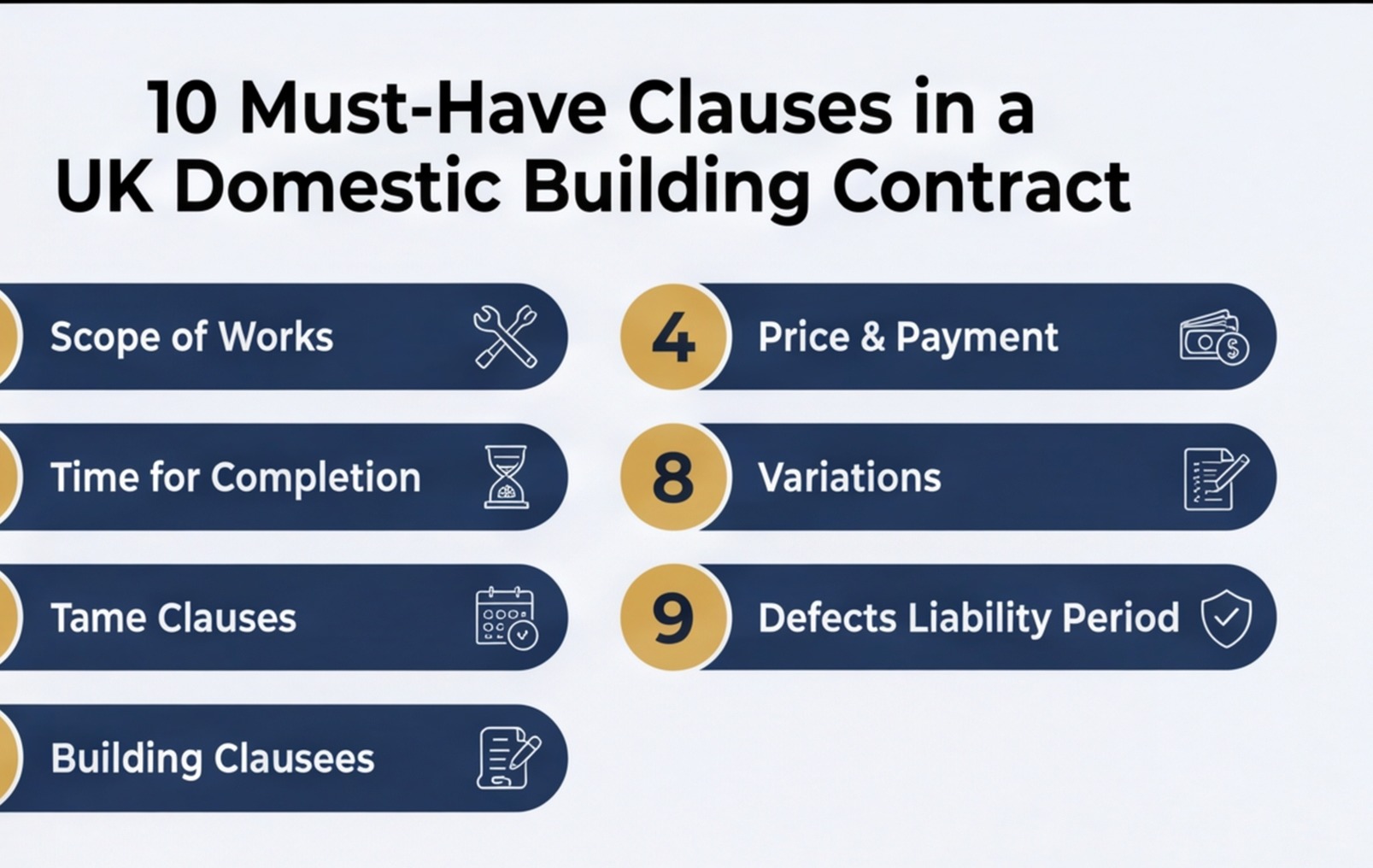
Dispute Resolution Clause
Include a tiered dispute resolution clause:
- Negotiation: Both parties attempt to resolve the dispute in writing within 14 days.
- Mediation: If negotiation fails, either party can request mediation through an agreed service (The Centre for Effective Dispute Resolution operates a widely used service).
- Adjudication or litigation: If mediation fails, either party may pursue their legal remedies through the courts or, where applicable, adjudication.
Most domestic disputes are resolved at step one or two. Having a written process stops disputes escalating immediately to "my solicitor will be in touch" territory, which is expensive for both sides and often disproportionate to the actual disagreement.
Termination Provisions
Your contract should set out what happens if either party wants to terminate:
- Termination by client: Client gives 14 days' written notice. You are entitled to payment for all work completed to the termination date, materials ordered for the contract, and a reasonable overhead and profit contribution on the uncompleted works.
- Termination for cause (by builder): If the client fails to make payment after a formal payment notice and seven days, you have the right to suspend works. If payment is not received within a further 14 days, you may terminate. You remain entitled to all sums owed plus reasonable costs of demobilisation.
- Termination for cause (by client): If the work is demonstrably sub-standard and you fail to remedy it within a reasonable period (typically 28 days), the client may engage another contractor and charge the cost against your contract sum.

Using a Quoting Tool to Underpin Your Contract
A contract is only as strong as the scope of works and costings that sit behind it. If your quote is vague or missing key line items, your contract will be too. I built RenoCalc precisely to solve this problem for builders. Upload a floor plan, generate a detailed line-item quote in under three minutes, and use that quote as the foundation for your contract scope.
If you are quoting a full refurbishment and need a structured cost breakdown to attach to your contract, our floor plan cost estimator handles the maths while you focus on running the job.
Start a free quote with RenoCalc and build your contract scope from a real set of numbers, not a rough guess.
Frequently Asked Questions
Do I legally need a written building contract for domestic work in the UK?
There is no blanket legal requirement in the UK that forces every domestic building job to have a written contract. However, the Consumer Rights Act 2015 gives residential clients strong statutory protections regardless of whether a contract exists. Without a written agreement, disputes over scope, payment and timescales become your word against theirs — and that is a battle you rarely win. For any job over £1,000 I would always put something in writing. It does not have to be a lengthy legal document; a clear, signed scope of works with payment stages is enough to protect both parties.
What is the difference between a JCT contract and a domestic builder contract?
JCT (Joint Contracts Tribunal) produces a range of standard building contracts. Their Homeowner Contract is designed for domestic work and is widely recognised by solicitors. However, many small builders find JCT contracts overly formal for straightforward jobs. A domestic building contract template is a simpler document covering the same essential clauses — scope, price, payment stages, variations, exclusions and dispute resolution — without the legal complexity of a full JCT document. For most jobs under £50,000, a well-written plain-English contract does the same job at a fraction of the hassle.
Can I use a free domestic building contract template from the internet?
You can, but you need to check it carefully. Many free templates are American, Scottish or outdated — and not suited to England and Wales residential work. Look for templates that reference the Consumer Rights Act 2015, include a right to vary the price with written client approval, include a defects liability period, and include a clause around access and delay caused by others. Do not use a template without reading every clause. If you are unsure whether a clause is enforceable, ask a solicitor or contact the Federation of Master Builders, who offer member contract support.
What payment stages should a domestic building contract include?
There is no set rule, but typical payment stages for domestic renovation work are: deposit on contract signing (10–25%), stage payments tied to specific completion milestones such as first fix complete or plaster dry, and a final retention payment released after the defects liability period. The deposit should reflect your genuine upfront material costs — never inflate it. Each stage payment should be linked to an observable, agreed milestone so there is no argument about whether the trigger has been met. Avoid asking for more than 50% of the contract value before the job reaches first fix.
How do I handle variations in a domestic building contract?
Variations — changes to the original agreed scope — are one of the biggest sources of disputes. Your contract should state clearly that any variation to scope or specification requires a written variation order signed by both parties before work begins. The variation order should describe what is being added or removed, the revised cost, and any impact on the programme. Never carry out additional work on a verbal instruction alone, no matter how friendly the client relationship. A simple email exchange confirming the variation is better than nothing, but a signed variation order is best practice.
What is a defects liability period and how long should it be?
A defects liability period (DLP) is a period after practical completion during which you agree to return and remedy any defects that arise from your workmanship at no additional cost. Typical DLPs on domestic work run from 3 months to 12 months. During this period a retention — usually 2.5–5% of the contract value — is held back from the final payment. The retention is released once the DLP expires without outstanding defects, or once all raised defects are rectified. The DLP is your professional guarantee and protects the client. It does not cover fair wear and tear, client-caused damage or works not included in the contract.
What happens if a client refuses to pay under a domestic building contract?
If a client refuses to pay a legitimate stage payment or final payment, your first step is a written payment notice referencing the contract. Give a clear deadline — typically 7 to 14 days. If that fails, a Letter Before Action is the precursor to a county court claim. For amounts under £10,000, the small claims track is relatively straightforward and does not require a solicitor. Having a signed contract with clear payment milestones is the single biggest factor in winning a payment dispute. Without it, courts treat the claim as a disputed verbal contract, which is much harder to prove.

Quote the Job Before You Sign the Contract
A contract is only as solid as the numbers behind it. RenoCalc generates detailed, line-item job quotes in under three minutes — giving you a proper scope of works to attach to your contract from day one.
Start a Free Quote with RenoCalc